

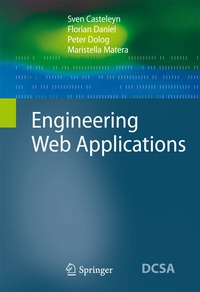
Engineering Web Applications
Description

Nowadays, Web applications are almost omnipresent. The Web has become a platform not only for information delivery, but also for eCommerce systems, social networks, mobile services, and distributed learning environments. Engineering Web applications involves many intrinsic challenges due to their distributed nature, content orientation, and the requirement to make them available to a wide spectrum of users who are unknown in advance. The authors discuss these challenges in the context of well-established engineering processes, covering the whole product lifecycle from requirements engineering through design and implementation to deployment and maintenance. They stress the importance of models in Web application development, and they compare well-known Web-specific development processes like WebML, WSDM and OOHDM to traditional software development approaches like the waterfall model and the spiral model. .
Reviews / Votes
From the reviews: "This well-written book describes each step of the Web application development process. It covers abstractions, methods, tools, models, and concepts that will give readers a global perspective . . it is suitable for students as a complete overview of Web development, its figures, illustration, and language are quite complex, making it appropriate for an advanced academic audience. . In conclusion, this complete, nontechnical guidebook can be used by academics and advanced students as a generalized approach to Web application engineering." (Athena Vakali, ACM Computing Reviews, December, 2009)More details
Other editions
Additional editions
Persons
Sven Casteleyn is a post-doc researcher at the Computer Science Department of the Faculty of Science at the Vrije Universiteit Brussel, Belgium. His research interests lie primarily within the field of Web Engineering and the Semantic Web technologies.
Florian Daniel is a post-doc researcher at the University of Trento, Italy. His main research interests are in Web engineering, UI integration, mashups, and business process intelligence.
Peter Dolog is an associate professor of computer science in the Information Systems Unit at the Department of Computer Science, Aalborg University, Denmark, where he leads the IWIS: Intelligent Web and Information Systems group. His research interests are in intelligent web and information systems, which includes adaptive hypertext and hypermedia, user modelling, personalization, web based systems, web services, software product lines and technology enhanced learning.
Maristella Matera is assistant professor at the Dipartimento di Elettronica e Informazione, Politecnico di Milano, Italy. Her current research focuses on Web Engineering, with particular emphasis on design methods and tools for Web application development, and concentrates on context-awareness, Web-based cooperative processes for e-learning, component integration at the presentation level, Web usage analysis, usability and accessibility.
