

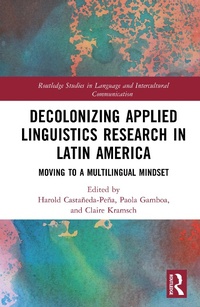
Decolonizing Applied Linguistics Research in Latin America
Moving to a Multilingual Mindset
1st Edition
Published on 29. September 2023
302 pages
978-1-000-92499-2 (ISBN)
Description

This collection explores the critical decolonial practices of applied linguistics researchers from Latin America and the Latin American diaspora, shedding light on the processes of epistemological decolonization and moving from a monolingual to a multilingual stance.
The volume brings together participants from an AILA 2021 symposium, in which researchers reflected on applied linguistics in Latin America, and on the ways in which it brought concerns around social justice, the legacy of coloniality, and the role of monolingual English in education to the fore. Each chapter is composed of four parts: an autobiographical section written both in Spanish or Portuguese and in English followed by a reflection on the epistemological differences between versions; a discussion in English of the research project; a critical reflection on the epistemic practices and critical pedagogies enacted in the project; and the author(s)' understanding of the concept of decolonization and recommendations for further decolonizing the monolingual mindset of language teachers and learners. At once linguistic, epistemological, and political, the collection aims to diversify the concept of decoloniality itself and showcase other ways in which decolonial thought can be implemented in language education.
This book will be of interest to scholars in applied linguistics, sociolinguistics, and language education.
The volume brings together participants from an AILA 2021 symposium, in which researchers reflected on applied linguistics in Latin America, and on the ways in which it brought concerns around social justice, the legacy of coloniality, and the role of monolingual English in education to the fore. Each chapter is composed of four parts: an autobiographical section written both in Spanish or Portuguese and in English followed by a reflection on the epistemological differences between versions; a discussion in English of the research project; a critical reflection on the epistemic practices and critical pedagogies enacted in the project; and the author(s)' understanding of the concept of decolonization and recommendations for further decolonizing the monolingual mindset of language teachers and learners. At once linguistic, epistemological, and political, the collection aims to diversify the concept of decoloniality itself and showcase other ways in which decolonial thought can be implemented in language education.
This book will be of interest to scholars in applied linguistics, sociolinguistics, and language education.
More details
Series
Edition
1. Auflage
Language
English
Place of publication
London
United Kingdom
Publishing group
Taylor & Francis Ltd
Target group
College/higher education
Illustrations
3 Tables, black and white; 2 Line drawings, black and white; 9 Halftones, black and white; 11 Illustrations, black and white
ISBN-13
978-1-000-92499-2 (9781000924992)
Copyright in bibliographic data and cover images is held by Nielsen Book Services Limited or by the publishers or by their respective licensors: all rights reserved.
Schweitzer Classification
Other editions
Additional editions
Harold Castaneda-Pena | Paola Gamboa | Claire Kramsch
Decolonizing Applied Linguistics Research in Latin America
Moving to a Multilingual Mindset
Book
12/2024
1st Edition
Routledge
€63.50
Shipment within 10-20 days
Harold Castaneda-Pena | Paola Gamboa | Claire Kramsch
Decolonizing Applied Linguistics Research in Latin America
Moving to a Multilingual Mindset
Book
09/2023
1st Edition
Routledge
€206.80
Shipment within 10-20 days
Persons
Harold Castaneda-Pena is Associate Professor in the Doctorado Interinstitucional en Educacion at Universidad Distrital Francisco Jose de Caldas, Colombia.
Paola Gamboa is Assistant Lecturer in the Department of French as a Foreign Language at the Sorbonne Nouvelle University, France.
Claire Kramsch is Emerita Professor of German and Affiliate Professor of Education at the University of California at Berkeley, USA.
Paola Gamboa is Assistant Lecturer in the Department of French as a Foreign Language at the Sorbonne Nouvelle University, France.
Claire Kramsch is Emerita Professor of German and Affiliate Professor of Education at the University of California at Berkeley, USA.
Content
List of Contributors
Foreword
Kyria Finardi
Acknowledgements
Introduction
Exploring the decolonial challenge: Critical pedagogy and epistemological translation in applied linguistic research in Latin America.
Claire Kramsch, Harold Castaneda-Pena & Paola Gamboa
Part I
Exploring coloniality in applied linguistic theory and practice
1 The syntax of marginalization in Colombian Language policies: From colonialism to neoliberalism.
Helena Guerrero Nieto
2 On being critical: Language ideologies and the (de)stabilization of the colonial logic in a Brazilian education policy
Paula Tatiana Carrera Szundy and Rogerio Casanovas Tilio
3 (Re)reading narratives and dancing in language education from (de)colonial perspectives
Nara Hiroko Takaki
Part II
Critical pedagogies for pre- and in-service teachers
4 A critical intercultural approach to decolonize foreign language teaching in Colombia: Explorations with teachers and Afro-Colombian and Indigenous learners in a public university.
Janeth Maria Ortiz Medina and Maure Carolina Aguirre Ortega
5 Reflecting on a community service-learning project for English learners in Argentina from a decolonial perspective.
Gabriela N. Tavella and S. Carina Fernandez
6 Non-normative corporeal-ity-ies in language education
Harold Castaneda-Pena and Diego Ubaque-Casallas
Part III
Epistemological translations from the Latin American diaspora
7 A plurilingual MOOC to engage reflexivity, criticality and multimodality in educational practices. Questioning coloniality and cultural and linguistic mindsets.
Paola Andrea Gamboa Diaz
8 Onward to Pquyquy (or thinking with the heart) : Conceptualizing the decolonization of being for language teaching and research
Yecid Ortega
9 La Lucha Sigue! Decolonizing College Composition Classrooms in Latinx California
A.Lane Igoudin
Conclusion
Towards a new framework for decolonizing practice: The multilingual mindset. Harold Castaneda-Pena, Paola Gamboa and Claire Kramsch
Index
Foreword
Kyria Finardi
Acknowledgements
Introduction
Exploring the decolonial challenge: Critical pedagogy and epistemological translation in applied linguistic research in Latin America.
Claire Kramsch, Harold Castaneda-Pena & Paola Gamboa
Part I
Exploring coloniality in applied linguistic theory and practice
1 The syntax of marginalization in Colombian Language policies: From colonialism to neoliberalism.
Helena Guerrero Nieto
2 On being critical: Language ideologies and the (de)stabilization of the colonial logic in a Brazilian education policy
Paula Tatiana Carrera Szundy and Rogerio Casanovas Tilio
3 (Re)reading narratives and dancing in language education from (de)colonial perspectives
Nara Hiroko Takaki
Part II
Critical pedagogies for pre- and in-service teachers
4 A critical intercultural approach to decolonize foreign language teaching in Colombia: Explorations with teachers and Afro-Colombian and Indigenous learners in a public university.
Janeth Maria Ortiz Medina and Maure Carolina Aguirre Ortega
5 Reflecting on a community service-learning project for English learners in Argentina from a decolonial perspective.
Gabriela N. Tavella and S. Carina Fernandez
6 Non-normative corporeal-ity-ies in language education
Harold Castaneda-Pena and Diego Ubaque-Casallas
Part III
Epistemological translations from the Latin American diaspora
7 A plurilingual MOOC to engage reflexivity, criticality and multimodality in educational practices. Questioning coloniality and cultural and linguistic mindsets.
Paola Andrea Gamboa Diaz
8 Onward to Pquyquy (or thinking with the heart) : Conceptualizing the decolonization of being for language teaching and research
Yecid Ortega
9 La Lucha Sigue! Decolonizing College Composition Classrooms in Latinx California
A.Lane Igoudin
Conclusion
Towards a new framework for decolonizing practice: The multilingual mindset. Harold Castaneda-Pena, Paola Gamboa and Claire Kramsch
Index
