


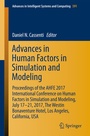
Advances in Human Factors in Simulation and Modeling
Description

This book focuses on computational modeling and simulation research that advances the current state-of-the-art regarding human factors in simulation and applied digital human modeling. It reports on cutting-edge simulators such as virtual and augmented reality, on multisensory environments, and on modeling and simulation methods used in various applications, such as surgery, military operations, occupational safety, sports training, education, transportation and robotics.
Based on the AHFE 2017 International Conference on Human Factors in Simulation and Modeling, held on July 17-21, 2017, in Los Angeles, California, USA, the book is intended as a timely reference guide for researchers and practitioners developing new modeling and simulation tools for analyzing or improving human performance. It also offers a unique resource for modelers seeking insights into human factors research and more feasible and reliable computational tools to foster advances in this exciting research field.
More details
Other editions
Additional editions
Person
Dr. Daniel Cassenti earned his Ph.D. at the Pennsylvania State University with a specialization in cognitive psychology in August 2004. After a one-year stint as a National Research Council post-doctoral associate with the U.S. Army Research Laboratory, Dr. Cassenti joined ARL as a civilian research psychologist employee. He currently has 35 publications to his name, and his research addresses a diverse set of topics in areas including: cognitive psychology, network science, simulation and modeling, robotics, neuroscience, computational modeling, human factors, and executive function. He is also the senior co-chair of the ARL IRB, which oversees all human-subject research at ARL covering a wide range of experimental paradigms across a variety of domains.
Content
- Intro
- Advances in Human Factors and Ergonomics 2017
- Preface
- Human Factors and Simulation
- Digital Human Modeling and Applied Optimization
- Contents
- Human Factors and Automated Agents
- Exploring Trust Barriers to Future Autonomy: A Qualitative Look
- Abstract
- 1 Introduction
- 2 Method
- 2.1 Participants
- 2.2 Procedure
- 3 Results
- 4 Discussion
- References
- A Design Pattern for Working Agreements in Human-Autonomy Teaming
- Abstract
- 1 Introduction on Working Agreements
- 1.1 Background and Intent
- 1.2 Motivation
- 1.3 Applicability - When Should You Use This Design Pattern?
- 1.4 Participants
- 1.5 Structure
- 1.6 Consequences - What Happens with Pattern Use?
- 1.7 Implementation
- 1.8 Known Uses and Related Patterns
- 2 Conclusions
- Acknowledgements
- References
- Automated Situation Analysis as Next Level of Unmanned Aerial Vehicle Artificial Intelligence
- Abstract
- 1 Introduction and Actual Possibilities of Mechanisms and Autopilot
- 2 Artificial Intelligence in Control Systems
- 2.1 AI Types and Hybrid Systems
- 2.2 Mathematical Model of the UAV with AI Device
- 3 Future Opportunities
- 3.1 Requirements and Usage of the Systems
- 3.2 Detections According to Input Data and Act Recognition
- 4 Conclusions
- Acknowledgements
- References
- Connected and Automated Vehicle Simulation to Enhance Vehicle Message Delivery
- Abstract
- 1 Introduction
- 2 Vehicle Messaging Research
- 3 CV and AV Simulation Development
- 4 Conclusion
- References
- Measuring Human Trust Behavior in Human-Machine Teams
- Abstract
- 1 Introduction
- 2 Background
- 2.1 Trust and Trust Behaviors
- 2.2 Compliance and Reliance
- 3 Paradigm for Measuring Trust Behaviors
- 3.1 Assumptions
- 3.2 Automation's Purpose
- 3.3 Authority to Initiate Automation
- 3.4 Human Authority to Override
- 3.5 Human Authority to Correct
- 4 Example Human-Machine Trust Measures
- 4.1 Experimental Environment
- 4.2 Automation Trust Behavior Measures
- 4.3 Notes on Creating Trust Measures
- 5 Conclusion
- Acknowledgements
- References
- Occupational Safety Simulators
- Analysis of Occupational Security Management Interventions Based on Coupling Human Factors
- Abstract
- 1 Introduction
- 2 Key Nodes in Topology
- 2.1 An Enterprise Security Topology Network
- 2.2 Selection of Key Nodes
- 3 Mathematical Model
- 3.1 Managers
- 3.2 Employees
- 4 Simulation
- 4.1 Initialization
- 4.2 Simulation and Discussion
- 5 Conclusion
- Acknowledgments
- References
- Group Safety Consciousness Reconstruction Based on the Inclusion Principle
- Abstract
- 1 Introduction
- 2 Group Security Awareness Dynamic Situation Model
- 3 Group Communication Topology
- 4 Pairs of Subsystem Security Awareness Reconstruction
- 5 Simulation Analysis
- Acknowledgments
- References
- Safety Awareness Emergence and Behavior-Based Safety Management in Enterprise
- Abstract
- 1 Introduction
- 2 Model Constructing
- 2.1 Definition 1: Local Safety Climate Sp
- 2.2 Definition 2: Safety Assessment Value Sv
- 2.3 Definition 3: Overall Safety Situation So
- 3 Simulations in Ideal Conditions
- 4 Behavior-Based Safety Management Measures
- 4.1 Education for General Safety State Employee
- 4.2 Punishment for Poor Safety State Employee
- 5 Summary
- Acknowledgments
- References
- Emergent Research of Employee Safety Awareness Based on Multi-agent Model
- Abstract
- 1 Introduction
- 2 Model Constructing
- 2.1 Behavioral Agents
- 2.2 The Rules of Interaction
- 3 Model Initialization
- 4 The Analysis of Simulation Result of Safety Awareness of Employee
- 4.1 The No Control Mode
- 4.2 Benchmark Mode in Controlled Condition
- 4.3 The Analysis of Output of Simulation in the Analytical Mode
- 5 Conclusions
- Acknowledgments
- References
- Recognizing Mine Site Hazards: Identifying Differences in Hazard Recognition Ability for Experienced and New Mineworkers
- Abstract
- 1 Introduction
- 2 Literature Review
- 3 Methods
- 3.1 Participants
- 3.2 Materials
- 3.3 Virtual Immersion Simulation Laboratory (VISLab)
- 3.4 Procedure
- 3.5 Data Post Processing
- 4 Results
- 4.1 Location
- 4.2 Classification
- 5 Discussion and Conclusion
- Acknowledgments
- References
- Modeling of Muscle Atrophy and Exercise Induced Hypertrophy
- Abstract
- 1 Introduction
- 2 Muscle Adaptation Model
- 3 Benchmarks and Model Calibration
- 3.1 Effects of Muscle Activation and Time Constant on Muscle Adaptation
- 3.2 Model Calibration with Muscle Atrophy, Hypertrophy, or Recovery Data
- 4 Spaceflight Induced Muscle Atrophy and Effects of Exercise Countermeasures
- 5 Discussion and Conclusions
- Acknowledgments
- References
- Medical Simulation: Filling the Training Gap
- Human Simulation System for Injury Assessment Due to Repetitive Loading
- Abstract
- 1 Introduction
- 2 Method
- 2.1 Dynamic Prediction System
- 2.2 Finite Element Analysis
- 3 Repetitive Loading and Injury Propensity
- 4 Results and Discussion
- 5 Conclusions
- References
- Image Enhancement Using FUZZY Set
- Abstract
- 1 Introduction
- 2 Existing Method
- 2.1 Spatial Domain
- 2.2 Gray Scale
- 2.3 Histogram Equalization
- 2.4 Image Smoothing [4]
- 2.5 Averaging
- 2.6 Gaussian Filter
- 2.7 Image Sharpening
- 2.8 Frequency Domain Methods
- 3 Fuzzy Image Enhancement [6-8, 10-12]
- 3.1 Generalized Fuzzy Image Enhancement
- 4 Proposed Method
- 5 Proposed Algorithm
- 6 Simulation and Experimental Results
- 7 Conclusion
- References
- Medical Simulation Training: Targeting Medical Skills to Emulate Real-Time Field Injuries
- Abstract
- 1 Background
- 2 Aim
- 3 Objectives
- 4 Materials and Methods
- 5 Data
- 6 Research Design
- 6.1 PHTR Population
- 6.2 Injury Description
- 6.3 Provider Description
- 6.4 Evacuation Description
- 7 Discussion
- 7.1 PHTR Population
- 7.2 Injury Descriptions
- 7.3 Provider Descriptions
- 7.4 Evacuation Descriptions
- 7.5 Results: AMEDD Center and School
- 7.6 Treatment and Simulation
- 7.7 Mechanism Resulting in Injury
- 7.8 Evacuation Simulation Training
- 8 Limitations
- 9 Conclusion
- Acknowledgements
- References
- Diagnosis of Alzheimer Disease Through an Artificial Neural Network Based System
- Abstract
- 1 Introduction
- 2 Knowledge Representation and Reasoning
- 3 Methods
- 3.1 Data Set
- 3.2 ImageJ Application to Measure the Hippocampus Volume
- 4 Case Study
- 5 Artificial Neural Networks
- 6 Conclusion
- Acknowledgments
- References
- Realization of the Principle of Conformal Symmetry in the Structure of the Heart
- Abstract
- 1 Introduction
- 2 Aim of Work
- 3 Material and Methods
- 4 Results
- 5 Conclusion
- References
- Modeling and Simulation for the Extreme Environment
- Modeling Operator Workload for the Resource Prospector Lunar Rover Mission
- Abstract
- 1 Introduction
- 2 Rover Driver Tasks
- 3 Contextual Factors that Contribute to Rover Driver Workload
- 3.1 Environment Characteristics
- 3.2 Task Characteristics
- 3.3 Equipment Characteristics
- 3.4 Operator Characteristics
- 4 Modeling Workload Drivers and Countermeasures
- 5 Conclusion
- Acknowledgments
- References
- Occupant Protection Modeling and Injury Prediction for NASA Human Exploration Spacecraft
- Abstract
- 1 Introduction
- 2 Methods
- 2.1 ATD Modeling and Simulation
- 2.2 ATD Testing
- 2.3 Model Updates
- 3 Discussion
- 4 Conclusions
- References
- Minimizing Human Risk: Human Performance Models in the Human Factors and Behavioral Performance Elements
- Abstract
- 1 Introduction
- 2 NASA's Human Research Program
- 2.1 NASA HRP Structure
- 2.2 Methods Used to Minimize Human Exploration Risks
- 2.3 HRP Risk Statements
- 3 NASA's Human Research Program Use of Modeling and Simulation
- 3.1 Computational Model for Spacecraft/Habitat Volume
- 3.2 A Tool for Automated Collection of Space Utilization Data
- 3.3 Human - Automation Interactions and Performance Analysis of Lunar Lander Supervisory Control
- 3.4 MIDAS-FAST: Development and Validation of a Tool to Support Function Allocation
- 3.5 Modeling and Mitigating Spatial Disorientation in Low G Environments
- 3.6 Space Performance Research Integration Tool (S-PRINT)
- 3.7 Occupant Protection Data Mining and Modeling
- 4 Discussion
- 5 Conclusions
- Acknowledgments
- References
- When Less is More: Studying the Role of Functional Fidelity in a Low Fidelity Mixed-Reality Tank Simulator
- Abstract
- 1 Introduction
- 2 Fidelity Within Simulated Environments
- 3 Simulation Modeling in Extreme Environments
- 4 Current Trends: Low Fidelity Mixed-Reality Simulations for Training Leadership Development
- 4.1 Design and Procedure
- 4.2 Results and Discussion
- 5 Conclusions, Recommendations and Implications for Training
- Acknowledgements
- References
- Advancements in Fleet Synthetic Training Systems: A Use Case of Landing Signal Officers
- Abstract
- 1 Introduction
- 1.1 Augmented Reality and Virtual Reality
- 2 Modern Landing Signal Officer Training
- 3 Future Directions for LSO Training Systems
- 3.1 Current Efforts to Enhance the Training of Landing Signal Officers
- 4 Conclusion
- Acknowledgements
- Appendix: Technical Terms
- References
- Transportation Modeling and Simulation
- Comprehensive Assessments of the Effects of Auditory Cognitive Distractions on Driving Safety Across the Lifespan
- Abstract
- 1 Introduction
- 2 Method
- 2.1 Sample
- 2.2 Procedure and Design
- 2.3 Measures and Data Reduction
- 3 Results
- 4 Discussion
- Acknowledgments
- References
- Exploring the Effects of Perception Errors and Anticipation Strategies on Traffic Accidents - A Simulation Study
- Abstract
- 1 Introduction
- 2 Overall Simulation Logic
- 3 Mathematical Model for Driving Behavior
- 3.1 Lane Change Model
- 3.2 Integration of Lane Change Model and Car Following Model
- 3.3 Modelling Perception Errors and Reaction Time
- 3.4 Modeling Anticipation Strategies
- 4 Experimental Setup
- 4.1 Road Network and Scenarios
- 4.2 Performance Indicators
- 5 Results
- 5.1 Traffic Flow Performance
- 5.2 Traffic Safety Results
- 6 Discussion and Synthesis
- Acknowledgments
- References
- Human Factors in Modelling Mixed Traffic of Traditional, Connected, and Automated Vehicles
- Abstract
- 1 Introduction
- 2 Important Human Factors in Modelling Traditional, Connected, and Automated Vehicles
- 2.1 Traditional Vehicles
- 2.2 Connected Vehicles
- 2.3 Automated Vehicles
- 3 Driving Simulator Experiment Design
- 4 Conclusion
- Acknowledgements
- References
- Implementation of a sEMG-Machine Interface for Steering a Virtual Car in a Driving Simulator
- Abstract
- 1 Introduction
- 2 Steering Control System
- 2.1 Equipment Overview
- 2.2 Signal Processing Algorithms
- 2.3 Steering Control Algorithms
- 2.4 sEMG-Machine Interface Design
- 3 Experimental Applications
- 4 Recommendations for Control System Improvement
- 4.1 Control Feedback
- 4.2 Alternatives for sEMG Measurement Equipment
- 5 Conclusion
- References
- Advances in Computational Social Sciences
- How Triangle Structure in Inter-firm Human Network Affects Bankruptcy Evolution: An Agent-Based Simulation Study with Real and Artificial Data
- Abstract
- 1 Introduction
- 2 Triangle Structure in Inter-firm Human Network
- 2.1 Empirical Data Analysis
- 2.2 Theoretical Support
- 2.3 Assumption About Importance of Triangle Structure
- 3 Agent-Based Model
- 3.1 Entities and State Variables
- 3.2 Process Overview
- 3.3 Internal Adaptation
- 3.4 External Interaction
- 4 Simulation Design and Setup
- 4.1 Simulation Configuration
- 4.2 Input Data Generation
- 4.3 Parameter Setting
- 5 Simulation Results
- 5.1 Whether Triangle Structure Affects
- 5.2 Whether Triangle Structure Affects Who Bankrupted
- 5.3 Whether Triangle Structure Survives
- 6 Conclusion and Discussion
- Acknowledgments
- References
- A Preliminary Study of Human Decision-Making, Risk Attitude, and Social Preference on Knowledge Management
- Abstract
- 1 Introduction
- 2 The KM Model
- 2.1 The Agent
- 2.2 The Organization
- 2.3 The Environment
- 3 The Incentive System
- 3.1 The Payoff Structure
- 3.2 The Payoff Function
- 3.3 The Bonus Function
- 3.4 Two Dilemmas
- 4 Behavioral Experiments
- 4.1 The Gaming Software Development
- 4.2 Baseline and the Interventions
- 4.3 Behavioral Experiments Execution
- 4.4 Results and Comparisons
- 5 The Agent-Based Model, Simulations, and Results
- 5.1 Results and Comparisons
- 5.2 Results and Comparisons
- 6 Discussion
- 7 Conclusion
- 7.1 Achievement
- 7.2 Future Work
- Acknowledgements
- References
- A Stock Market Model Based on the Interaction of Heterogeneous Traders' Behavior
- Abstract
- 1 Introduction
- 2 Model Construction
- 3 Model Analysis
- 3.1 Definition 1
- 4 Simulations Analysis
- 4.1 Heterogenous Groups of Traders Affected by Herding Effect
- 4.2 The Volatility of the Stock Price Affected by Herding Effect
- 4.3 X-P Phase Diagram, X-Y-P Phase Diagram and System Stability Affected by Herding Effect
- 5 Conclusions
- Acknowledgements
- References
- The Agent-Based Agri-Household Micro-Simulation Platform and Its Application
- Abstract
- 1 Introduction
- 2 Modeling Frameworks of Rural Households
- 2.1 Research Objective
- 2.2 Data Sources
- 2.3 Model Hypothesis
- 2.4 Simulation Rules
- 2.5 Agent Behavior Description
- 3 Empirical Results and Evaluation
- 4 Conclusion
- Acknowledgements
- References
- An Agent-Based Approach on Conditional Deterrence
- Abstract
- 1 Introduction
- 2 Conditional Deterrence Background
- 3 The Model
- 4 Discussion
- References
- User Experience Modeling
- The Virtuality Continuum and Storytelling: Simulation, Interactivity, User Experience and Interaction Design in Virtual and Mixed Environments. A STEAM Based Approach
- Abstract
- 1 Introduction
- 2 Literature Review
- 3 Methodology
- 4 Results
- 5 Conclusions
- References
- Simulating Seat Discomfort: An Experimental Design for Using Digital Human Models
- Abstract
- 1 Introduction
- 2 Relevant Theories of Seat Comfort and Discomfort
- 3 Objectives
- 4 Methods
- 4.1 Requirements
- 4.2 Experimental Setup
- 4.3 Experimental Design
- 4.4 Procedure
- 4.5 Participants
- 5 Results
- 6 Discussion
- 7 Conclusion
- Acknowledgements
- References
- A Comparative Study of Virtual Reality and 2D Display Methods in Visual Search in Real Scenes
- Abstract
- 1 Introduction
- 1.1 Background of the Study and Rationale
- 1.2 Problem Statement
- 2 Review of Related Literature
- 2.1 Classical Visual Search Methods
- 2.2 Visual Search in Real Scenes
- 2.3 Virtual Reality and Its Application in Human Factors and Behavior Research
- 3 Methodology
- 3.1 Selection of Test Subjects
- 3.2 Gathering of Quantitative Data
- 3.3 Gathering of Qualitative Data
- 3.4 Data Analysis of Quantitative Data
- 3.5 Data Analysis of Qualitative Data
- 4 Results and Discussion
- 4.1 Study Demographics
- 4.2 Quantitative Data: Accuracy
- 4.3 Quantitative Data: Time
- 4.4 Qualitative Data: Visual Experience
- 4.5 Qualitative Data: Preferred Method
- 5 Conclusion
- 6 Areas of Further Study
- 6.1 Localization of Target Objects
- 6.2 Wider Range of Scenes and Targets
- 6.3 Incorporation of Movement, Interaction, and Auditory Features
- References
- Using Cognitive Modeling for Adaptive Automation Triggering
- Abstract
- 1 Multi-level Cognitive Cybernetics
- 1.1 Cybernetics
- 1.2 Cognition
- 1.3 Triggering Adaptive Automation
- 1.3.1 Always On or Always Off
- 1.3.2 Automation Triggered by the Environment
- 1.3.3 Automation Triggered by Human Behavior
- 1.3.4 Conclusions
- 2 Cognitive Modeling and MLCC
- 2.1 Sources of Complexity
- 2.2 Temporal Dimension
- 3 Isolating Cognitive Difficulties
- 3.1 Perception
- 3.2 Information Processing
- 3.3 Decision-Making
- 3.4 Motor Control
- 4 Deriving Performance and Physiological Thresholds
- 4.1 Detecting Patterns in Performance Over Time
- 4.2 Connecting Physiological Data with Performance
- 4.3 Referencing Cognitive Stage to Eye Tracking
- 5 Dynamic Modeling of Individual Differences
- 6 Conclusions
- References
- Applied Digital Human Modeling and Simulation
- Validation of Interruption Management Stage Model: Can We Develop the Human Cognitive Behavior Model in Interruptive Working Environment?
- Abstract
- 1 Introduction
- 2 Experiment
- 2.1 Subjects
- 2.2 Variables and Measures
- 2.3 Procedure
- 3 Results
- 4 Discussion
- 5 Conclusion
- References
- An Evaluation Method for Human Fatigue in Virtual Maintenance Simulation Based on the Cube Model
- Abstract
- 1 Introduction
- 2 The Cube Model
- 3 Analysis
- 4 Determination Method of Posture Level
- 5 Case Analysis
- 6 Discussion
- Acknowledgments
- References
- Optimization-Based Simulation of the Motion of a Human Performing a Horizontal Drop Jump
- Abstract
- 1 Introduction
- 2 Motion Capture Procedure
- 3 The Digital Human Model
- 4 The Kinematics of the Digital Human
- 5 The Dynamics of the Digital Human
- 6 Optimization Formulation
- 7 Initial Results for the "Horizontal Drop Jump" Task
- References
- Concept of Formalized Test Procedure for Proactive Assessment of Ergonomic Value by Digital Human Modelling Tools in Lean Product Development
- Abstract
- 1 Introduction
- 2 Method
- 3 Results
- 3.1 LPD in the Perspective of DHM
- 3.2 Concept for a Formalized Test Procedure Using DHM
- 4 Discussion
- Acknowledgments
- References
- Full Body Statistical Shape Modeling with Posture Normalization
- Abstract
- 1 Introduction
- 2 Methods
- 2.1 Statistical Shape Model (SSM)
- 2.2 Feature Modification
- 2.3 Identity Removal
- 2.4 Posture Normalization
- 3 Experiments and Results
- 3.1 Statistical Shape Model (SSM)
- 3.2 Posture Model
- 3.3 Poseture Normalization Case
- 3.4 Normalized Statistical Shape Model
- 3.5 Model Performance - Compactness
- 4 Conclusion and Further Work
- Acknowledgements
- References
- A Study of Digital Media Art Utilizing 2D Animation: Digital Video Expression Using Projection Mapping and Multi Screen Techniques
- Abstract
- 1 Introduction
- 2 Research Background
- 3 Projection Animation
- 3.1 Introduction of Projection Animations
- 3.2 Projection Animation Examples
- 4 Multi-screen
- 4.1 Introduction of Multi Screen
- 4.2 Multi Screen Examples
- 5 Animation Experiment
- 5.1 Animation of Spring
- 5.2 Animation of Summer
- 5.3 Animation of Autumn
- 5.4 Animation of Winter
- 5.5 The Whole Story of These Four Animations
- 6 Experiment Process
- 6.1 Prototype
- 6.2 The Position of Projectors
- 6.3 Experiment Questions
- 7 Conclusion
- References
- Comprehensive Mappings of Postural Angles on a Normalized Plane of Reachability
- Abstract
- 1 Introduction
- 2 Material and Methods
- 2.1 Obtainment of the Postural Angles
- 2.2 Extension of the Mappings
- 2.3 Normalization of the Reachability Plane
- 3 Results and Discussions
- 3.1 Number of Nodes in the Grid and Interpolation Methods
- 3.2 Mappings of the Postural Angles
- 3.3 Normalized Maps
- 4 Conclusions
- References
- Comparison of Gender Specific and Anthropometrically Scaled Musculoskeletal Model Predictions Using the Sorensen Test
- Abstract
- 1 Introduction
- 2 Methods
- 2.1 Comparison of Anthropometric Model Performance
- 3 Results
- 3.1 Intervertebral Disc Joint Reaction Data
- 4 Discussion and Conclusions
- References
- Enhancing User Identification During Reading by Applying Content-Based Text Analysis to Eye-Movement Patterns
- Abstract
- 1 Introduction
- 2 Experimental Setup
- 3 Methodology
- 3.1 Eye Movement in Reading
- 3.2 Word Vector Representations
- 3.3 Information Fusion
- 4 Conclusion
- References
- Effects of Socks and Shoes on Normal Foot Skin Temperature
- Abstract
- 1 Introduction
- 2 Methods
- 2.1 Participants
- 2.2 Equipment
- 2.3 Procedures
- 3 Statistical Analysis
- 4 Results
- 5 Discussion and Conclusion
- Acknowledgments
- References
- Research on the Competency Model for the Professional Ship Crew
- Abstract
- 1 Introduction
- 2 General Idea and Framework
- 3 Result and Analysis
- 3.1 Potential Competency Characteristics Set
- 3.2 Reliability Analysis
- 3.3 Competency Model
- 4 Conclusion
- Appendix: Descriptive Statistical Analysis
- References
- Ergonomic Study to Compare Digital Human Modeling Simulation Versus Real Life and Momentum
- Abstract
- 1 Introduction
- 2 Method
- 3 Result and Discussion
- 3.1 Results
- 4 Conclusion
- References
- Optimization, Analysis and Scheduling
- A Comparison Between Physical and Virtual Experiments of Convective Heat Transfer Between Head and Bicycle Helmet
- Abstract
- 1 Introduction
- 2 Calculation of Convective Heat Transfer and Cooling Efficiency
- 3 Methods
- 3.1 Experimental Setup
- 3.2 Numerical Simulations
- 4 Results and Discussion
- 4.1 Wind Tunnel Experiments
- 4.2 Numerical Simulations
- 4.3 Cooling Efficiency
- 4.4 Correlation Coefficient
- 5 Conclusion
- Acknowledgements
- References
- Modeling Transition and Mobility Patterns
- Abstract
- 1 Introduction
- 2 Background and Problem Definition
- 2.1 Definition: Raw Reading
- 2.2 Definition: Transition Model
- 2.3 Problem Definition
- 3 Hierarchical Localization
- 4 An Information Theoretic and Learning Based Ranking and Modeling
- 4.1 From Activity Graph to a Feature Space
- 4.2 A Neural Network Based Pattern Score
- 4.3 An Information Theoretic Score
- 4.4 Transition Modeling
- 5 Experiments
- 6 Conclusion and Future Work
- References
- A Combined Statistical Shape Model of the Scalp and Skull of the Human Head
- Abstract
- 1 Introduction
- 2 Methods
- 2.1 Segmentation
- 2.2 Statistical Shape Model (SSM)
- 3 Experiments and Results
- 3.1 Segmentation
- 3.2 Statistical Shape Model (SSM)
- 3.3 Model Performance
- 4 Discussion
- 5 Conclusion and Further Work
- Acknowledgements
- References
- Improved Motion Capture Processing for High-Fidelity Human Models Using Optimization-Based Prediction of Posture and Anthropometry
- Abstract
- 1 Introduction
- 2 Methods
- 2.1 Kinematic Human Model
- 2.2 Motion Capture Processing
- 2.3 Link-Lengths as Design Variables
- 2.4 Flexible Marker Positions
- 3 Results
- 3.1 Motion Capture Data
- 3.2 Implementation of Link-Lengths as Design Variables
- 3.3 Comparison of Fixed and Flexible Marker Positions in Posture Prediction
- 4 Conclusion
- Acknowledgements
- References
- Finding the Maximal Day-Time Dependent Component of a Subway System
- Abstract
- 1 Introduction
- 2 The MDTDC Problem with the LDTDSP Sub-problem
- 2.1 Formulation
- 2.2 Algorithm
- 3 Data Collection
- 4 Results and Discussion
- 5 Conclusions
- Acknowledgments
- References
- The Research of Maintainability Analysis Based on Immersive Virtual Maintenance Technology
- Abstract
- 1 Introduction
- 2 Maintainability Simulation Environment and Maintainability Evaluation
- 2.1 Maintainability Simulation Environment
- 2.2 Maintainability Evaluation
- 3 Maintainability Analysis of APU in Immersive Virtual Maintenance Environment
- 4 Conclusions
- References
- Biometric Identification Through Eye-Movement Patterns
- Abstract
- 1 Introduction
- 2 Experimental Design
- 2.1 Design Criteria
- 2.2 Experimental Setup
- 3 Feature Extraction
- 3.1 Fixation Features
- 3.2 Saccadic Features
- 3.3 Pupillary Response Features
- 3.4 Spatial Reading Features
- 4 Classification
- 5 Identification Performance
- 5.1 Optimizing the Performance of Identification
- 6 Conclusion
- References
- Author Index
