

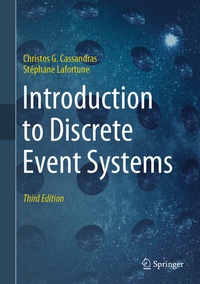
Introduction to Discrete Event Systems
Description

More details
Other editions
Additional editions
Persons
Christos G. Cassandras is Distinguished Professor of Engineering at Boston University. He is Head of the Division of Systems Engineering, Professor of Electrical and Computer Engineering, and co-founder of the Boston University Center for Information and Systems Engineering (CISE). He received a B.S degree from Yale University, M.S.E.E degree from Stanford University, and S.M and Ph.D degrees from Harvard University. Prior to joining Boston University, he worked on automated manufacturing systems with ITP Boston (1982-1984), and was Professor of Electrical and Computer Engineering at the University of Massachusetts at Amherst until 1997. Besides discrete event and hybrid systems, his interests include stochastic control and optimization, computer simulation, multi-agent systems, manufacturing systems, transportation systems and autonomous vehicles, and computer and sensor networks. He has published over 450 technical papers in these areas. He has worked extensively with industrial organizations and has most recently collaborated with The MathWorks, Inc. in the development of the discrete event and hybrid system simulator SimEvents. His prior book, Discrete Event Systems: Modeling and Performance Analysis, on which a substantial portion of the present book is based, received the 1999 Harold Chest[1]nut Prize, awarded by the International Federation of Automatic Control for best control engineering textbook. Dr. Cassandras was Editor-in-Chief of the IEEE Transactions on Automatic Control from 1998 through 2009 and is currently a member of several journal editorial boards. He was the 2012 President of the IEEE Control Systems Society. He is the recipient of several awards, including the 2011 IEEE Control Systems Technology Award, the Distinguished Member Award of the IEEE Control Systems Society (2006), and 2011 and 2014 prizes for the IBM/IEEE Smarter Planet Challenge competition. He is a Fellow of the IEEE and of the IFAC.
Stéphane Lafortune is the N. Harris McClamroch Collegiate Professor of Electrical Engineering and Computer Science at the University of Michigan. He received his B.Eng. degree from Ecole Polytechnique de Montréal, M.Eng. degree from McGill University, and Ph.D. degree from the University of California at Berkeley. He joined the University of Michigan in 1986. The principal focus of his research has been the area of discrete event systems, including modeling, diagnosis, supervisory control, optimal control, centralized and decentralized control and diagnosis, and communication in decentralized-information problems. Lafortune is a Fellow of the IEEE and of IFAC. He received the Presidential Young Investigator Award from the National Science Foundation in 1990 and the George S. Axelby Outstanding Paper Award from the Control Systems Society of the IEEE in 1994 (for a paper co-authored with S.L. Chung and F. Lin) and in 2001 (for a paper co-authored with G. Barrett). Lafortune was Editor-in-Chief of the Journal of Discrete Event Dynamic Systems: Theory and Applications from 1/2015 to 12/2020.
