

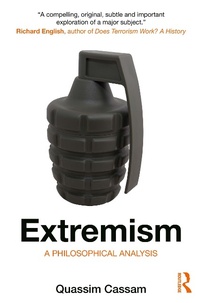
Extremism
A Philosophical Analysis
1st Edition
Published on 1. September 2021
254 pages
978-1-000-42937-4 (ISBN)
Description

Extremism is one of the most charged and controversial issues of the twenty-first century. Despite myriad programs of deradicalization and prevention around the world, it remains an intractable and poorly understood problem. Yet it is also sometimes regarded as a positive force - according to Martin Luther King Jr., 'the question is not whether we will be extremists, but what kind of extremists we will be'.
In this much-needed and lucid book, Quassim Cassam identifies three types of extremism - ideological; methods; and psychological extremism - and discusses the following fundamental topics and issues: What is extremism? What are the methods adopted by extremists? Is there an extremist 'mindset' and if so, what is it? What role do ideas of purity, victimhood and humiliation play in understanding extremism? How does extremism differ from fanaticism and fundamentalism? How does one become an extremist and how should we understand deradicalization?
Throughout the book, Quassim Cassam uses many compelling examples, ranging from the Khmer Rouge, the IRA, Al-Qaeda and Timothy McVeigh to Philip Roth's novel American Pastoral and counter-extremism programmes, including the UK's Prevent strategy.
Clear-headed and engaging, Extremism: A Philosophical Analysis is essential reading for anyone interested in this important topic, not only in Philosophy but related disciplines such as Politics and International Relations, Conflict and Terrorism Studies, Law, Education and Religion. It will also be of great interest to policy-makers and those engaged in understanding extremism at any level.
In this much-needed and lucid book, Quassim Cassam identifies three types of extremism - ideological; methods; and psychological extremism - and discusses the following fundamental topics and issues: What is extremism? What are the methods adopted by extremists? Is there an extremist 'mindset' and if so, what is it? What role do ideas of purity, victimhood and humiliation play in understanding extremism? How does extremism differ from fanaticism and fundamentalism? How does one become an extremist and how should we understand deradicalization?
Throughout the book, Quassim Cassam uses many compelling examples, ranging from the Khmer Rouge, the IRA, Al-Qaeda and Timothy McVeigh to Philip Roth's novel American Pastoral and counter-extremism programmes, including the UK's Prevent strategy.
Clear-headed and engaging, Extremism: A Philosophical Analysis is essential reading for anyone interested in this important topic, not only in Philosophy but related disciplines such as Politics and International Relations, Conflict and Terrorism Studies, Law, Education and Religion. It will also be of great interest to policy-makers and those engaged in understanding extremism at any level.
Reviews / Votes
"Cassam's accounts are unfailingly clear, interesting, and informative. His point is that selected theories of fundamentalism, fanaticism, radicalism, and others, although they seem relevant to extremism, are, on examination, insufficient for the cases he has in view. ... His point is to say 'yes, we should be bothered by extremism, but perhaps not for the reasons that you thought'." - Elizabeth Frazer, Society"This is a fascinating book by virtue of the conclusions it does not reach. Disciplined by analytical philosophy, Cassam's inquiry takes the form of precise questions about the meaning of 'extremism' followed by acute deconstructions of virtually all possible answers." - Daniel Gordon, Society
"Applying the clarity and rigor in arguments of a distinguished analytical philosopher... Cassam's book is an important contribution that presents extremism scholars with a sharper, more well-defined focus to apply to the topics of their respective research." - Markus Schindler, Terrorism and Political Violence
"... [T]he first major work in the philosophy of extremism. ... Cassam's analyses provide important insights, particularly into phenomena that are often overlooked in the literature, such as extremists' preoccupations. His work is a call for others to join the project of developing a philosophy of extremism. ...Cassam's book provides an excellent starting point for answering these fascinating and important questions." - Rik Peels, Ethics
"A compelling, original, subtle and important exploration of a major subject." - Richard English, author of Does Terrorism Work? A History
"With eloquence, Cassam helps us untangle our thoughts and communicates with a clarity and directness that is unexpected of philosophers and academics. If you want to sort out your thinking about extremism this is a must read." - Gabrielle Rifkind, Group Analyst and Conflict Mediator, author of The Psychology of Political Extremism
"This book is philosophy at its best. It is deeply empirically informed and supported by a large number of case studies. It shows the direct relevance of rigorous analytic thinking for empirical research and, perhaps even more importantly, for policy based on such research." - Rik Peels, VU University Amsterdam, The Netherlands
"Intellectually fascinating and engaging, this pathbreaking book achieves the difficult task of bridging the gap between students and more expert research-orientated readers. It shows that philosophy has much to offer in understanding the many dimensions of extremism." - Christopher Finlay, Durham University, UK
More details
Edition
1. Auflage
Language
English
Place of publication
London
United Kingdom
Publishing group
Taylor & Francis Ltd
Target group
College/higher education
Professional and scholarly
ISBN-13
978-1-000-42937-4 (9781000429374)
Copyright in bibliographic data and cover images is held by Nielsen Book Services Limited or by the publishers or by their respective licensors: all rights reserved.
Schweitzer Classification
Other editions
Additional editions
Book
09/2021
1st Edition
Routledge
€34.00
Shipment within 15-20 days
Book
09/2021
1st Edition
Routledge
€148.56
Shipment within 15-20 days

Book
08/2021
Routledge
Unfortunately, price unknown
Available (delivery time upon request)
Person
Quassim Cassam is Professor of Philosophy, University of Warwick, UK. He is the author of several books, most recently Vices of the Mind: From the Intellectual to the Political (2019) and Conspiracy Theories (2019).
Content
Preface Introduction 1. How to think about extremism 2. Ideological extremism 3. Methods extremism 4. The psychology of extremism 5. Extremism, fanaticism, fundamentalism 6. Why not extremism? 7. Pathways to extremism 8. Countering extremism Conclusion: the new extremism. References Index
