

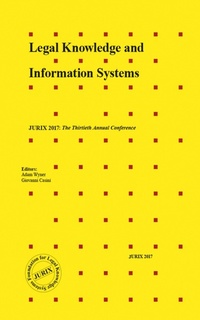
Legal Knowledge and Information Systems
JURIX 2017: The Thirtieth Annual Conference
1st Edition
Published on 15. December 2017
212 pages
978-1-61499-838-9 (ISBN)
Description

Like every other walk of modern life, the law has embraced digital technology, and is increasingly reliant on information systems for its efficient functioning.
This book presents papers from the 30th International Conference on Legal Knowledge and Information Systems (JURIX 2017), held in Luxembourg City, Luxembourg, in December 2017. In the three decades since they began, the JURIX conferences have been held under the auspices of the Dutch Foundation for Legal Knowledge Based Systems, and have become a fully European conference series which addresses familiar topics and extends known techniques, as well as exploring newer topics such as question answering and the use of data mining and machine learning.
Of the 42 submissions received for this edition, 12 have been selected for publication as full papers and 13 as short papers, with an acceptance rate of around 59%. The papers address a wide range of topics in artificial intelligence and law, such as argumentation, norms, evidence, belief revision, citations, case-based reasoning and ontologies. Diverse techniques such as information retrieval and extraction, machine learning, semantic web, and network analysis were applied, among others, and textual sources include legal cases, bar examinations, and legislative/regulatory documents.
The book will be of interest to all those working in the legal system who wish to keep abreast of the latest developments in information systems.
This book presents papers from the 30th International Conference on Legal Knowledge and Information Systems (JURIX 2017), held in Luxembourg City, Luxembourg, in December 2017. In the three decades since they began, the JURIX conferences have been held under the auspices of the Dutch Foundation for Legal Knowledge Based Systems, and have become a fully European conference series which addresses familiar topics and extends known techniques, as well as exploring newer topics such as question answering and the use of data mining and machine learning.
Of the 42 submissions received for this edition, 12 have been selected for publication as full papers and 13 as short papers, with an acceptance rate of around 59%. The papers address a wide range of topics in artificial intelligence and law, such as argumentation, norms, evidence, belief revision, citations, case-based reasoning and ontologies. Diverse techniques such as information retrieval and extraction, machine learning, semantic web, and network analysis were applied, among others, and textual sources include legal cases, bar examinations, and legislative/regulatory documents.
The book will be of interest to all those working in the legal system who wish to keep abreast of the latest developments in information systems.
More details
Series
Language
English
Place of publication
London
Netherlands
Publishing group
IOS Press
Target group
Professional and scholarly
File size
2,75 MB
ISBN-13
978-1-61499-838-9 (9781614998389)
Copyright in bibliographic data and cover images is held by Nielsen Book Services Limited or by the publishers or by their respective licensors: all rights reserved.
Schweitzer Classification
Other editions
Additional editions
Book
12/2017
1st Edition
IOS Press,US
€126.48
Article exhausted; check different version
Content
- Title Page
- Preface
- Contents
- Conference Organisation
- Normative Requirements as Linked Data
- Classifying Legal Norms with Active Machine Learning
- Cloudy with a Chance of Concepts
- Dimensions and Values for Legal CBR
- Timed Contract Compliance Under Event Timing Uncertainty
- Detecting Agent Mentions in U.S. Court Decisions
- Temporalised Belief Revision in the Law
- Giving Every Case Its (Legal) Due - The Contribution of Citation Networks and Text Similarity Techniques to Legal Studies of European Union Law
- Argument Schemes for Discussing Bayesian Modellings of Complex Criminal Cases
- Noise Induced Hearing Loss: An Application of the Angelic Methodology
- Passing the Brazilian OAB Exam: Data Preparation and Some Experiments
- Answering Legal Research Questions About Dutch Case Law with Network Analysis and Visualization
- On Annotation of the Textual Contents of Scottish Legal Instruments
- Balancing with Thresholds
- Linking European Case Law: BO-ECLI Parser, an Open Framework for the Automatic Extraction of Legal Links
- Scoring Judicial Syllabi in Portuguese
- A Semi-Supervised Training Method for Semantic Search of Legal Facts in Canadian Immigration Cases
- Toward Building a Legal Knowledge-Base of Chinese Judicial Documents for Large-Scale Analytics
- Automated Detection of Unfair Clauses in Online Consumer Contracts
- A Deep Learning Approach to Contract Element Extraction
- Automatic Detection of Significant Updates in Regulatory Documents
- A Computational Model of Moral and Legal Responsibility via Simplicity Theory
- Toward Linking Heterogenous References in Czech Court Decisions to Content
- Utilizing Vector Space Models for Identifying Legal Factors from Text
- Concept Recognition in European and National Law
- Subject Index
- Author Index
