

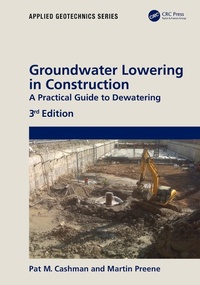
Groundwater Lowering in Construction
A Practical Guide to Dewatering
3rd Edition
Published on 10. August 2020
956 pages
978-1-000-08070-4 (ISBN)
Description

Praise for the Second Edition:
"This is the book that the dewatering sector really needs - it is reliably based on sound theory and profound understanding of the physical processes, yet is presented in a very accessible and user-friendly manner. It draws on many, many decades of experience, and yet is utterly up to date. . . . It is a one-stop shop for the dewatering practitioner - who can nonetheless rest assured that the theoretical basis of the methods presented is flawless."
- Professor Paul L. Younger, FGS, FICE, C.Geol., C.Eng., FREng, University of Glasgow, Scotland, UK
"The best reference on this topic available . . . and will prove useful to a wide variety of readers ranging from junior construction engineers or dewatering contractors to theoretical hydrogeologists and environmental managers. It is rare that a book is able to bridge the gap between theoretical design guidance and practical application."
- S.N. Sterling, University of Waterloo, Canada
The extensively updated Groundwater Lowering in Construction: A Practical Guide to Dewatering, 3rd Edition offers practical advice on all phases of groundwater control systems, from planning and design, through installation and maintenance, and ultimately decommissioning. The expertise provided in this book can help you improve working conditions, increase project viability, save time and reduce excavation costs.
Designers and managers of construction and engineering projects are given the tools necessary to effectively control groundwater. The content is divided into three sections - Principles, Design and Construction. The Principles section explains the fundamentals of groundwater flow as it relates to civil engineering excavations. The Design section explores in extensive detail site investigation, permeability assessment methods and groundwater control strategies. Chapters in the Construction section describe dewatering and exclusion techniques, and examine the complete life cycle of a groundwater control scheme, including monitoring, maintenance and decommissioning. This section incorporates eleven case histories from the authors' casebook.
The 3rd edition has been greatly revised and updated, and contains more than 200 new illustrations. The new content covers:
Permeability of soils and rocks
Groundwater problems for excavations in rock
Groundwater control for tunnelling projects, such as shafts and cross passages
Methods for assessing permeability
Decommissioning of dewatering systems
Optimisation of groundwater control schemes.
The new, expanded content offers valuable direction that can give you a true competitive advantage in the planning and execution of temporary and permanent dewatering works for excavation and tunnelling. Written for practising engineers, geologists and construction managers, as well as postgraduate engineering students, this revamped manual on design and practice presents numerous case studies and extensive references to enhance understanding.
"This is the book that the dewatering sector really needs - it is reliably based on sound theory and profound understanding of the physical processes, yet is presented in a very accessible and user-friendly manner. It draws on many, many decades of experience, and yet is utterly up to date. . . . It is a one-stop shop for the dewatering practitioner - who can nonetheless rest assured that the theoretical basis of the methods presented is flawless."
- Professor Paul L. Younger, FGS, FICE, C.Geol., C.Eng., FREng, University of Glasgow, Scotland, UK
"The best reference on this topic available . . . and will prove useful to a wide variety of readers ranging from junior construction engineers or dewatering contractors to theoretical hydrogeologists and environmental managers. It is rare that a book is able to bridge the gap between theoretical design guidance and practical application."
- S.N. Sterling, University of Waterloo, Canada
The extensively updated Groundwater Lowering in Construction: A Practical Guide to Dewatering, 3rd Edition offers practical advice on all phases of groundwater control systems, from planning and design, through installation and maintenance, and ultimately decommissioning. The expertise provided in this book can help you improve working conditions, increase project viability, save time and reduce excavation costs.
Designers and managers of construction and engineering projects are given the tools necessary to effectively control groundwater. The content is divided into three sections - Principles, Design and Construction. The Principles section explains the fundamentals of groundwater flow as it relates to civil engineering excavations. The Design section explores in extensive detail site investigation, permeability assessment methods and groundwater control strategies. Chapters in the Construction section describe dewatering and exclusion techniques, and examine the complete life cycle of a groundwater control scheme, including monitoring, maintenance and decommissioning. This section incorporates eleven case histories from the authors' casebook.
The 3rd edition has been greatly revised and updated, and contains more than 200 new illustrations. The new content covers:
Permeability of soils and rocks
Groundwater problems for excavations in rock
Groundwater control for tunnelling projects, such as shafts and cross passages
Methods for assessing permeability
Decommissioning of dewatering systems
Optimisation of groundwater control schemes.
The new, expanded content offers valuable direction that can give you a true competitive advantage in the planning and execution of temporary and permanent dewatering works for excavation and tunnelling. Written for practising engineers, geologists and construction managers, as well as postgraduate engineering students, this revamped manual on design and practice presents numerous case studies and extensive references to enhance understanding.
Reviews / Votes
"Totally comprehensive in scope and coverage, the book will likely become - if not already - the standard work on subsurface dewatering on small- to medium-sized projects. Although practical, the book is not short on theory or analysis."- Tunnels and Tunnelling International
Praise for the Second Edition
"This is the book that the dewatering sector really needs-it is reliably based on sound theory and profound understanding of the physical processes, yet is presented in a very accessible and user-friendly manner. It draws on many, many decades of experience, and yet is utterly up to date, even including an intriguing glimpse into the future at the end of the book...It is a one-stop shop for the dewatering practitioner-who can nonetheless rest assured that the theoretical basis of the methods presented is flawless."
- Professor Paul L. Younger, FGS, FICE, C.Geol., C.Eng., FREng, University of Glasgow, Scotland, UK
"An essential and highly practical tool for all hydrogeologists and geotechnical and civil engineers involved in the quantified design and planning, construction, monitoring, operation, decommissioning, regulation and assessment of environmental impacts of groundwater lowering and dewatering systems."
-- Trevor Muten in Quarterly Journal of Engineering Geology and Hydrogeology
"The main difference from the previous edition is the introduction of a chapter on the environmental effects of dewatering, reflecting increased societal and regulatory focus on these aspects. However, new sections on cutoff methods, long-term systems and contaminated land all reflect developments in the industry over this period."
-- Mike Streetly in Quarterly Journal of Engineering Geology and Hydrogeolog
"The best reference on this topic available...and will prove useful to a wide variety of readers ranging from junior construction engineers or dewatering contractors to theoretical hydrogeologists and environmental managers. It is rare that a book is able to bridge the gap between theoretical design guidance and practical application."
- S.N. Sterling, University of Waterloo, Canada
"The book provides an excellent and practical account of many aspects of dewatering in construction, usefully including a detailed discussion of permanent groundwater control systems. It provides a good account of basic hydrogeology and the history of the development of the science, and includes a thorough chapter on site investigations for dewatering design. Dewatering design and the installation and operation of various types of dewatering system are described in detail, making the book an excellent resource, both for practical purposes and for training. Each chapter has a good reference list for further, more detailed reading. I certainly recommend the book for both practitioners and teaching institutions."
- John Waterhouse, Golder Associates Pty Ltd, West Perth, Australia
"[This second edition] takes a well received and respected book on this niche subject and brings it fully up to date."
- David Richards, University of Southampton, UK "Totally comprehensive in scope and coverage, the book will likely become - if not already - the standard work on subsurface dewatering on small- to medium-sized projects. Although practical, the book is not short on theory or analysis."
- Tunnels and Tunnelling International
Praise for the Second Edition
"This is the book that the dewatering sector really needs-it is reliably based on sound theory and profound understanding of the physical processes, yet is presented in a very accessible and user-friendly manner. It draws on many, many decades of experience, and yet is utterly up to date, even including an intriguing glimpse into the future at the end of the book...It is a one-stop shop for the dewatering practitioner-who can nonetheless rest assured that the theoretical basis of the methods presented is flawless."
- Professor Paul L. Younger, FGS, FICE, C.Geol., C.Eng., FREng, University of Glasgow, Scotland, UK
"An essential and highly practical tool for all hydrogeologists and geotechnical and civil engineers involved in the quantified design and planning, construction, monitoring, operation, decommissioning, regulation and assessment of environmental impacts of groundwater lowering and dewatering systems."
-- Trevor Muten in Quarterly Journal of Engineering Geology and Hydrogeology
"The main difference from the previous edition is the introduction of a chapter on the environmental effects of dewatering, reflecting increased societal and regulatory focus on these aspects. However, new sections on cutoff methods, long-term systems and contaminated land all reflect developments in the industry over this period."
-- Mike Streetly in Quarterly Journal of Engineering Geology and Hydrogeolog
"The best reference on this topic available...and will prove useful to a wide variety of readers ranging from junior construction engineers or dewatering contractors to theoretical hydrogeologists and environmental managers. It is rare that a book is able to bridge the gap between theoretical design guidance and practical application."
- S.N. Sterling, University of Waterloo, Canada
"The book provides an excellent and practical account of many aspects of dewatering in construction, usefully including a detailed discussion of permanent groundwater control systems. It provides a good account of basic hydrogeology and the history of the development of the science, and includes a thorough chapter on site investigations for dewatering design. Dewatering design and the installation and operation of various types of dewatering system are described in detail, making the book an excellent resource, both for practical purposes and for training. Each chapter has a good reference list for further, more detailed reading. I certainly recommend the book for both practitioners and teaching institutions."
- John Waterhouse, Golder Associates Pty Ltd, West Perth, Australia
"[This second edition] takes a well received and respected book on this niche subject and brings it fully up to date."
- David Richards, University of Southampton, UK
More details
Series
Edition
3rd edition
Language
English
Place of publication
London
United Kingdom
Publishing group
Taylor & Francis Ltd
Target group
College/higher education
Professional and scholarly
Illustrations
33 Tables, black and white; 642 Line drawings, black and white; 163 Halftones, black and white
ISBN-13
978-1-000-08070-4 (9781000080704)
Copyright in bibliographic data and cover images is held by Nielsen Book Services Limited or by the publishers or by their respective licensors: all rights reserved.
Schweitzer Classification
Other editions
Additional editions
Book
03/2022
3rd Edition
CRC Press
€118.50
Shipment within 15-20 days
Book
08/2020
3rd Edition
CRC Press
€204.61
Shipment within 15-20 days
Persons
The late Pat Cashman was the leading British exponent of groundwater control for his generation, championing a practical and straightforward approach for more than forty years.
Dr. Martin Preene draws on thirty years' experience of groundwater control and groundwater management gained with contractors and consultants in more than forty countries worldwide. He currently operates as an independent groundwater specialist via Preene Groundwater Consulting.
Dr. Martin Preene draws on thirty years' experience of groundwater control and groundwater management gained with contractors and consultants in more than forty countries worldwide. He currently operates as an independent groundwater specialist via Preene Groundwater Consulting.
Content
1 Groundwater Lowering: A Personal View and Introduction by Pat M. Cashman SECTION 1 PRINCIPLES 2 The History of Groundwater Theory and Practice 3 Principles of Groundwater Flow 4 Permeability of Soils and Rocks 5 Groundwater Models 6 Objectives of Groundwater Control 7 Groundwater Problems for Excavations in Soils 8 Groundwater Problems for Excavations in Rock SECTION 2 DESIGN 9 Methods for Control of Surface Water and Groundwater 10 Groundwater Control for Tunnelling Projects 11 Site Investigation for Groundwater Lowering 12 Assessment of Permeability 13 Design of Groundwater Lowering Systems SECTION 3 CONSTRUCTION 14 Sump Pumping 15 Wellpoint Systems 16 Deep Well Systems 17 Other Dewatering Systems 18 Methods for Exclusion of Groundwater 19 Pumps for Groundwater Lowering Duties 20 Permanent Groundwater Control Systems 21 Environmental Impacts from Groundwater Control 22 Monitoring of Groundwater Control Systems 23 Maintenance of Groundwater Lowering Systems 24 Decommissioning of Groundwater Control Systems 25 Safety, Contracts and Environmental Regulation 26 Optimization of Groundwater Control Systems 27 Case Histories 28 The Future [TOBY ROBERTS]
