
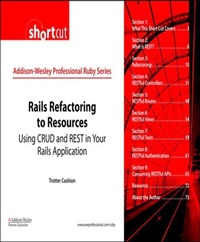
Rails Refactoring to Resources (Digital Short Cut)
Description
Alles über E-Books | Antworten auf Fragen rund um E-Books, Kopierschutz und Dateiformate finden Sie in unserem Info- & Hilfebereich.
This is the eBook version of the printed book.
Since David Heinemeier Hansson's keynote speech at RailsConf 2006 and the release of Rails 1.2 in early 2007, Representational State Transfer, better known as REST, has taken the Rails world by storm. If you're new to REST, this short cut will help you decide which parts of the REST paradigm you want to introduce to your application. If you're a developer with more RESTful experience, this short cut will introduce you to some refactorings that will give your application a cleaner, leaner code base, while also serving as a reference to much of the functionality REST has brought to Rails.
Section 1: What This Short Cut Covers 3
Section 2: What Is REST? 6
Section 3: Refactorings 10
Section 4: RESTful Controllers 31
Section 5: RESTful Routes 48
Section 6: RESTful Views 54
Section 7: RESTful Tests 59
Section 8: RESTful Authentication 61
Section 9: Consuming RESTful APIs 63
Resources 72
About the Author 73
All prices
More details
Person
Trotter Cashion has been using Ruby for almost the past two years. At Eastmedia, he worked on pip.verisignlabs.com, the first Open ID server in Rails. In addition, he worked on the cms for nyjets.com. He is now employed as an application developer at motionbox.com, a Rails-based video sharing site.
Content
1.1 Target Audience 5
1.2 Rails 5
Section 2: What Is REST? 62.1 REST Explained 7
2.2 REST and Rails 7
2.3 REST and CRUD 8
2.4 Verbs and Nouns 9
Section 3: Refactorings 103.1 respond_to 10
3.2 CRUD 16
3.3 Resource 27
Section 4: RESTful Controllers 314.1 A RESTful Controller 31
4.2 Automating RESTful Controller Generation 34
4.3 respond_to 40
4.4 How Content Type Negotiation Works 46
Section 5: RESTful Routes 485.1 Pretty URLs 52
5.2 Browsers and the HTTP Methods 53
Section 6: RESTful Views 546.1 SimplyHelpful
Section 7: RESTful Tests 59 Section 8: RESTful Authentication 61 Section 9: Consuming RESTful APIs 639.1 ActiveResource 64
9.2 cURL 69

Resources 72
About the Author 73
System requirements
File format: ePUB
Copy protection: Adobe-DRM (Digital Rights Management)
System requirements:
- Computer (Windows; MacOS X; Linux): Install the free reader Adobe Digital Editions prior to download (see eBook Help).
- Tablet/smartphone (Android; iOS): Install the free app Adobe Digital Editions or the app PocketBook before downloading (see eBook Help).
- E-reader: Bookeen, Kobo, Pocketbook, Sony, Tolino and many more (not Kindle).
The file format ePub works well for novels and non-fiction books – i.e., „flowing” text without complex layout. On an e-reader or smartphone, line and page breaks automatically adjust to fit the small displays.
This eBook uses Adobe-DRM, a „hard” copy protection. If the necessary requirements are not met, unfortunately you will not be able to open the eBook. You will therefore need to prepare your reading hardware before downloading.
Please note: We strongly recommend that you authorise using your personal Adobe ID after installation of any reading software.
For more information, see our ebook Help page.
File format: ePUB
Copy protection: Watermark-DRM (Digital Rights Management)
System requirements:
- Computer (Windows; MacOS X; Linux): Use a reading software that can process the file format ePUB: e.g., Adobe Digital Editions or FBReader – both free (see eBook Help).
- Tablet/Smartphone (Android; iOS): Before downloading, install the free app Adobe Digital Editions (see eBook Help).
- E-reader: Bookeen, Kobo, Pocketbook, Sony, Tolino and many more (not Kindle).
The file format ePUB works well for novels and non-fiction books – i.e., „flowing” text without complex layout. On an e-reader or smartphone, line and page breaks automatically adjust to fit the small displays.
This eBook uses Watermark-DRM, a „soft” copy protection. This means that there are no technical restrictions to prevent illegal distribution. However, there is a personalised watermark embedded in the eBook that can be used to identify the purchaser of the eBook in the event of misuse and to provide evidence for legal purposes.
For more information, see our eBook Help page.