

Adding the Lone Star
Description
Alles über E-Books | Antworten auf Fragen rund um E-Books, Kopierschutz und Dateiformate finden Sie in unserem Info- & Hilfebereich.
The annexation of Texas was one of the most momentous actions the United States government took in the antebellum period. Apart from adding what was the largest state in the Union at that time, it expedited further avenues for westward expansion, exacerbated tensions with Mexico resulting in the Mexican-American War, and accelerated the sectional conflict over slavery.
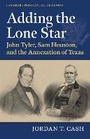
While the familiar concept of Manifest Destiny gives the impression that Texas joining the United States was inevitable, the history is much more complicated. In Adding the Lone Star, Jordan Cash explores how the decisions and actions of a cast of political actors in the United States, Texas, Mexico, and Great Britain contributed to the addition of Texas to the Union.
Cash focuses on the annexation of Texas as a two-president decision while examining the administrations of American President John Tyler and Texian President Sam Houston, providing a comparative case study of the American and Texian presidencies to better comprehend how executive authority may be used in a system of separation of powers.
Tyler's ability to push his agenda on Texas despite the lack of institutional support shows the strength of premodern presidential power. Houston's actions give an alternative view of executive authority, since the Texian Republic, including the powers bestowed on the presidency, was structured on the model of its American counterpart. Tyler viewed the decision to annex Texas as beneficial for the United States as a whole while Houston considered it to be beneficial for Texas and proponents of slavery; Tyler's secretary of state, John C. Calhoun, saw the decision as a victory for the South and the expansion of slavery.
The examination of how these two presidents worked on the same issue at the same time but in largely different constitutional, institutional, political, and geographical contexts provides not only a better understanding of the history and politics of annexation but also an investigation of the nuances of presidential power in a constitutional system of checks and balances and separation of powers.
All prices
More details
Other editions
Additional editions
Person
Jordan T. Cash is assistant professor of political theory and constitutional democracy in the James Madison College at Michigan State University and author of The Isolated Presidency.
Content
Foreword
Introduction: Not One, but Two Presidents
1. The Tex-Mex Executive
2. His Accidency, John Tyler
3. Sam Houston and the Republic of Texas
4. The Annexation Treaty
5. The Elections of 1844
Conclusion: The Primacy of Presidential Policymaking
Notes
Bibliographic Essay
Index

System requirements
File format: ePUB
Copy protection: Adobe-DRM (Digital Rights Management)
System requirements:
- Computer (Windows; MacOS X; Linux): Install the free reader Adobe Digital Editions prior to download (see eBook Help).
- Tablet/smartphone (Android; iOS): Install the free app Adobe Digital Editions or the app PocketBook before downloading (see eBook Help).
- E-reader: Bookeen, Kobo, Pocketbook, Sony, Tolino and many more (not Kindle).
The file format ePub works well for novels and non-fiction books – i.e., „flowing” text without complex layout. On an e-reader or smartphone, line and page breaks automatically adjust to fit the small displays.
This eBook uses Adobe-DRM, a „hard” copy protection. If the necessary requirements are not met, unfortunately you will not be able to open the eBook. You will therefore need to prepare your reading hardware before downloading.
Please note: We strongly recommend that you authorise using your personal Adobe ID after installation of any reading software.
For more information, see our ebook Help page.
File format: PDF
Copy-Protection: Adobe-DRM (Digital Rights Management)
System requirements:
- Computer (Windows; MacOS X; Linux): Install the free reader Adobe Digital Editions prior to download (see eBook Help).
- Tablet/smartphone (Android; iOS): Install the free app Adobe Digital Editions or the app PocketBook before downloading (see eBook Help).
- E-reader: Bookeen, Kobo, Pocketbook, Sony, Tolino and many more (only limited: Kindle).
The file format PDF always displays a book page identically on any hardware. This makes PDF suitable for complex layouts such as those used in textbooks and reference books (images, tables, columns, footnotes). Unfortunately, on the small screens of e-readers or smartphones, PDFs are rather annoying, requiring too much scrolling.
This eBook uses Adobe-DRM, a „hard” copy protection. If the necessary requirements are not met, unfortunately you will not be able to open the eBook. You will therefore need to prepare your reading hardware before downloading.
Please note: We strongly recommend that you authorise using your personal Adobe ID after installation of any reading software.
For more information, see our eBook Help page.
File format: ePUB
Copy protection: Watermark-DRM (Digital Rights Management)
System requirements:
- Computer (Windows; MacOS X; Linux): Use a reading software that can process the file format ePUB: e.g., Adobe Digital Editions or FBReader – both free (see eBook Help).
- Tablet/Smartphone (Android; iOS): Before downloading, install the free app Adobe Digital Editions (see eBook Help).
- E-reader: Bookeen, Kobo, Pocketbook, Sony, Tolino and many more (not Kindle).
The file format ePUB works well for novels and non-fiction books – i.e., „flowing” text without complex layout. On an e-reader or smartphone, line and page breaks automatically adjust to fit the small displays.
This eBook uses Watermark-DRM, a „soft” copy protection. This means that there are no technical restrictions to prevent illegal distribution. However, there is a personalised watermark embedded in the eBook that can be used to identify the purchaser of the eBook in the event of misuse and to provide evidence for legal purposes.
For more information, see our eBook Help page.
