

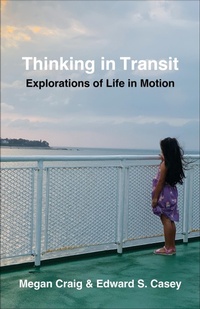
Thinking in Transit
Explorations of Life in Motion
1st Edition
Published on 26. August 2025
240 pages
978-0-231-56368-0 (ISBN)
Description

Does being in motion change how we think? Tracing the connections between thinking and transit-including walking, being transported by a vehicle, and many other modes-this innovative book shows how embodiment and movement deepen, expand, and transform creative thought.
Megan Craig and Edward S. Casey provide a collaborative phenomenological exploration of thought in motion, interspersing lively first-person accounts with broader philosophical inquiry. Their investigation, structured around the four ancient elements-water, air, earth, and fire-ranges across swimming, boats, balloons, planes, cars, trains, and other modes of transport. Craig and Casey invite readers to recall their own experiences of travel and how thinking changes in tandem with shifting environments and whatever conveys a person from place to place. They also consider how changing climates and evolving technologies, with new rhythms and materialities, have shaped human thinking in its many varieties.
Thinking in Transit celebrates forms of movement and motion that carry the body and mind out of their habituated routines. This book urges a change in how philosophers have traditionally framed the setting for serious thought: from the austere, solitary space of a study to populated places of interaction and passage.
Megan Craig and Edward S. Casey provide a collaborative phenomenological exploration of thought in motion, interspersing lively first-person accounts with broader philosophical inquiry. Their investigation, structured around the four ancient elements-water, air, earth, and fire-ranges across swimming, boats, balloons, planes, cars, trains, and other modes of transport. Craig and Casey invite readers to recall their own experiences of travel and how thinking changes in tandem with shifting environments and whatever conveys a person from place to place. They also consider how changing climates and evolving technologies, with new rhythms and materialities, have shaped human thinking in its many varieties.
Thinking in Transit celebrates forms of movement and motion that carry the body and mind out of their habituated routines. This book urges a change in how philosophers have traditionally framed the setting for serious thought: from the austere, solitary space of a study to populated places of interaction and passage.
More details
Other editions
Additional editions
Book
08/2025
Columbia University Press
€27.50
Shipment within 10-20 days
Book
08/2025
Columbia University Press
€117.61
Shipment within 10-20 days
Persons
Megan Craig is associate professor of philosophy at the State University of New York at Stony Brook as well as an artist and essayist. She is the author of Levinas and James: Toward a Pragmatic Phenomenology (2009).
Edward S. Casey is distinguished professor emeritus of philosophy at the State University of New York at Stony Brook and past president of the American Philosophical Association. His many books include Plants in Place: A Phenomenology of the Vegetal (Columbia, 2023), with Michael Marder.
Content
Preface
1. Water
2. Air
3. Earth
4. Fire
Postface
Acknowledgments
Notes
Bibliography
Index
