

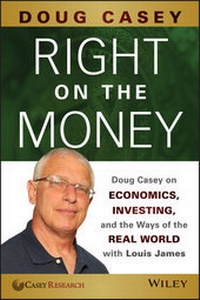
Right on the Money
Description

More details
Other editions
Additional editions
Person
Content
Chapter 1
Doug Casey on Bernanke: Be Afraid, Be Very Afraid (Part One)
December 8, 2010
Louis: Thanks for the link to the “historic” Ben Bernanke interviewa. It was breathtaking to hear the man who didn’t see the crash of 2008 coming say he’s “100 percent confident” he can control the U.S. economy. What do you make of that—is it hubris or stupidity?
Doug: As 60 Minutes pointed out, it’s rare for a Fed chairman to give an interview; this was only Bernanke’s second—here’s a link to his first. It’s such an unusual thing that I think it’s a sign that the Powers That Be are really quite worried. As they should be. His last interview was at the height of the crisis in early 2009.
L: Bernanke himself looked worried. I was amazed, actually, watching the interview, by just how nervous and stressed he appeared. He stuttered, his lip quivered continuously, and that pulsing vein on his forehead really stood out throughout the interview. He looked like he was flat-out lying and doubted anyone would believe him, but had no choice but to keep lying. It was almost like a cartoon of a liar caught red-handed. It’s a shocker that the Powers That Be would let such an interview be aired—it would seem to be the opposite of reassuring, to me.
D: I know. It’d be nice to run that interview through a voice stress analyzer and see what it says. It’s a question of whether he’s a knave or a fool—neither answer is bullish for the U.S. economy. He’d be wonderful to play poker against.
He’s not a skilled or enthusiastic liar, but he is certainly becoming more practiced at it, which is, of course, par for the course of being Fed chairman. That aside, the interview is really interesting, because there are several times in the interview when he really comes across as being scared and warning people: the way he stressed how close to the edge of a precipice the economy was, and how troubled it remains.L: Well, that was the reason given for the interview. He says the critics of his latest $600 billion shot in the economy’s arm don’t understand how serious things are, how dangerous the high unemployment rate is.
D: Yes, of course he’d say that. You know my argument is that “doing something” is a mistake, if it’s based on incorrect economics. Everything they are doing is not just the wrong thing, it’s the opposite of the right thing.
L: So, do you believe Bernanke was actually lying? Or was he just highly stressed, because he’s the one in the hot seat, and he knows that just because the Titanic didn’t sink the moment it hit the iceberg, that doesn’t mean it’s out of danger?
D: Perhaps it’s a bit like Hitler in the bunker, who was under great stress, and really wasn’t lying when he insisted that the Third Reich could still win the war. In fact, I can’t wait to see if someone does one of those “Hitler in the bunker” spoofs, based on this interview.
L: I wouldn’t be surprised to see one posted on YouTube tomorrow. Meantime, Jon Stewart skewers Bernanke admirably in a recent skit on his show.
D: Actually, someone just did one of those “Hitler in the bunker” spoofs on manipulation of the silver market—which, incidentally, I don’t believe is a reality. But it mentions our redoubt at La Estancia de Cafayate. There’s a lot of very rich and colorful language, which some people won’t like, but it’s very funny.
L: Warning to readers: That video is not family-friendly. So, lying aside, let’s look at some of the things he said. The first and foremost thing that jumps out at me is that he says the Fed is “not printing money” and that the Fed’s actions have no significant impact on money supply. How can he imagine they can inject liquidity into the economy, and that it won’t have any impact on money supply?
D: I think he knows better than that. Look, what the Fed has been doing is buying securities. And the way they do that is to credit the account of the seller with dollars. So, of course it creates money. That’s why they call it “quantitative easing”—because they’re increasing the number of Federal Reserve units in circulation. I really love that term, QE, because it’s so cynically dishonest, like the whole monetary system itself. And it’s amazing that nobody even challenges it. They just accept it instead of calling it what it is—printing money. It’s Orwellian.
In any event, creating more currency units by buying government bonds serves several purposes, from their point of view. It raises the prices of bonds, and therefore pushes interest rates down—and they want lower rates because it makes it easier to finance the staggering amount of debt out there that threatens to collapse the system. And they want more currency units out there because that makes people feel richer, consume more, and that props up preexisting economic conditions—which are actually unsustainable. The crash prompted them to buy toxic paper from banks for a while, to keep them from going under. Now they’re buying U.S. treasuries again, with the latest $600 billion. Bernanke is taking desperate measures to solve an acute problem. But their consequences will be disastrous—much, much more damaging than if he’d done nothing. Of course if he did nothing, the system would collapse through a deflation: bonds would default, banks would close. What will now happen is the currency itself is going to be destroyed, which is much worse. But since it’s put off a bit further in the future, that’s the course he’s taking.L: Agreed. In spite of what Bernanke says, whatever the sellers of the securities do with the new dollars deposited to their accounts—even if they leave them on deposit with the Fed because the Fed is now paying interest for excess reserves—it still frees up other money the sellers can now use for other purposes. And because of the fractional reserve system, there’s a multiplier effect on the added liquidity. Bernanke says that all he’s doing is keeping interest rates down to stimulate the economy, but the way he’s doing it adds to the money supply.
D: Exactly. We’re beyond the time when you have to cut down trees to print up hundred dollar bills. It’s just a keystroke, now. But playing with the amount of currency doesn’t create new wealth—it actually makes real wealth creation much harder.
So as the situation gets more serious in the months and years to come, you can expect ever more ad-hoc measures from the government. They’ll probably try capital controls, to keep people from transferring wealth outside the U.S. Those will be popular because only “unpatriotic” people would do such a thing, as well as rich people—and it’s now time to eat the rich. They’ll likely require all pension plans to buy a certain amount of government securities. They’ll have restrictions on the amount you can spend on foreign travel. They’ll probably even try price controls, like Nixon did in the early 1970s. They’ll increasingly limit what can be done with cash—like the new requirement that all transactions of any type above $600 must be reported on 1099s—because digital money is much easier to control. New government bureaucracies will be set up to enforce all these things, and many more.L: Scary. Does it mean anything for Bernanke to say that the $600 billion came from the Fed’s “own reserves”? Where would the Fed’s reserves come from, if not from electronic dollars newly created at the stroke of a computer key?
D: No. That’s a cynical lie. I think what he was trying to stress was that the money was not coming directly from taxes. The Federal Reserve is a misnomer. There is no reserve, as there was in the days when the gold at Fort Knox backed the dollar. Now, the dollar isn’t backed by anything, so there’s nothing to reserve—they can and do create as many dollars as they want, as ledger entries, which they can and do use to pay banks and others, who can and do use them to pay others, and so forth.
It’s not a “reserve,” and it’s not “federal.” Although the Fed is a creature of the government, it’s not, technically speaking, part of it. It’s really controlled by the large banks, who benefit primarily through “fractional reserve” banking. In the past, when banks were just ordinary businesses that warehoused money and acted as brokers for loans made with savings, keeping a fractional reserve was a fraudulent practice that would eventually result in bankruptcy, followed by criminal charges. The creation of central banks, like the Fed, facilitated it as common practice; in effect, debt became a form of money. This isn’t the forum to explain the subject in detail; I’ve done that in my books. But we’ve now reached the inevitable consequence of the system, which is a financial cataclysm. Bernanke is trying...