

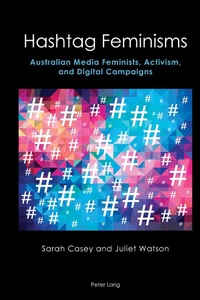
Hashtag Feminisms
Description

«This fantastic book investigates the proliferation, power and changing nature of online feminist activism. The book critically focuses on the challenges and risks of online feminist activism, as well as the capacity of activist campaigns to achieve real, transformative change. Casey and Watson argue that although feminists should harness the power of hashtag and celebrity feminism, there are tensions, inequalities and power imbalances within feminism which must be navigated.
This book is a must-read, especially for activists, academics, victim-survivors and policymakers. It makes an important contribution to contemporary debates about the role of feminist digital activism across three key areas: raising public awareness of gender-based violence, contributing to cultural change, including changing norms, attitudes and behaviours, and shaping understandings of how gender, race, sexuality and other markers of difference intersect to shape experience. The book is a timely reminder that feminist activism is an important piece of the puzzle to preventing gender-based violence.»
(Professor Nicola Henry, RMIT University)
«Hashtag Feminisms is powerful. It is potent. It is engaging. This book offers momentum and transformation. It provides a pathway to our future, through courage, reflection, kindness and compassion.»
(Professor Tara Brabazon, Professor of Cultural Studies (Flinders University) / Professor of Higher Education (Massey University))
Broad-scale feminist consciousness continues to gain ground globally, as witnessed by the Women's March, #MeToo, and #EnoughIsEnough in Australia. Aided by hashtag activism and media feminists, feminist campaigns have highlighted the need for change in cultural attitudes to issues such as gender-based violence. This book focuses on feminist campaigning in the Australian context over the last decade, contending the increased velocity of feminist discourse in the Australian mediascape represents a critical opportunity for larger scale, feminist-led mass awareness campaigns. The authors ask: what is it about hashtag activism and celebrity feminisms that may be most useful to (some) Australian feminists, and what are the challenges and potential risks of these forms of activism? Does such activism have substantive political or material effects? Or is this type of activism just echo chamber activism, which does little to address structural inequalities and, if so, might anything be salvaged?
More details
Other editions
Additional editions
Persons
Dr Sarah Casey is a Senior Lecturer in the School of Business and Creative Industries at the University of the Sunshine Coast, Australia. Her research centres on advocacy, and media and communication campaigning, with a particular interest in rural, regional, and remote women. She is a long-term executive member of the Australian Women's and Gender Studies Association.
Dr Juliet Watson is a Senior Lecturer in the School of Global, Urban and Social Studies at RMIT University, Australia. Her research interests include homelessness, gender-based violence, and feminisms. She was previously President of the Australian Women's and Gender Studies Association.
Content
Contents: Introduction: A Groundswell of Feminist Activism - Australian Feminist Online Activism - Feminisms, Gender-Based Violence, and Activism - #Hysteria: Activism and the Online World - A Case Study of Feminist Activist Interventions in Queensland Party Politics: #SackGavin - Popular Media Feminisms and Feminists in Campaigning - Media Feminists: Bytesizes and Branding - Unpalatable-Palatable Tensions - Conclusion: Feminist Solidarity and Consciousness-Raising.
