

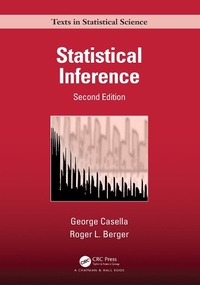
Statistical Inference
2nd Edition
Published on 23. May 2024
565 pages
978-1-040-02402-7 (ISBN)
Description

This classic textbook builds theoretical statistics from the first principles of probability theory. Starting from the basics of probability, the authors develop the theory of statistical inference using techniques, definitions, and concepts that are statistical and natural extensions, and consequences, of previous concepts. It covers all topics from a standard inference course including: distributions, random variables, data reduction, point estimation, hypothesis testing, and interval estimation.
Features
The classic graduate-level textbook on statistical inference
Develops elements of statistical theory from first principles of probability
Written in a lucid style accessible to anyone with some background in calculus
Covers all key topics of a standard course in inference
Hundreds of examples throughout to aid understanding
Each chapter includes an extensive set of graduated exercises
Statistical Inference, Second Edition is primarily aimed at graduate students of statistics, but can be used by advanced undergraduate students majoring in statistics who have a solid mathematics background. It also stresses the more practical uses of statistical theory, being more concerned with understanding basic statistical concepts and deriving reasonable statistical procedures, while less focused on formal optimality considerations.
This is a reprint of the second edition originally published by Cengage Learning, Inc. in 2001.
Features
The classic graduate-level textbook on statistical inference
Develops elements of statistical theory from first principles of probability
Written in a lucid style accessible to anyone with some background in calculus
Covers all key topics of a standard course in inference
Hundreds of examples throughout to aid understanding
Each chapter includes an extensive set of graduated exercises
Statistical Inference, Second Edition is primarily aimed at graduate students of statistics, but can be used by advanced undergraduate students majoring in statistics who have a solid mathematics background. It also stresses the more practical uses of statistical theory, being more concerned with understanding basic statistical concepts and deriving reasonable statistical procedures, while less focused on formal optimality considerations.
This is a reprint of the second edition originally published by Cengage Learning, Inc. in 2001.
More details
Series
Edition
2nd edition
Language
English
Place of publication
London
United Kingdom
Publishing group
Taylor & Francis Ltd
Target group
College/higher education
Product notice
Reflowable
Illustrations
17 Tables, black and white; 54 Line drawings, black and white; 54 Illustrations, black and white
ISBN-13
978-1-040-02402-7 (9781040024027)
Copyright in bibliographic data and cover images is held by Nielsen Book Services Limited or by the publishers or by their respective licensors: all rights reserved.
Schweitzer Classification
Other editions
Additional editions
George Casella | Roger Berger
Statistical Inference
Book
05/2024
2nd Edition
Chapman & Hall/CRC
€109.20
Shipment within 10-20 days
Persons
Professor George Casella completed his undergraduate education at Fordham University and graduate education at Purdue University. He served on the faculty of Rutgers University, Cornell University, and the University of Florida. His contributions focused on the area of statistics including Monte Carlo methods, model selection, and genomic analysis. He was particularly active in Bayesian and empirical Bayes methods, with works connecting with the Stein phenomenon, on assessing and accelerating the convergence of Markov chain Monte Carlo methods, as in his Rao-Blackwellisation technique, and recasting lasso as Bayesian posterior mode estimation with independent Laplace priors.
Casella was named as a Fellow of the American Statistical Association and the Institute of Mathematical Statistics in 1988, and he was made an Elected Fellow of the International Statistical Institute in 1989. In 2009, he was made a Foreign Member of the Spanish Royal Academy of Sciences.
After receiving his doctorate in statistics from Purdue University, Professor Roger Berger held academic positions at Florida State University and North Carolina State University. He also spent two years with the National Science Foundation before coming to Arizona State University in 2004. Berger is co-author of the textbook "Statistical Inference," now in its second edition. This book has been translated into Chinese and Portuguese. His articles have appeared in publications including Journal of the American Statistical Association, Statistical Science, Biometrics and Statistical Methods in Medical Research. Berger's areas of expertise include hypothesis testing, (bio)equivalence, generalized linear models, biostatistics, and statistics education.
Berger was named as a Fellow of the American Statistical Association and the Institute of Mathematical Statistics.
Casella was named as a Fellow of the American Statistical Association and the Institute of Mathematical Statistics in 1988, and he was made an Elected Fellow of the International Statistical Institute in 1989. In 2009, he was made a Foreign Member of the Spanish Royal Academy of Sciences.
After receiving his doctorate in statistics from Purdue University, Professor Roger Berger held academic positions at Florida State University and North Carolina State University. He also spent two years with the National Science Foundation before coming to Arizona State University in 2004. Berger is co-author of the textbook "Statistical Inference," now in its second edition. This book has been translated into Chinese and Portuguese. His articles have appeared in publications including Journal of the American Statistical Association, Statistical Science, Biometrics and Statistical Methods in Medical Research. Berger's areas of expertise include hypothesis testing, (bio)equivalence, generalized linear models, biostatistics, and statistics education.
Berger was named as a Fellow of the American Statistical Association and the Institute of Mathematical Statistics.
Content
1. Probability Theory. 2. Transformations and Expectations. 3. Common Families of Distributions. 4. Multiple Random Variables. 5. Properties of a Random Sample. 6. Principles of Data Reduction. 7. Point Estimation. 8. Hypothesis Testing. 9. Interval Estimation. 10. Asymptotic Evaluations. 11. Analysis of Variance and Regression. 12. Regression Models. 13. Computer Algebra.
