

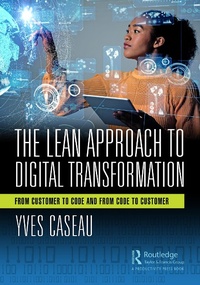
The Lean Approach to Digital Transformation
From Customer to Code and From Code to Customer
1st Edition
Published on 1. May 2022
256 pages
978-1-000-55287-4 (ISBN)
Description

The Lean Approach to Digital Transformation: From Customer to Code and From Code to Customer is organized into three parts that expose and develop the three capabilities that are essential for a successful digital transformation:
1. Understanding how to co-create digital services with users, whether they are customers or future customers. This ability combines observation, dialogue, and iterative experimentation. The approach proposed in this book is based on the Lean Startup approach, according to an extended vision that combines Design Thinking and Growth Hacking. Companies must become truly "customer-centric", from observation and listening to co-development. The revolution of the digital age of the 21st century is that customer orientation is more imperative -- the era of abundance, usages rate of change, complexity of experiences, and shift of power towards communities -- are easier, using digital tools and digital communities.
2. Developing an information system (IS) that is the backbone of the digital transformation - called "exponential information system" to designate an open IS (in particular on its borders), capable of interfacing and combining with external services, positioned as a player in software ecosystems and built for processing scalable and dynamic data flows. The exponential information system is constantly changing and it continuously absorbs the best of information processing technology, such as Artificial Intelligence and Machine Learning.
3. Building software "micro-factories" that produce service platforms, which are called "Lean software factories." This "software factory" concept covers the integration of agile methods, tooling and continuous integration and deployment practices, a customer-oriented product approach, and a platform approach based on modularity, as well as API-based architecture and openness to external stakeholders. This software micro-factory is the foundation that continuously produces and provides constantly evolving services.
These three capabilities are not unique or specific to this book, they are linked to other concepts such as agile methods, product development according to lean principles, software production approaches such as CICD (continuous integration and deployment) or DevOps. This book weaves a common frame of reference for all these approaches to derive more value from the digital transformation and to facilitate its implementation.
The title of the book refers to the "lean approach to digital transformation" because the two underlying frameworks, Lean Startup and Lean Software Factory, are directly inspired by Lean, in the sense of the Toyota Way. The Lean approach is present from the beginning to the end of this book -- it provides the framework for customer orientation and the love of a job well done, which are the conditions for the success of a digital transformation.
1. Understanding how to co-create digital services with users, whether they are customers or future customers. This ability combines observation, dialogue, and iterative experimentation. The approach proposed in this book is based on the Lean Startup approach, according to an extended vision that combines Design Thinking and Growth Hacking. Companies must become truly "customer-centric", from observation and listening to co-development. The revolution of the digital age of the 21st century is that customer orientation is more imperative -- the era of abundance, usages rate of change, complexity of experiences, and shift of power towards communities -- are easier, using digital tools and digital communities.
2. Developing an information system (IS) that is the backbone of the digital transformation - called "exponential information system" to designate an open IS (in particular on its borders), capable of interfacing and combining with external services, positioned as a player in software ecosystems and built for processing scalable and dynamic data flows. The exponential information system is constantly changing and it continuously absorbs the best of information processing technology, such as Artificial Intelligence and Machine Learning.
3. Building software "micro-factories" that produce service platforms, which are called "Lean software factories." This "software factory" concept covers the integration of agile methods, tooling and continuous integration and deployment practices, a customer-oriented product approach, and a platform approach based on modularity, as well as API-based architecture and openness to external stakeholders. This software micro-factory is the foundation that continuously produces and provides constantly evolving services.
These three capabilities are not unique or specific to this book, they are linked to other concepts such as agile methods, product development according to lean principles, software production approaches such as CICD (continuous integration and deployment) or DevOps. This book weaves a common frame of reference for all these approaches to derive more value from the digital transformation and to facilitate its implementation.
The title of the book refers to the "lean approach to digital transformation" because the two underlying frameworks, Lean Startup and Lean Software Factory, are directly inspired by Lean, in the sense of the Toyota Way. The Lean approach is present from the beginning to the end of this book -- it provides the framework for customer orientation and the love of a job well done, which are the conditions for the success of a digital transformation.
More details
Edition
1. Auflage
Language
English
Place of publication
London
United Kingdom
Publishing group
Taylor & Francis Ltd
Target group
Professional and scholarly
Illustrations
15 Line drawings, black and white; 15 Illustrations, black and white
ISBN-13
978-1-000-55287-4 (9781000552874)
Copyright in bibliographic data and cover images is held by Nielsen Book Services Limited or by the publishers or by their respective licensors: all rights reserved.
Schweitzer Classification
Other editions
Additional editions
Yves Caseau
The Lean Approach to Digital Transformation
From Customer to Code and From Code to Customer
Book
05/2022
1st Edition
Productivity Press
€169.60
Shipment within 10-20 days
Yves Caseau
The Lean Approach to Digital Transformation
From Customer to Code and From Code to Customer
Book
05/2022
1st Edition
Productivity Press
€63.50
Shipment within 10-20 days
Person
Yves Caseau has been the Director of Information Systems for the Michelin Group since October 2017. He was previously the Digital Director of the AXA Group, in charge of the development of innovative digital applications and IT coordination in the digital domain.
He was Deputy CEO of Technologies, Services and Innovation of Bouygues Telecom from 2007 to 2013, in particular in charge of the development of new products for the fixed network. He was the CIO (Director of Information Systems) of Bouygues Telecom from 2001 to 2006. He taught the course "Theory and practice of information systems" at Polytechnique and frequently speaks as a guest speaker on architecture. information systems.
Yves devoted the first part of his scientific career - which began at the "Marcoussis Laboratories" of Alcatel-Alstom - to software engineering, object programming, and artificial intelligence. He then turned to research operations in the 1990s at Telcordia (USA) then in the Bouygues Group, which he joined in 1994.
A former student of ENS (Ulm), Yves Caseau holds a doctorate and an authorization to supervise research in computer science (Paris XI and Paris VII), as well as an MBA from the College of Engineers. He is a member of the Academy of Technologies and author of three books at Dunod: "Urbanization, BPM and SOA" (2005), "Performance of the Information System" (2007), and "Process and Enterprise 2.0" (2011).
He was Deputy CEO of Technologies, Services and Innovation of Bouygues Telecom from 2007 to 2013, in particular in charge of the development of new products for the fixed network. He was the CIO (Director of Information Systems) of Bouygues Telecom from 2001 to 2006. He taught the course "Theory and practice of information systems" at Polytechnique and frequently speaks as a guest speaker on architecture. information systems.
Yves devoted the first part of his scientific career - which began at the "Marcoussis Laboratories" of Alcatel-Alstom - to software engineering, object programming, and artificial intelligence. He then turned to research operations in the 1990s at Telcordia (USA) then in the Bouygues Group, which he joined in 1994.
A former student of ENS (Ulm), Yves Caseau holds a doctorate and an authorization to supervise research in computer science (Paris XI and Paris VII), as well as an MBA from the College of Engineers. He is a member of the Academy of Technologies and author of three books at Dunod: "Urbanization, BPM and SOA" (2005), "Performance of the Information System" (2007), and "Process and Enterprise 2.0" (2011).
Content
Part 1: Digital transformation: Customer orientation and homeostasis Chapter 1 Why a digital transformation? Chapter 2 Homeostasis: continuous adaptation to change Chapter 3 Lean Startup: Lean principles applied to co-creation Part II: Exponential information systems Chapter 4 The Information System as a foundation for digital transformation Chapter 5 Artificial intelligence and machine learning Chapter 6 Governance, architecture and situational potential Part III: Software platforms and service factories Chapter 7 DevOps and software factories Chapter 8 Putting platforms at the service of digital transformation Conclusion
