

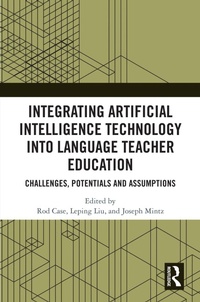
Integrating Artificial Intelligence Technology into Language Teacher Education
Challenges, Potentials and Assumptions
Published on 17. November 2025
134 pages
978-1-040-75871-7 (ISBN)
Description

This volume provides five exploratory studies on the constraints and affordances of artificial intelligence (AI), specifically examining ChatGPT's applications among preservice teachers preparing to teach multilingual learners. Through detailed analysis of classroom implementation, student perceptions, and pedagogical outcomes, this collection offers groundbreaking insights into how large language models can transform teacher preparation programs. Three studies present firsthand accounts of preservice teachers' experiences with ChatGPT, revealing a pragmatic orientation where adoption hinges on student motivation, accelerated English language development, and ease of use. The remaining two studies investigate ChatGPT-produced text as an instructional tool, highlighting its potential for fostering critical analysis while emphasizing the necessity of thoughtful integration through careful teacher planning.
This volume speaks directly to graduate students, teacher educators, educational technology specialists, TESOL professionals, and researchers in applied linguistics and AI ethics. It bridges multiple disciplines including educational technology, second language acquisition, teacher preparation, multilingual education, and artificial intelligence in education. The research presented in this volume contributes to ongoing conversations about technological innovation in classrooms, ethical considerations in AI implementation, and evolving best practices for preparing teachers to work effectively with multilingual populations in technology-enhanced learning environments.
The chapters in this book were originally published as a special issue of Computers in the Schools.
This volume speaks directly to graduate students, teacher educators, educational technology specialists, TESOL professionals, and researchers in applied linguistics and AI ethics. It bridges multiple disciplines including educational technology, second language acquisition, teacher preparation, multilingual education, and artificial intelligence in education. The research presented in this volume contributes to ongoing conversations about technological innovation in classrooms, ethical considerations in AI implementation, and evolving best practices for preparing teachers to work effectively with multilingual populations in technology-enhanced learning environments.
The chapters in this book were originally published as a special issue of Computers in the Schools.
More details
Language
English
Place of publication
London
United Kingdom
Publishing group
Taylor & Francis Ltd
Target group
College/higher education
Professional and scholarly
File size
5,11 MB
ISBN-13
978-1-040-75871-7 (9781040758717)
Copyright in bibliographic data and cover images is held by Nielsen Book Services Limited or by the publishers or by their respective licensors: all rights reserved.
Schweitzer Classification
Other editions
Additional editions
Rod E. Case | Leping Liu | Joseph Mintz
Integrating Artificial Intelligence Technology into Language Teacher Education
Challenges, Potentials and Assumptions
Book
11/2025
1st Edition
Routledge
€206.10
Shipment within 15-20 days
Persons
Rod Case is Associate Professor of Teaching English as a Second Language at the University of Nevada, Reno, USA. He is one of three recipients of the Northern Nevada English Learning Initiative (NNELI). Case teaches courses in second language acquisition and second language assessment. His research interests include various topics in applied linguistics and second language acquisition.
Leping Liu is Professor of Quantitative Methods and Learning Sciences at the University of Nevada, Reno, USA. She has more than 20 years of higher education for two universities in the USA. She has taught over 25 courses in instructional technology, instructional design, information technology in education, statistics, research design, and counseling technologies. Liu has published over 20 books and numerous refereed journal articles, book chapters, and conference articles. She also is research editor for Computers in the Schools and editor in chief of the International Journal of Technology in Teaching and Learning.
Joseph Mintz is Professor of Inclusive Education at UCL's Institute of Education with a diverse background spanning software development, primary teaching in London schools, and higher education. His research focuses on autism education, teacher education for inclusion, and educational technology for children with special needs. His work bridges psychological knowledge and classroom practice, while his recent projects investigate AI applications in educational settings.
Leping Liu is Professor of Quantitative Methods and Learning Sciences at the University of Nevada, Reno, USA. She has more than 20 years of higher education for two universities in the USA. She has taught over 25 courses in instructional technology, instructional design, information technology in education, statistics, research design, and counseling technologies. Liu has published over 20 books and numerous refereed journal articles, book chapters, and conference articles. She also is research editor for Computers in the Schools and editor in chief of the International Journal of Technology in Teaching and Learning.
Joseph Mintz is Professor of Inclusive Education at UCL's Institute of Education with a diverse background spanning software development, primary teaching in London schools, and higher education. His research focuses on autism education, teacher education for inclusion, and educational technology for children with special needs. His work bridges psychological knowledge and classroom practice, while his recent projects investigate AI applications in educational settings.
Content
Preface 1. Integrating AI Technology into Language Teacher Education: Challenges, Potentials, and Assumptions 2. Unveiling the Drivers of AI Integration Among Language Teachers: Integrating UTAUT and AI-TPACK 3. Assessing the Efficacy of Intelligent Tutoring Systems in Language Teacher Education: A Quantitative Study 4. The Integration of ChatGPT in English for Foreign Language Course: Elevating AI Writing Assistant Acceptance 5. Assessing AI and Human Writing Skills: A Comparative Analysis of Pre-Service Teachers' Perceptions 6. ChatGPT-Produced Content as a Resource in the Language Education Classroom: A Guiding Hand
