

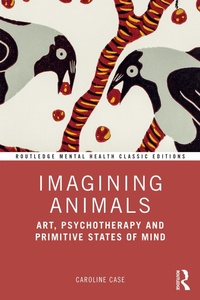
Imagining Animals
Art, Psychotherapy and Primitive States of Mind
Published on 30. July 2025
256 pages
978-1-040-38491-6 (ISBN)
Description

This classic edition of Imagining Animals explores how the making of animal images in art therapy and child psychotherapy can act as a powerful catalyst for children who may be struggling with communication. Readers will benefit from learning about the different ways that animal symbolism can support autistic children and children navigating trauma, abuse and depression in engaging with the therapeutic process.
This essential book explores two contrasting primitive states of mind throughout: the investing of the world around us with life through animism and participation mystique, and the lifeless world in the states of mind encountered in children who are hard to reach. Featuring a new introduction by the author, subjects covered in subsequent chapters include, but are not limited to:
Animal/human relationships
Animal symbolism
Animals on stage in therapy and anthropomorphic animal objects
Three-dimensional clay-work
The location of the self in animals
Imagining Animals offers a unique insight into the role and representation of animal imagery in art therapy and child psychotherapy. This is an essential read for all arts and play therapists working with children as well as adult psychotherapists interested in the use of imagery.
This essential book explores two contrasting primitive states of mind throughout: the investing of the world around us with life through animism and participation mystique, and the lifeless world in the states of mind encountered in children who are hard to reach. Featuring a new introduction by the author, subjects covered in subsequent chapters include, but are not limited to:
Animal/human relationships
Animal symbolism
Animals on stage in therapy and anthropomorphic animal objects
Three-dimensional clay-work
The location of the self in animals
Imagining Animals offers a unique insight into the role and representation of animal imagery in art therapy and child psychotherapy. This is an essential read for all arts and play therapists working with children as well as adult psychotherapists interested in the use of imagery.
Reviews / Votes
'This gem of a book will enrich the thinking of all those working analytically with states of mind in which autistic and psychotic defences predominate. Case distils many years of clinical experience with "difficult-to-reach" child patients into a sensitively crafted work which not only uses a wealth of clinical material, but also stories, poetry and images, to convey her approach in theory and in practice. She offers us the animal world, both in itself and in metaphor, as a medium for contacting and relating to the primitive levels of experience encountered in working with profoundly defended areas of the psyche.'Katherine Killick, Society of Analytical Psychology
More details
Series
Language
English
Place of publication
London
United Kingdom
Publishing group
Taylor & Francis Ltd
Target group
College/higher education
Professional and scholarly
Illustrations
1 Line drawings, black and white; 20 Halftones, black and white; 21 Illustrations, black and white
File size
12,76 MB
ISBN-13
978-1-040-38491-6 (9781040384916)
Copyright in bibliographic data and cover images is held by Nielsen Book Services Limited or by the publishers or by their respective licensors: all rights reserved.
Schweitzer Classification
Other editions
Additional editions
Book
07/2025
1st Edition
Routledge
€53.60
Shipment within 15-20 days
Book
07/2025
1st Edition
Routledge
€207.80
Shipment within 15-20 days
Person
Caroline Case worked with children and families in the statutory services and in private practice for 48 years. She has published widely on her therapeutic work as an art therapist and child and adolescent psychotherapist.
Content
PART I
Introduction: working with children who are hard
to reach
1. An animal alphabet of our actual and symbolic relationship to
animals
2. Animals on stage in therapy: anthropomorphic animal objects
3. Animation through the window: the beautiful and the sublime
PART II
Introduction: closeness and separation
4. Separation and sleeping difficulties: helpful images with
sleepless children
5. The location of self in animals
6. Entangled and confusional children: analytical approaches to
psychotic thinking and autistic features in childhood
PART III
Introduction: case study: the heart and the bone
7. From calm to chaos and rage
8. Things that go bump in the night, the 'fish pictures' and the
development of clay-work
9. The heart and the bone
10. Working towards the end of therapy and conclusions
Introduction: working with children who are hard
to reach
1. An animal alphabet of our actual and symbolic relationship to
animals
2. Animals on stage in therapy: anthropomorphic animal objects
3. Animation through the window: the beautiful and the sublime
PART II
Introduction: closeness and separation
4. Separation and sleeping difficulties: helpful images with
sleepless children
5. The location of self in animals
6. Entangled and confusional children: analytical approaches to
psychotic thinking and autistic features in childhood
PART III
Introduction: case study: the heart and the bone
7. From calm to chaos and rage
8. Things that go bump in the night, the 'fish pictures' and the
development of clay-work
9. The heart and the bone
10. Working towards the end of therapy and conclusions
