

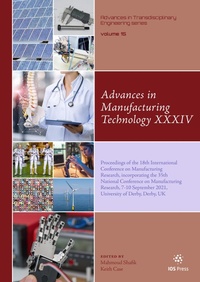
Advances in Manufacturing Technology XXXIV
Proceedings of the 18th International Conference on Manufacturing Research, incorporating the 35th National Conference on Manufacturing Research, 7-10 September 2021, University of Derby, Derby, UK
1st Edition
Published on 15. September 2021
440 pages
978-1-64368-199-3 (ISBN)
Description

The development of technologies and management of operations is key to sustaining the success of manufacturing businesses, and since the late 1970s, the International Conference on Manufacturing Research (ICMR) has been a major annual event for academics and industrialists engaged in manufacturing research. The conference is renowned as a friendly and inclusive platform that brings together a broad community of researchers who share a common goal.
This book presents the proceedings of ICMR2021, the 18th International Conference on Manufacturing Research, incorporating the 35th National Conference on Manufacturing Research, and held in Derby, UK, from 7 to 10 September 2021. The theme of the ICMR2021 conference is digital manufacturing. Within the context of Industrial 4.0, ICMR2021 provided a platform for researchers, academics and industrialists to share their vision, knowledge and experience, and to discuss emerging trends and new challenges in the field. The 60 papers included in the book are divided into 10 parts, each covering a different area of manufacturing research. These are: digital manufacturing, smart manufacturing; additive manufacturing; robotics and industrial automation; composite manufacturing; machining processes; product design and development; information and knowledge management; lean and quality management; and decision support and production optimization.
The book will be of interest to all those involved in developing and managing new techniques in manufacturing industry.
This book presents the proceedings of ICMR2021, the 18th International Conference on Manufacturing Research, incorporating the 35th National Conference on Manufacturing Research, and held in Derby, UK, from 7 to 10 September 2021. The theme of the ICMR2021 conference is digital manufacturing. Within the context of Industrial 4.0, ICMR2021 provided a platform for researchers, academics and industrialists to share their vision, knowledge and experience, and to discuss emerging trends and new challenges in the field. The 60 papers included in the book are divided into 10 parts, each covering a different area of manufacturing research. These are: digital manufacturing, smart manufacturing; additive manufacturing; robotics and industrial automation; composite manufacturing; machining processes; product design and development; information and knowledge management; lean and quality management; and decision support and production optimization.
The book will be of interest to all those involved in developing and managing new techniques in manufacturing industry.
More details
Series
Language
English
Place of publication
London
Netherlands
Publishing group
IOS Press
Target group
Professional and scholarly
File size
45,22 MB
ISBN-13
978-1-64368-199-3 (9781643681993)
Copyright in bibliographic data and cover images is held by Nielsen Book Services Limited or by the publishers or by their respective licensors: all rights reserved.
Schweitzer Classification
Other editions
Additional editions

Keith Case
Advances in Manufacturing Technology XXXIV
Proceedings of the 18th International Conference on Manufacturing Research, incorporating the 35th National Conference on Manufacturing Research, 7-10 September 2021, University of Derby, Derby, UK
Book
10/2021
1st Edition
IOS Press,US
€184.50
Shipment within 10-20 days
Content
- Intro
- Title Page
- Preface
- Acknowledgements
- Conference Organisation
- Contents
- Part 1. Digital Manufacturing
- The Cognitive Operator 4.0
- Digital Transformation Challenges in the Manufacturing Industry
- Development of an Optimised Dataset for Training a Deep Neural Network
- Towards Managing Digital Transformation in Manufacturing Industry: Theoretical Framework
- Appropriate Assembly Instruction Modes: Factors to Consider
- Mental Workload of Local vs Remote Operator in Human-Machine Interaction Case Study
- Part 2. Smart Manufacturing
- New Manufacturing Process and Product Developments in Metal Forming Industry Using Finite Element Modelling and Optimization Techniques
- Introducing Functional Tones for Analysing Action Perception in Manufacturing: Explaining What Affordances Cannot
- Reverse Engineering Application Instruments and Code Reliability: A Comparative Study of Tools
- Actuator and Process Development for Vibration Assisted Turning of Steel
- Theoretical Derivation of Mean Cutting-Point Space of Grinding Wheel
- Part 3. Additive Manufacturing
- A model for Manufacturing Large Parts with WAAM Technology
- An Investigation into the Exploratory Use of Additive Manufacturing in Weir Design and Open Channel Flow
- Legal Considerations for Using Digital Twins in Additive Manufacture - A Review of the Literature
- Analysis of the Porous Structures from Laser Powder Bed Fusion Additive Manufacturing
- Part 4. Robotics and Industrial Automation
- Comprehensive Simulation of Cooperative Robotic System for Advanced Composite Manufacturing: A Case Study
- A Tracking Platform Solution for Autonomous Vehicles Localization in Future Smart Cities Using Machine and Deep Learning
- An Industrial Self-Learning Robotic Platform Solution for Smart Factories Industrial Applications Using Machine and Deep Imitation Learning
- LiDAR Based Multi-Robot Cooperation for the 3D Printing of Continuous Carbon Fiber Reinforced Composite Structures
- Autonomous Mobile Robots in High Occupancy Aerospace Manufacturing
- Unmanned Transportation Applications at First Level Air Infrastructure (FLAI)
- Part 5. Composite Manufacturing
- A Multi-Zoned Self-Resistance Electric Heating Method for Curing Irregular Fiber Reinforced Composite Parts
- Oxide Ceramic Matrix Composite Materials for Aero-Engine Applications: A Literature Review
- Characterization of Titanium Metal Matrix Composites (Ti-MMC) Made Using Different Manufacturing Routes
- Understanding Uncertainty in Recycling Carbon Fiber Reinforced Composites
- Part 6. Machining Processes
- Effect of Machining Parameters on Surface Roughness During Milling Operation
- Development of a Novel System for Adaptive Machining of Near-Net-Shape Components
- Creep-Fatigue Behaviours of Sn-Ag-Cu Solder Joints in Microelectronics Applications
- Constitutive Modelling of Laser Based Powder Bed Fusion Melted Inconel 718 Superalloy over a Wide Range of Strain Rates
- Collision-Free Path Planning for Efficient Inspection of Free-Form Surface by Using a Trigger Probe
- Part 7. Product Design and Development
- Factory Manufactured Modular Construction of Process Plants
- Design & Development of a Variable Height, Removable Watersports Pylon
- Intelligent Healthcare Platform Solution and Medication Management System for Elderly People with Long Term Health Conditions
- A Smart Factory Approach to Mass Producing Customised Healthcare Devices for Patients
- An Ultrasonic Piezoelectric Power Generator for Public and Industrial Buildings Application
- Analysis, Design, and Optimisation of an Electromagnetic Energy Harvester
- Multimodal Biometric Recognition Using Iris and Face Features
- Circular Green Technology & Material for the Tire Industry
- Part 8. Information and Knowledge Management
- Reduce, Reuse, Recycle: Visual Re-Representation of Design Engineering Knowledge
- Virtual Reality Based Digital Twin System for Remote Laboratories and Online Practical Learning
- Integration of Operation Technology (OT) and Information Technology (IT) Through Intelligent Automation in Manufacturing Industries
- Modelling Interdependencies in an Electrical Motor Manufacturing Process Involving Deformable Material
- Research into Early-Stage Identification of Entrepreneurs and Innovators with Development of an Identification Guidance Framework
- Development of a New Research Methodology Tool 'Pearsons Visual Relationship Framework'
- Supersonic Laser Deposition of Self-Lubricating Coatings
- An investigation of the Formability Behaviour of High Strength Aluminium Alloys Using Different Heat Assisted Forming Processes
- Development of Virtual Emulation Modelling on the Reconfigurable Hot Forming Process and Its Digital Twin Implementation Perspectives
- Assessing the Enablers and Barriers to Quality and Supply Chain Management Based Approach to Sustainable Operations in the Manufacturing Context
- Part 9. Lean and Quality Management
- Industry 4.0 Application in Lean Manufacturing - A Systematic Review
- A Critical Review of Smart Manufacturing & Industry 4.0 Maturity Models: Applicability in the O&G Upstream Industry
- Uncertainties in Adoption of Model-Based Definition and Enterprise for High-Value Manufacturing
- Digital Twin for Manufacturing Equipment in Industry 4.0
- Technology Roadmapping Application in Smart City's Development
- Part 10. Decision Support and Production Optimization
- Machine Learning Algorithms Comparison for Manufacturing Applications
- An ISM Analysis of the Critical Success Factors in ERP Implementation
- Resilience in Industry 4.0 Digital Infrastructures and Platforms
- A Data-Driven Method for Predicting Deformation of Machined Parts Using Sparse Monitored Deformation Data
- Feature Extraction of Time-Series Data Using DWT and FFT for Ballscrew Condition Monitoring
- Cost Data Visualisation
- A Generic Cost Estimating Approach for a Composite Manufacturing Process Assessment
- Subject Index
- Author Index
