

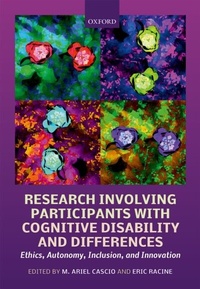
Research Involving Participants with Cognitive Disability and Differences
Ethics, Autonomy, Inclusion, and Innovation
1st Edition
Published on 5. September 2019
304 pages
978-0-19-255769-8 (ISBN)
Description

Research participants who have cognitive disabilities and differences may be considered a vulnerable population. At the same time, they should also be empowered to participate in research in order to foster the growth of knowledge and the improvement of practices. For research participants with cognitive disabilities or differences, participating in research that concerns them follows the Disability Rights Movement's call "Nothing About Us Without Us" and is a vital component of the principle of justice. However, cognitive disabilities and differences may pose challenges to ethical research, particularly with respect to the research ethics principle of autonomy, for a variety of reasons. Several alternative or modified strategies, for example when obtaining informed consent, have been used by researchers.
This volume provides timely, multidisciplinary insights into the ethical aspects of research that includes participants with cognitive disability and differences. These include conditions such as intellectual disability, autism, mild cognitive impairment (MCI), and psychiatric diagnoses. The chapters in this volume describe situations where difficulties arise, explore strategies for empowerment and inclusion, drawing on both empirical and normative research to offer suggestions for research design, research ethics, and best practices that empower people with cognitive disabilities and differences to participate in research while respecting and managing potential coercion or undue influence.
The book includes contributions from scholars in anthropology, sociology, ethics, child studies, health and rehabilitation sciences, philosophy, and law who address these issues in both clinical and social/behavioural research. The book will be valuable for anyone performing research involving these populations - from the fields of neuropsychology, neurology, psychiatry, and neuroscience.
More details
Other editions
Additional editions
M. Ariel Cascio | Eric Racine
Research Involving Participants with Cognitive Disability and Differences
Ethics, Autonomy, Inclusion, and Innovation
Book
09/2019
Oxford University Press
€87.60
Shipment within 15-20 days
Persons
M. Ariel Cascio, PhD, is a postdoctoral researcher at the Pragmatic Health Ethics Research Unit of the Institut de recherches cliniques de Montréal with a Ph.D. in Anthropology from Case Western Reserve University. Cascio's research focuses on social and ethical issues related to autism, including developing guidelines for person-oriented autism research ethics through a collaborative project with autistic self-advocates, parents, researchers, professionals, and advocacy organization representatives.
Eric Racine, PhD, is Director of the Pragmatic Health Ethics Research Unit and Full Research Professor at the Institut de recherches cliniques de Montréal (IRCM), Canada with joint appointments at the Université de Montréal and McGill University. Inspired by philosophical pragmatism, his research aims to understand and bring to the forefront the experience of ethically problematic situations encountered by patients and stakeholders in order to resolve them collaboratively through deliberative and evidenced-informed processes. He has published over 150 peer reviewed publications in leading journals in the social sciences (e.g., Social Science & Medicine; Public Understanding of Science), bioethics (e.g., Bioethics, American Journal of Bioethics), neuroscience (e.g., Pain, Neuron, Nature Reviews Neuroscience), and clinical medicine and neurology (e.g., Neurology, Lancet Neurology).
Content
- Section I: Conceptual Frameworks
- 1: Lauren Sankary and Paul Ford: Ongoing consent in situations of cognitive vulnerability: Special considerations in implanted neural device trials
- 2: Megan Wright: Who Decides? Legal Changes to Facilitate Inclusion of Participants with Impaired Cognition in Research
- 3: Britteny Howell and Karrie Shogren: Differing Understandings of Informed Consent Held by Research Institutions, People with Intellectual Disability, and Guardians: Implications for Inclusive, Ethical Research
- 4: Deborah Barnbaum: Research Cohorts: Diverse Research Subjects, Similar Remedies to Errors in Consent
- 5: Kenneth A Richman: Autism, Autonomy, and Research
- Section II: Challenges
- 6: Stephanie Patterson and Pamela Block: Disability, Vulnerability, and the Capacity to Consent
- 7: Mackenzie Salt: REB/IRB Variability and Other Ethical Challenges in Multi-site Research Involving Participants on the Autism Spectrum
- 8: Leonardo Campoy: Bridging worlds: can anthropology be a communicational therapy?
- 9: Christine Schneider and Eva Kahana: Challenges of Participating in Research about Living with MCI among Disabled Veterans
- 10: Vanessa Cox, Treena Orchard, Pamela Cushing, and Elizabeth Anne Kinsella: Mediators of Inclusion: Challenges to Including Adults with Mild Intellectual Disability in Qualitative Research
- 11: Jack Trammell: Shifting Identities: Research on Macro and Micro Aspects of ID College Programs
- Section III: Successes
- 12: Marjorie Montreuil, Gail Teachman, and Franco Carnevale: Recognizing the voices of children with 'cognitive impairments' in research
- 13: Eran Klein: Informed consent for closed-loop DBS psychiatric research: Engaging end users to understand risks and improve practice
- 14: Saira A. Mehmood: Using Ethnographic Methods to Determine Capacity to Consent amongst Individuals Diagnosed with Chronic Mental Illnesses
- 15: John Aspler: Making research more ethical for adults with FASD: A story of stakeholder engagement, accommodation, and inclusion
- 16: Virginie Cobigo, Lynne A. Potvin, Casey Fulford, Hajer Chalghoumi, Mariam Hanna, Natasha Plourde, and Whitney Taylor: A conversation with research ethics boards about inclusive research with persons with intellectual and developmental disabilities
- 17: Anne Kohler: Assuming Competency
- Section IV: Commentaries
- 18: Laura Dunn and Paul Holzheimer: Commentary on: "Informed consent for next generation DBS psychiatric research: Engaging end users to understand risks and improve practice"
- 19: Caitlin Courchesne and Judy Illes: Response to Sankary and Ford: Ongoing Consent for the Inverse Problematic to Loss of Capacity
- 20: Jack Trammell: Differing Understandings of Informed Consent
- 21: Deborah Barnbaum: 18. Comments on Britteny M. Howell and Karrie A. Shogren's "Differing Understandings of Informed Consent Held by Research Institutions,People with Intellectual Disability, and Guardians: Implications for Inclusive, Ethical Research"
- 22: Deborah Barnbaum: 18. Comments on Kenneth A. Richman's "Autism, Autonomy, and Research"
- 23: Allison Bloom: Commentary
- 24: Megan Wright: Repurposing Ethnography to Assess Consent Capacity
- 25: Jack Trammell: Using Ethnographic Methods
- 26: Anne Kohler and Ben Majewski: Commentary on Assuming Capacity: Ethical Participatory Research with Adolescents and Adults with Down Syndrome
- 27: Leonard Campoy: What stories tell? In praise of anthropology
- 28: Melissa Park and Donald Fogelberg: Commentary on Bridging Worlds: Can Anthropology be a Communication Therapy?
- 29: Eric Racine: Toward a research (ethics) culture of inclusion and participation
- 30: M. Ariel Cascio: 18. Vulnerability, empowerment, and dissent - The importance of saying no
