

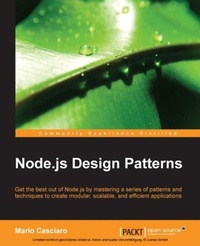
Node.js Design Patterns
Master a series of patterns and techniques to create modular, scalable, and efficient applications
1st Edition
Published on 3. June 2024
454 pages
978-1-78328-732-1 (ISBN)
Description

Get the best out of Node.js by mastering a series of patterns and techniques to create modular, scalable, and efficient applicationsKey Features - Dive into the core patterns and components of Node.js in order to master your application's design
- Learn tricks, techniques, and best practices to solve common design and coding challenges
- Take a code-centric approach to using Node.js without friction
Book DescriptionNode.js is a massively popular software platform that lets you use JavaScript to easily create scalable server-side applications. It allows you to create efficient code, enabling a more sustainable way of writing software made of only one language across the full stack, along with extreme levels of reusability, pragmatism, simplicity, and collaboration. Node.js is revolutionizing the web and the way people and companies create their software. In this book, we will take you on a journey across various ideas and components, and the challenges you would commonly encounter while designing and developing software using the Node.js platform. You will also discover the "Node.js way" of dealing with design and coding decisions. The book kicks off by exploring the fundamental principles and components that define the platform. It then shows you how to master asynchronous programming and how to design elegant and reusable components using well-known patterns and techniques. The book rounds off by teaching you the various approaches to scale, distribute, and integrate your Node.js application.What you will learn - Design and implement a series of server-side JavaScript patterns so you understand why and when to apply them in different use case scenarios
- Understand the fundamental Node.js components and use them to their full potential
- Untangle your modules by organizing and connecting them coherently
- Reuse well-known solutions to circumvent common design and coding issues
- Deal with asynchronous code with comfort and ease
- Identify and prevent common problems, programming errors, and anti-patterns
Who this book is forIf you're a JavaScript developer interested in a deeper understanding of how to create and design Node.js applications, this is the book for you.
- Learn tricks, techniques, and best practices to solve common design and coding challenges
- Take a code-centric approach to using Node.js without friction
Book DescriptionNode.js is a massively popular software platform that lets you use JavaScript to easily create scalable server-side applications. It allows you to create efficient code, enabling a more sustainable way of writing software made of only one language across the full stack, along with extreme levels of reusability, pragmatism, simplicity, and collaboration. Node.js is revolutionizing the web and the way people and companies create their software. In this book, we will take you on a journey across various ideas and components, and the challenges you would commonly encounter while designing and developing software using the Node.js platform. You will also discover the "Node.js way" of dealing with design and coding decisions. The book kicks off by exploring the fundamental principles and components that define the platform. It then shows you how to master asynchronous programming and how to design elegant and reusable components using well-known patterns and techniques. The book rounds off by teaching you the various approaches to scale, distribute, and integrate your Node.js application.What you will learn - Design and implement a series of server-side JavaScript patterns so you understand why and when to apply them in different use case scenarios
- Understand the fundamental Node.js components and use them to their full potential
- Untangle your modules by organizing and connecting them coherently
- Reuse well-known solutions to circumvent common design and coding issues
- Deal with asynchronous code with comfort and ease
- Identify and prevent common problems, programming errors, and anti-patterns
Who this book is forIf you're a JavaScript developer interested in a deeper understanding of how to create and design Node.js applications, this is the book for you.
More details
Other editions
New editions
Mario Casciaro | Luciano Mammino
Node.js Design Patterns
Master best practices to build modular and scalable server-side web applications
E-Book
06/2024
2nd Edition
Packt Publishing Limited
€34.99
Available for download
Additional editions
Person
Casciaro Mario :
Mario Casciaro is a software engineer and entrepreneur, passionate about technology, science and open source knowledge. Mario graduated with a master's degree in software engineering and started his professional career at IBM where he worked for several years on different enterprise products such as Tivoli Endpoint Manager, Cognos Insight, and SalesConnect. Next, he moved to D4H Technologies, a growing SaaS company, to lead the development of a new bleeding-edge product for managing emergency operations in real time. Currently, Mario is the co-founder and CEO of Sponsorama.com, a platform to help online projects raise funds through corporate sponsorship. Mario is also the author of the first edition of Node.js Design Patterns.
Mario Casciaro is a software engineer and entrepreneur, passionate about technology, science and open source knowledge. Mario graduated with a master's degree in software engineering and started his professional career at IBM where he worked for several years on different enterprise products such as Tivoli Endpoint Manager, Cognos Insight, and SalesConnect. Next, he moved to D4H Technologies, a growing SaaS company, to lead the development of a new bleeding-edge product for managing emergency operations in real time. Currently, Mario is the co-founder and CEO of Sponsorama.com, a platform to help online projects raise funds through corporate sponsorship. Mario is also the author of the first edition of Node.js Design Patterns.
Content
Table of Contents - Node.js Design Fundementals
- Asynchronous control flow patterns
- Coding with streams
- Design patterns
- Writing modules
- Recipes
- Scalability and Architectural Patterns
- Messaging and Intergration Patterns
- Asynchronous control flow patterns
- Coding with streams
- Design patterns
- Writing modules
- Recipes
- Scalability and Architectural Patterns
- Messaging and Intergration Patterns
