

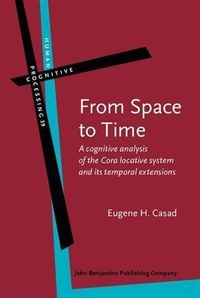
From Space to Time
A cognitive analysis of the Cora locative system and its temporal extensions
1st Edition
Published on 19. December 2012
XXVII, 263 pages
978-90-272-7324-6 (ISBN)
Description

Eugene Casad's posthumous monograph is an in-depth study of the TIME IS SPACE metaphor in Cora - an Uto-Aztecan language spoken in the state of Nayarit, Mexico - within the framework of Ronald Langacker's Cognitive Grammar. The author provides an introduction to Cora speakers and their history, and traces the evolution of Cora locative expressions, comparing them with cognate or corresponding expressions in other Uto-Aztecan languages, e.g. Huichol, to reconstruct the development of Cora temporal meanings. Based on a meticulous analysis of synchronic and diachronic data, Casad postulates distinct Cora models of time, grammatical aspect, and event structure, among which the topographically based model of time is especially prominent. This important book can be regarded as the opus magnum of the author. It should be of interest to scholars working in conceptual metaphor theory, grammaticalization, and the history and typology of Uto-Aztecan languages.
More details
Other editions
Additional editions
Eugene H. Casad | Klaus-Uwe Panther | Linda L. Thornburg
From Space to Time
A cognitive analysis of the Cora locative system and its temporal extensions
Book
12/2012
John Benjamins Publishing Co
€100.70
Shipment within 10-15 days
Persons
Content
- From Space to Time
- Editorial page
- Title page
- LCC data
- Eugene Homer Casad
- Table of contents
- List of figures
- List of tables
- List of maps
- Abbreviations
- Author's preface
- Editors' preface
- References
- Prologue
- Introduction
- Part 1. Background and orientation
- Chapter 1. The Cora people and their language
- Chapter 2. Theoretical prerequisites
- 2.1 Introduction
- 2.2 Overview of Cognitive Grammar
- 2.3 Aspects of imagery and construal
- 2.4 Semantic domains
- 2.5 Figure and ground relations
- 2.5.1 Characterizing figure/ground organization
- 2.5.2 The linguistic side of figure/ground organization
- 2.6 Reference point constructions
- 2.7 Grounding
- 2.8 The viewing arrangement
- 2.9 Grammaticalization processes
- 2.9.1 Overview of grammaticalization
- 2.9.2 Meillet as innovator of the term 'grammaticalization
- 2.9.3 The Cora bi-verbal construction
- 2.9.4 Heine and Reh (1984)
- Part 2. The emergence of the Cora locative system
- Chapter 3. Inventory of Cora and Huichollocative prefixes
- 3.1 Introduction
- 3.1.1 Cora and Huichol sound correspondences
- 3.1.2 Corachol vowel correspondences
- 3.2 Cora and Huichol prefixes: Historical background
- 3.3 The eleven Huichol prefixes vis-à-vis Cora
- 3.3.1 Huichol e- 'ablative' and a- 'allative'
- 3.3.2 Huichol and Cora na- and nu-
- 3.3.3 Huichol ye- and Cora ra-
- 3.4 Locative-directional prefixes unique to Cora
- 3.4.1 Cora ablative uu-
- 3.4.2 Huichol a- allative and Cora ii- allative
- 3.4.3 Cora ve'e- 'covering a surface' or 'coming this way'
- 3.4.4 Cora re'e- 'back and forth'
- 3.4.5 Cora tya- 'in the middle'
- Chapter 4. Emergence of some Cora locative prefixsequences
- 4.1 Introduction
- 4.2 Cora locative particle and clitic sources
- 4.3 Cora locative procomplement aúu and subordinator a'u
- 4.3.1 Typical usages of the procomplement aúu
- 4.3.2 Typical usages of the locative subordinator á'u
- 4.4 Cora topographic particles and adverbs
- 4.5 Cora -h and an-: Historical evidence from Uto-Aztecan
- 4.5.1 Evidence from Southern Tepehuan
- 4.5.2 Evidence from Tohono O'odham
- 4.5.3 Evidence from Náhuatl
- 4.6 Cora a-ná- and a-nú-: Adverbial demonstrative source
- 4.6.1 Huichol adverbial demonstratives
- 4.6.2 O'odham adverbial demonstratives
- 4.6.3 Yaqui adverbial demonstratives
- 4.7 Cliffs, innards, and metonymies
- 4.7.1 Where did Huichol directional -pa-i go?
- 4.7.2 Cora u-rá- and Southern Tepehuan temporals
- 4.7.3 A pair of downers: a-ká and u-ká
- 4.8 Emergence of Cora topographical adverbs
- 4.9 Verbal locative prefix sequences from Proto-Corachol
- Part 3. From space to time
- Chapter 5. Cora temporals
- 5.1 Introduction
- 5.2 Tense-aspect and clausal subordinators
- 5.3 Temporal use of the conditional
- 5.4 Sectors of the day and night cycle
- 5.5 Temporal uses of quantifiers
- 5.6 The temporal verb ha'atyéevi'i
- 5.7 Complex temporal expressions with postpositions
- Chapter 6. Space, events, and time in Cora
- 6.1 Introduction
- 6.2 Topography-based models of time
- 6.2.1 The distal form áhka'i
- 6.2.2 The medial form máhka'i
- 6.2.3 The verb antyipwá'araka'a
- 6.3 The horizontal movement of time
- 6.3.1 Time viewed perfectively
- 6.3.2 Heightened perfective wa-ta-
- 6.3.3 Intentive uu-
- 6.3.4 The complex path perfective
- 6.4 Time viewed imperfectively
- 6.5 Time viewed cyclically
- 6.6 Time stands back to back
- Chapter 7. Time and the sequencing of events
- 7.1 Introduction
- 7.2 Normal sequence of events A and B
- 7.3 Closure of sequence of events
- 7.4 Event B immediately following event A
- 7.5 The 'instrumental precipitous action' construction
- 7.6 The 'delayed temporal succession' scenario
- 7.6.1 Short delay: ha'a¢ú plus main verb
- 7.6.2 Longer delay: The temporal verb ha'atyéevi'i
- 7.7 Events that form a natural sequence
- 7.8 Immediate succession of days
- Chapter 8. Grammatical constructions and theirtemporal usages
- 8.1 Introduction
- 8.2 Event B encounters pre-existing condition A
- 8.3 Repetitive senses of time
- 8.4 Remote time
- 8.5 Another view of time: 'no longer' and others
- 8.6 Beginnings, endings, and spans of days and months
- 8.7 Events and their interrelations across clause/sentence boundaries
- 8.8 Temporal grounding via the bi-verbal construction
- 8.9 Definite and indefinite temporals
- Notes
- References
- Name index
- Subject index
