

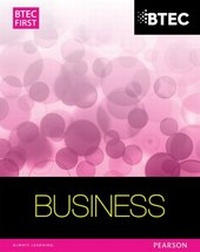
BTEC First Business Student Book
1st Edition
Published on 2. February 2017
448 pages
978-1-292-19013-6 (ISBN)
Description

Resources designed to support learners of the new next generation BTEC First in Business specification*. Covers three mandatory units and a wide selection of optional units. Each unit of the Student Book is presented in topics to ensure the content is accessible and engaging for learners. Covers all the underpinning knowledge and understanding needed at level 2 to ensure that learners are fully prepared for this course. Activities in each unit provide support and clear direction for learners and can be used in the classroom or for independent work. New Assessment Zone guides learners through both internal and external assessment. Practice assignments and assessment guidance will help learners to achieve their potential in internally assessed units.* From 2012, Pearsons BTEC First qualifications have been under re-development, so schools and colleges could be teaching the existing 2010 specification or the new next generation 2012-2013 specification. There are different Student Books to support each specification. If learners are unsure, they should check with their teacher or tutor.
More details
Other editions
Additional editions
Carol Carysforth | Mike Neild | Karen Glencross
BTEC First Business Student Book
Book
06/2013
Pearson Education Limited
€38.00
Article not available at the moment
Content
- Cover
- Contents
- About this book
- How to use this book
- Study skills
- Unit 1: Enterprise in the Business World
- A1: Finding information
- Sources of information
- Reliability of sources
- A2: Factors to consider in the current business environment
- National factors
- Local factors
- Impact of factors
- A3: Trends affecting business
- Social trends
- Technology trends
- Environmental trends
- Ethical trends
- A4: Size of business and type
- Types of business
- B1: How business ideas can be successful
- Successful business ideas
- B2: Business ideas
- Researching the market
- Selecting a product or service
- Targeting customers
- Meet the needs of your target customer
- Benefits versus features
- B3: Assessing the suitability of a business idea
- The resources required
- Selecting the most appropriate idea
- Likelihood of success or failure
- Identification of major barriers to entry
- B4: Producing an initial plan for a business idea
- What is a rationale?
- Supporting evidence
- C1: Choice of business format
- Social enterprises
- C2: Sources of help and support in developing a new business
- Sources of help
- Support networks
- C3: Business model
- Unit 2: Finance for Business
- A1: Understand the costs involved in business
- Understand and identify the costs of a business
- Understand, define and identify different types of running costs
- A2: Understand how businesses make a profit
- Understanding revenue
- Understanding expenditure
- Understanding profit
- B 1: Understand the planning tools businesses use to predict when they will start making a profit
- Calculating break-even point using a formula
- Break-even charts
- Present break-even information graphically
- Analyse the effect on the break-evenpoint if the figures change
- The importance of break-even analysis and risks of ignoring it
- B2: Understand the tools businesses use to plan for success
- The purpose of budgeting
- Budgeting and budgetary control
- Cash flow forecasting
- The purpose of cash flow forecasting
- Cash inflows and outflows
- The purpose of a cash flow forecast
- Impact of timings of inflows and outflows
- The benefits of cash flow forecasts and risks of not completing them
- Completing and analysing a cash flow forecast
- C1: Understand how businesses measure success
- Making a profit
- Looking at financial statements
- Income statement (profit and loss account)
- Statement of financial position (balance sheet)
- Preparing a statement of financial position
- C2: Understand how businesses can be more successful
- Identify ways in which a business can increase profits
- Analyse financial statements and suggest actions to take
- Unit 3: Promoting a Brand
- A1: The importance of branding to businesses
- What is a brand?
- Why businesses use branding
- Types of branding
- Adding value
- Benefits of successful branding
- Unsuccessful branding
- A2: Promotion in businesses
- Why businesses need to promote themselves
- Activities used in the marketing mix
- Benefits of promotion to businesses
- A3: Elements of the promotional mix and their purposes
- Advertising
- Sales promotion
- Personal selling
- Public relations activities
- Direct marketing
- A4: Promotional activities in business
- Types of market
- Market segmentation
- The use of promotional activities in business
- The AIDA model
- B1: Branding methods and techniques
- Planning ideas for a brand for a business
- B2: Promoting a brand
- Promoting a brand image
- Planning a promotional campaign
- Unit 4: Principles of Customer Service
- A1, A2 & A3: Customer service in business
- The meaning of customer service
- Different customer service roles in a business
- The different types of customer service businesses have
- A4 & A5: Providing customer service
- Customer satisfaction
- Consistent and reliable customer service
- A6 & A7: Good customer service and customer expectations
- The effect of good customer service
- Different ways of exceeding customer expectations
- A8: Providing effective customer service
- Organisational procedures
- The purpose of organisational procedures
- A9: Customer service requirements
- Complying with legislative and regulatory requirements
- B1: Who are your customers?
- Customers
- Factors that impact on different customer service expectations
- B2: Customer service skills
- Skills required to deliver consistent and reliable customer service
- B3: Customer service skills
- Developing customer service skills
- B4: Limits of authority and customer queries
- Unit 5: Sales and Personal Selling
- A1: The role of sales staff
- Selling
- Providing information
- Dealing with routine enquiries
- Representing the organisation
- A2 & A3: Knowledge and skills
- What knowledge and skills do sales people need?
- A4: The process of personal selling
- B1: Demonstrate personal selling skills
- Preparing for the sales process
- Maintaining an appropriate appearance
- Maintaining an appropriate attitude
- Dealing with different types of customers
- Communicating with customers
- Different types of communication
- Closing techniques
- Preparing the sales area
- Awareness of personal space
- B2: Demonstrate personal selling processes
- Recording information
- Closing techniques
- Customer care and after-sales services
- Dealing with enquiries
- Handling complaints or problems
- Overcoming barriers to closing the sale
- Repeat sales
- Up-selling
- Liaison with other departments
- Methods of recording
- Unit 6: Introducing Retail Business
- A1: The nature of retailing
- What is retail?
- Wholesalers and manufacturers
- The supply chain
- Retail channels
- A2 & A3: Sub-sectors and ownership
- Retail sub-sectors
- Retail business ownership
- A4: Retail outlets
- Organising retailers by size
- Types of retail outlet
- A5 & A6: Aspects of retailing
- Non-outlet retailing
- Location
- A7 & A8: What makes retail businesses function?
- Jobs in retail business
- Supporting retail business
- A9 & A10: Retail targets and performance
- Aims and objectives
- Measuring performance
- B1: Retail business in the UK
- Retail business and the external environment
- The benefits of retail developments to communities and customers
- B2: Doing business with the rest of the world
- The relationship between UK retailers and international markets
- Unit 7: Providing Business Support
- A1 & A2: Providing business support
- Types of support
- The purpose of providing business support
- B1: Using office equipment for different purposes
- Types of office equipment
- B2: Working safely
- Using office equipment safely
- C1 & C2: Organising and providing support for meetings
- Types of meeting
- Organising meetings
- C3 & C4: Supporting meetings and following up meetings
- Supporting tasks
- Follow-up activities
- Other tasks
- Unit 8: Recruitment, Selection and Employment
- A1: Organisational structures and functional areas
- Understanding organisational structures
- A1: Functional areas
- Sales
- Production
- Purchasing
- Administration
- Customer service
- Distribution
- Finance
- Human resources (HR)
- ICT (Information and Communications Technology)
- Marketing
- Research and development (R & D)
- A1: Purposes of functional areasand links between them
- Supporting business aims and objectives
- Links between functional areas
- A2: Job roles and responsibilities
- What do people at these levels do?
- Impact on roles of different organisational structures
- B1: Recruitment
- Why vacancies arise in a business
- Ways of recruiting staff
- Types of recruitment
- Cost and legal considerations
- B2, B3 & B.4: Job descriptions and person specifications
- Contents of a job description
- Contents of a person specification
- B5: Applying for jobs
- Application forms
- Curriculum vitae
- Letters of application
- Other requirements
- Pre-application tests
- Next steps after applying for a job
- C1: Job interviews
- Before the interview
- Behaviour during the interview
- C2: Personal audit
- Personal audit
- C3: Career development
- Information and advice
- Developing a career plan
- Unit 9: Principles of Marketing
- A1: Principles of marketing
- Defining marketing
- The importance of marketing
- How businesses use marketing
- Marketing and corporate objectives
- SMART objectives
- A2: What is a market?
- Types of market
- Related market activities
- Different types of markets
- Business models
- Business orientation and choice of model
- A3: Principles of branding
- The distinctive nature of branding
- The different dimensions of a distinctive brand
- The benefits of building brands
- B1: Researching the market
- Types and sources of data
- The uses of different types of data
- The use and benefits of situational analysis
- B2: Using market research in businesses
- Understand the purpose of research and analysis
- B3: The value of market research to businesses
- Interpreting key research findings
- The desirability of different levels of market share
- PESTLE analysis
- C1: The 4 Ps of the marketing mix
- Product
- Price
- Elasticity of demand
- Place
- Promotion
- Consistency and the marketing mix
- The difference between ebusiness and ecommerce
- Benefits of ebusiness and ecommerce
- C2: Factors affecting the marketing mix
- Influences on the marketing mix
- Evaluating the effectiveness of a marketing mix
- Unit 10: Using Business Documentation
- A1: The purpose of written communication in business contexts
- Purposes and formats of different types of business documents
- A2: Business contexts and business documents
- Formal and informal documents used in a business context
- The influence of internal audiences, external stakeholders and the public
- Selecting appropriate documents to meet the business context
- Impact of effective and ineffective written communication in businesses
- B1: Planning and selecting appropriate business documents
- C1: Produce business documents for communication in a business
- Steps involved in producing business documents
- C1: Document conventions
- Memos and emails
- Notices and reports
- Business letters
- Unit 11: Building Successful Business Teams
- A1: Effective teams
- What is a team?
- A1: What makes a team effective?
- Characteristics
- Stages in team development
- A1: Team roles
- Belbin's Team Roles
- A2: Effective teamworking
- Team behaviours
- The benefits of effective team working
- B1: Roles and responsibilities of the team leader
- Team leader responsibilities
- How the team leader contributes to overall effectiveness
- B2: Attributes and qualities of an effective leader
- C1: Effective teamworking skills
- Teamworking skills
- Potential barriers to effective team performance
- C2: Developing effective teamworking skills
- Unit 12: Introducting Law and Consumer Rights
- A1: Role of civil law and its courts
- Civil law
- Civil courts
- Civil procedure
- Case management
- Alternative methods of resolving disputes and their uses
- A2: Role of criminal law and its courts
- Criminal law
- Criminal courts
- The adversarial system
- Types of offence
- Bail or remand
- Mode of trial
- At the trial
- A3: Working in the law
- B1: How contract and negligence relate to consumers
- Contract
- Negligence
- B2: How legislation protects consumers
- Contracts for the sale of goods
- Contracts for the provision of services
- Negligence or defective goods
- Breaches of criminal law
- C1: Situations and legal remedies
- Situations where consumers may have a legal claim
- The rights and duties of buyers and sellers
- Remedies and their benefits
- Unit 13: Financial Planning and Forecasting
- A1: Calculating breakeven
- The concept of breakeven
- Definition of breakeven point
- Methods of calculating breakeven
- A2: Breakeven analysis
- The concept of breakeven analysis
- Identifying areas of profit and loss
- Margin of safety
- Costs (fixed, variable, total)
- Contribution
- Total revenue
- Presenting and interpreting breakeven information graphically
- The relevance of breakeven analysis to a business
- B1: Preparing a cash flow forecast
- Identifying cash inflows
- Identifying cash outflows
- Cash balances
- B2: Analysing a cash flow forecast
- The purpose of analysing a cash flow forecast
- How cash flow forecasting can be used to manage business finances
- C1: The use of budgets in business
- The purpose of budgets in business
- Types of business budgets and their differences
- C2: Controlling budgets
- Budgetary control
- How budgetary control is used in businesses
- The benefits of budgetary control for a business
- C3: Using variance analysis to inform business decisions
- The concept of variance
- The concept of variance analysis
- Identifying favourable and adverse variances
- The cause and significance of variances
- How variances affect business decisions
- Unit 14: Business Online
- A1: Online business activity
- Range of online business activities
- Types of online presence
- Types of activity
- Complementing offline activities
- Types of website
- A2: Doing business online
- Purpose of doing business online
- Achievement of business aims and objectives
- Provision of effective communication
- The customer interface
- Relationship marketing
- Advantages and disadvantages of having an online presence
- How businesses operate online
- Market presence
- A3: Researching trends and changes in the online business environment
- Changes in media format including the growth of social media
- The impact of growth of social media on online business activity
- Changes in technology
- Online advertising
- Effect of the current online business environment on the achievement of business aims
- B1: Planning and implementation
- B2: Operational risks
- B3: Staffing
- B4: Finance
- B5: Distribution
- C1: Using a website to operate a business online
- Why businesses use websites
- C2: Types and features of business websites
- Types of websites
- Platforms and compatibility
- Construction features
- Interactive features
- Aesthetics
- C3: User experience of websites
- How features improve user experience
- D1: Design a website to meet a client brief
- Planning the design of a website to meet a business need
- D2: Ensuring that a client brief is met
- Feedback from others
- Assessing the suitability of the website
- The importance of revising website designs
- Unit 17: Visual Merchandising in Retail Business
- A1: Visual merchandising activities
- A2: How size and sub-sector affect visual merchandisers
- The effect of size
- The effect of sub-sectors
- A3: Responsibilities of visual merchandisers
- B1: Visual merchandising techniques
- Psychological techniques
- Display techniques
- Visual techniques
- B1: Visual merchandising tools
- B2: Using visual merchandising techniques and tools successfully
- Benefits of successful visual merchandising
- C1 & C2: Apply visual merchandisingtechniques
- Supporting design ideas
- Planning a positive retail environment
- Planning a positive retail environment
- C3: Designing a product display
- Realistic product display designs
- Links to existing planograms
- Glossary
- Index
