

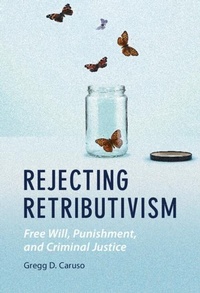
Rejecting Retributivism
Free Will, Punishment, and Criminal Justice
Published on 5. May 2021
402 pages
978-1-108-75480-4 (ISBN)
Description

Within the criminal justice system, one of the most prominent justifications for legal punishment is retributivism. The retributive justification of legal punishment maintains that wrongdoers are morally responsible for their actions and deserve to be punished in proportion to their wrongdoing. This book argues against retributivism and develops a viable alternative that is both ethically defensible and practical. Introducing six distinct reasons for rejecting retributivism, Gregg D. Caruso contends that it is unclear that agents possess the kind of free will and moral responsibility needed to justify this view of punishment. While a number of alternatives to retributivism exist - including consequentialist deterrence, educational, and communicative theories - they have ethical problems of their own. Moving beyond existing theories, Caruso presents a new non-retributive approach called the public health-quarantine model. In stark contrast to retributivism, the public health-quarantine model provides a more human, holistic, and effective approach to dealing with criminal behavior.
Reviews / Votes
'Caruso mounts a series of robust challenges not just to retributivism (his main target) but also to other recent attempts to provide justifying rationalisations of the institution of criminal punishment: the most striking and original of these are the metaphysical and epistemological challenges that he grounds in scepticism about free will and desert. He then develops, in impressive and empirically informed detail, an alternative, 'public health-quarantine' model of crime prevention, grounded in part on the right of self-defence. This aims not only to provide more humanely effective ways of preventing crime, but also to serve the aims of social justice, and to ensure a proper respect for the interests and the dignity of offenders. Those who want to defend the practice of criminal punishment will need to meet Caruso's challenges, while those who wonder whether and how we could do without this practice will find imaginative food for thought in his proposals.' Antony Duff, University of Minnesota 'The question for anyone skeptical, as I am, about the possibility of free will is whether there is a morally acceptable alternative to retributive punishment. Caruso's Rejecting Retributivism takes the 'quarantine' approach ... and provides its first full statement and defense. The proposal is to understand crime control as a public health measure, justified as a form of self-defense and defense of others and limited by a capabilities approach to autonomy. It is a first rate study of the problem and the solution, and I recommend it to anyone concerned about the future of criminal justice.' Michael Corrado, University of North Carolina, Chapel Hill 'In this compelling and thoroughly researched book, Caruso proposes an account for the treatment of criminals that opposes the two most widespread justifications for criminal punishment, retributivism and general deterrence theory. In their place, he proposes incapacitation justified by the right to self-defense and defense of others. Caruso embeds this account within a public health model, which shifts the focus of criminology to identifying and addressing the social determinants of crime. Caruso's proposal, if implemented, would thoroughly reform the criminal justice system as it exists in many jurisdictions today. A truly impressive achievement.' Derk Pereboom, Cornell University '... Caruso's model challenges us to rethink, from top to bottom, our assumptions about who we fundamentally are, our conceptions of justice, and the justifications for punishment. He's marshalled an impressive array of arguments and evidence to expand the options for criminal justice reform from a progressive, naturalistic perspective.' Tom Clark, Naturalism '... remarkably thorough, well organized, and lucid ... Highly recommended.' J. Glick, Choice 'While debates over penal theory can seem intractable, Caruso offers a refreshingly original account. His model is the most comprehensive defence of a pro-rehabilitative position arguing for seeing criminal justice as a public health issue that I have seen in very many years and I welcome it. ... this is an important work that should be of great interest to penal scholars and policy makers.' Thom Brooks, Ethical Theory and Moral PracticeMore details
Series
Language
English
Place of publication
Cambridge
United Kingdom
Target group
Professional and scholarly
Illustrations
Worked examples or Exercises
File size
9,94 MB
ISBN-13
978-1-108-75480-4 (9781108754804)
Copyright in bibliographic data and cover images is held by Nielsen Book Services Limited or by the publishers or by their respective licensors: all rights reserved.
Schweitzer Classification
Other editions
Additional editions
Book
04/2021
Cambridge University Press
€141.30
Shipment within 15-20 days
Content
Acknowledgments; 1. Free will, legal punishment, and retributivism; 2. Free will skepticism: hard incompatibilism and hard luck; 3. The epistemic argument against retributivism; 4. Additional reasons for rejecting retributivism; 5. Consequentialist, educational, and mixed theories of punishment; 6. Public health-quarantine model I: a non-retributive approach to criminal behavior; 7. Public health-quarantine model II: the social determinants of health & criminal behavior; 8. Public health-quarantine model iii: human dignity, victims' rights, rehabilitation, and preemptive incapacitation; 9. Public health-quarantine model IV: funishment, deterrence, evidentiary standards, and indefinite detention; References; Index.
