

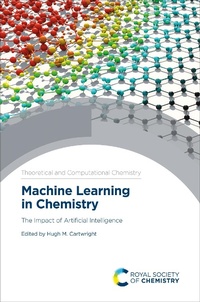
Machine Learning in Chemistry
The Impact of Artificial Intelligence
1st Edition
Published on 15. July 2020
546 pages
978-1-83916-024-0 (ISBN)
Description

Progress in the application of machine learning (ML) to the physical and life sciences has been rapid. A decade ago, the method was mainly of interest to those in computer science departments, but more recently ML tools have been developed that show significant potential across wide areas of science. There is a growing consensus that ML software, and related areas of artificial intelligence, may, in due course, become as fundamental to scientific research as computers themselves.
Yet a perception remains that ML is obscure or esoteric, that only computer scientists can really understand it, and that few meaningful applications in scientific research exist. This book challenges that view.
With contributions from leading research groups, it presents in-depth examples to illustrate how ML can be applied to real chemical problems. Through these examples, the reader can both gain a feel for what ML can and cannot (so far) achieve, and also identify characteristics that might make a problem in physical science amenable to a ML approach.
This text is a valuable resource for scientists who are intrigued by the power of machine learning and want to learn more about how it can be applied in their own field.
Yet a perception remains that ML is obscure or esoteric, that only computer scientists can really understand it, and that few meaningful applications in scientific research exist. This book challenges that view.
With contributions from leading research groups, it presents in-depth examples to illustrate how ML can be applied to real chemical problems. Through these examples, the reader can both gain a feel for what ML can and cannot (so far) achieve, and also identify characteristics that might make a problem in physical science amenable to a ML approach.
This text is a valuable resource for scientists who are intrigued by the power of machine learning and want to learn more about how it can be applied in their own field.
More details
Series
Language
English
Place of publication
Cambridge
United Kingdom
Target group
Professional and scholarly
Product notice
Reflowable
ISBN-13
978-1-83916-024-0 (9781839160240)
DOI
10.1039/9781839160233
Copyright in bibliographic data and cover images is held by Nielsen Book Services Limited or by the publishers or by their respective licensors: all rights reserved.
Schweitzer Classification
Other editions
Additional editions
Book
07/2020
Royal Society of Chemistry
€230.50
Shipment within 3-4 weeks
Person
Hugh Cartwright is a computational chemist, now retired. He spent almost three decades as a member of the Chemistry Faculty at Oxford University in the U.K., where his research focussed on the application of Artificial Intelligence related methods to problems in science, using Artificial Neural Networks, Genetic Algorithms, Self-Organising Maps and Support Vector Machines.
He has written or edited several texts on the use of Artificial Intelligence in science, including Applications of Artificial Intelligence in Chemistry, and Using Artificial Intelligence in Chemistry and Biology: a Practical Guide.
He has written or edited several texts on the use of Artificial Intelligence in science, including Applications of Artificial Intelligence in Chemistry, and Using Artificial Intelligence in Chemistry and Biology: a Practical Guide.
Content
Computers as Scientists;
How Do Machines Learn?;
MedChemInformatics: An Introduction to Machine Learning for Drug Discovery;
Machine Learning for Nonadiabatic Molecular Dynamics;
Machine Learning in Science - A Role for Mechanical Sympathy?;
A Prediction of Future States: AI-powered Chemical Innovation for Defense Applications;
Machine Learning for Chemical Synthesis;
Constraining Chemical Networks in Astrochemistry;
Machine Learning at the (Nano)materials-biology Interface;
Machine Learning Techniques Applied to a Complex Polymerization Process;
Machine Learning and Scoring Functions (SFs) for Molecular Drug Discovery: Prediction and Characterisation of Druggable Drugs and Targets;
Artificial Intelligence Applied to the Prediction of Organic Materials;
A New Era of Inorganic Materials Discovery Powered by Data Science;
Machine Learning Applications in Chemical Engineering;
Representation Learning in Chemistry;
Demystifying Artificial Neural Networks as Generators of New Chemical Knowledge: Antimalarial Drug Discovery as a Case Study;
Machine Learning for Core-loss Spectrum;
Autonomous Science: Big Data Tools for Small Data Problems in Chemistry;
Machine Learning for Heterogeneous Catalysis: Global Neural Network Potential from Construction to Applications;
A Few Guiding Principles for Practical Applications of Machine Learning to Chemistry and Materials
How Do Machines Learn?;
MedChemInformatics: An Introduction to Machine Learning for Drug Discovery;
Machine Learning for Nonadiabatic Molecular Dynamics;
Machine Learning in Science - A Role for Mechanical Sympathy?;
A Prediction of Future States: AI-powered Chemical Innovation for Defense Applications;
Machine Learning for Chemical Synthesis;
Constraining Chemical Networks in Astrochemistry;
Machine Learning at the (Nano)materials-biology Interface;
Machine Learning Techniques Applied to a Complex Polymerization Process;
Machine Learning and Scoring Functions (SFs) for Molecular Drug Discovery: Prediction and Characterisation of Druggable Drugs and Targets;
Artificial Intelligence Applied to the Prediction of Organic Materials;
A New Era of Inorganic Materials Discovery Powered by Data Science;
Machine Learning Applications in Chemical Engineering;
Representation Learning in Chemistry;
Demystifying Artificial Neural Networks as Generators of New Chemical Knowledge: Antimalarial Drug Discovery as a Case Study;
Machine Learning for Core-loss Spectrum;
Autonomous Science: Big Data Tools for Small Data Problems in Chemistry;
Machine Learning for Heterogeneous Catalysis: Global Neural Network Potential from Construction to Applications;
A Few Guiding Principles for Practical Applications of Machine Learning to Chemistry and Materials
