

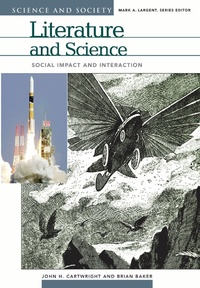
Literature and Science
Social Impact and Interaction
Published on 21. June 2005
496 pages
978-1-85109-463-9 (ISBN)
Description

A survey of the interaction between science and Anglo-American literature from the late medieval period to the 20th century, examining how authors, thinkers, and philosophers have viewed science in literary texts, and used science as a window to the future.
Spanning six centuries, this survey of the interplay between science and literature in the West begins with Chaucer's Treatise on the Astrolabe and includes commentary on key trends in contemporary literature.
Beginning with the birth of science fiction, the authors examine the works of H. G. Wells and Jules Verne as well as Mary Shelley's Frankenstein within the context of a wider analysis of the impact of major historical developments like the Renaissance, the scientific revolution, the Enlightenment, and Romanticism. The book balances readings of literature with explanations of the impact of key scientific ideas. Focusing primarily on British and American literature, the book also takes an informed but accessible approach to the history of science, with seminal scientific works discussed in a critical rather than overly theoretical manner.
Spanning six centuries, this survey of the interplay between science and literature in the West begins with Chaucer's Treatise on the Astrolabe and includes commentary on key trends in contemporary literature.
Beginning with the birth of science fiction, the authors examine the works of H. G. Wells and Jules Verne as well as Mary Shelley's Frankenstein within the context of a wider analysis of the impact of major historical developments like the Renaissance, the scientific revolution, the Enlightenment, and Romanticism. The book balances readings of literature with explanations of the impact of key scientific ideas. Focusing primarily on British and American literature, the book also takes an informed but accessible approach to the history of science, with seminal scientific works discussed in a critical rather than overly theoretical manner.
More details
Series
Language
English
Place of publication
Oxford
United Kingdom
Target group
College/higher education
Interest Age: From 7 to 17 years
Illustrations
64 bw illus
File size
6,32 MB
ISBN-13
978-1-85109-463-9 (9781851094639)
Copyright in bibliographic data and cover images is held by Nielsen Book Services Limited or by the publishers or by their respective licensors: all rights reserved.
Schweitzer Classification
Other editions
Additional editions
John H. Cartwright | Brian Baker | Mark A. Largent
Literature and Science
Social Impact and Interaction
Book
06/2005
ABC-CLIO
€93.50
Shipment within 3-4 weeks
Persons
John H. Cartwright is senior lecturer at the University of Chester, Chester, England and a historian of science.
Brian Baker, PhD, is senior lecturer in literature at the University of Chester, Chester, England and an authority on Anglo-American film and literature.
Brian Baker, PhD, is senior lecturer in literature at the University of Chester, Chester, England and an authority on Anglo-American film and literature.
Content
- Cover
- Contents
- Series Editor's Preface
- Acknowledgments
- Preface
- 1 Medieval Cosmology and European Literature: Dante and Chaucer
- Aristotelian Cosmology
- Dante and The Divine Comedy
- Chaucer
- Chaucer and Astrology
- The Humours
- Chaucer's Doctor of Physic
- Alchemy
- Bibliographic Essay
- 2 Science and Literature in the Elizabethan Renaissance
- Natural Philosophy
- Elizabethan Commonplaces
- The Great Chain of Being
- Astrology
- Analogical Thinking and the Correspondences
- Hierarchy and Degree
- The Elements
- The Age of the World
- Medicine
- Music of the Spheres
- Satire
- Breaking Boundaries
- Marlowe's Faustus
- Lear and the World Breaking Up
- Bibliographic Essay
- 3 Science and Literature in Seventeenth-Century England
- Affecting the Metaphysical
- The World's Decay
- The Redemption of Natural Philosophy
- The Royal Society
- Satire and the Virtuosi
- Science and the Language of Literature
- Milton
- The Earl of Rochester
- Bibliographic Essay
- 4 Science and Literature 1680-1790
- "Of Newton, to the Muses Dear"
- Pope and the Essay on Man
- Jonathan Swift
- Nature Poems: Scientific and Moral
- Night Thoughts
- The Didactic Poem
- Bibliographic Essay
- 5 The Touch of Cold Philosophy: The Response to Science in Romantic Literature 1790-1840
- Unweaving the Rainbow
- The Romantic Revolution-Context and Characteristics
- Romantic Epistemologies
- Wordsworth
- Lyrical Ballads (1798)
- Kant's Revolution
- Wordsworth and Newton
- Mary Shelley's Frankenstein
- Bibliographic Essay
- 6 Nineteenth-Century American Literature and Science: Problems of Analogy
- The Analogical Method
- Changes in Nineteenth-Century Science
- American Nature and Spirituality
- Moby-Dick and Classification Systems
- Moby-Dick: Analogy, Anatomy, and Autopsy
- Nature and the Transcendentalists
- Science and Religion: The Way to Hell
- Science, Non-Science, and Nonsense: The Case of Edgar Allan Poe
- Conclusion
- Bibliographic Essay
- 7 Those Dreadful Hammers: Geology and Evolution in Nineteenth-Century Literature
- Geology Comes of Age
- Lamarck and Chambers
- Tennyson
- Darwin and The Origin of Species
- Thomas Hardy (1840-1928)
- Man's Place in Nature
- Hardy and Sexual Selection
- Hardy and August Weismann
- Epilogue: Evolutionary Epistemology
- Bibliographic Essay
- 8 Darwin's Gothic: Science and Literature in the Late Nineteenth Century
- Darwin and "Progress"
- Herbert Spencer and Social Darwinism
- The Time Machine
- The Time Machine and Evolution
- The Time Machine and Race
- Theories of Degeneration
- Cesare Lombroso's Criminal Man
- Atavism and Dracula
- Degeneration and Sherlock Holmes
- Thomas Hardy's Tess of the d'Urbervilles
- Reversion and "The Creeping Man"
- Strange Case of Dr Jekyll and Mr Hyde
- Conclusion
- Bibliographic Essay
- 9 Themes in Science Fiction
- The Fantastic Journey
- Evolution and Humanity
- Science Fiction and Time
- The Robots
- Dystopia: The Machine State
- Bibliographic Essay
- 10 Science and Literature in the Twentieth Century: From Entropy to Chaos
- Thermodynamics and Entropy
- Entropy and Postwar Literature
- Entropy and Information
- Cybernetics and Cyborgs
- Cyberpunk, Bifurcation Points, and Chaos Theory
- Back to the Future: The Difference Engine
- Bibliographic Essay
- 11 The Two Cultures Debates
- Two Cultures: An Anatomy of a Cultural Divide
- The Battle of the Books
- The Romantic Revolution and Varieties of Truth
- The Huxley-Arnold Debate
- C. P. Snow and Two Cultures
- Bibliographic Essay
- 12 Science Wars and Imperial Ambitions
- Realism and Social Constructivism
- Human Nature and Human Knowledge: The Allure of Social Constructivism
- The Counterattack
- Sokal's Modest Experiment
- Extract A
- Extract B
- Extract C
- Can Literature be Explored Scientifically?
- E. O. Wilson and Consilience
- The Third Culture and Popularizations of Science
- The Third Culture
- Popular Culture and the Literature of Science
- Popular History of Science
- Expositions of Key or New Ideas
- Synthesis of Ideas and Position Statements
- Biographies and Autobiographies
- Compilations of Writings on or about Science
- Plays and Poetry
- Bibliographic Essay
- Epilogue
- Appendix: Spherical Astronomy and "Saving the Appearances"
- The Stars
- Appearances Saved
- Chronology of Significant Events
- General Bibliographic Essay
- Glossary
- Primary Source Documents
- Chapter 1 Extracts from La Vita Nuova (The New Life)
- Section II. The first meeting with Beatrice
- Section VI The List of Sixty Ladies
- Chapter XXIX. The Number Nine
- Chapter 2 Extract from Of the Laws of Ecclesiastical Polity by Richard Hooker (1554-1600)
- III. [The law which natural agents have given them to observe, and their necessary manner of keeping it.]
- Chapter 3 Extract from The New Atlantis (Internet Version-Details Below)
- Extract from The History of the Royal Society by Thomas Sprat (1667)
- Sect. XX. Their Manner of Discourse
- Chapter 4 Extract from The Memoirs of Scriblerus
- Chapter XIV
- Extract from Gulliver's Travels Part II:A Voyage to Laputa, Balnibarbi, Luggnagg, Glubbdubdrib, and Japan
- Chapter II
- Chapter V
- Chapter 5 Extract from Preface to Lyrical Ballads, by William Wordsworth (1800)
- Chapter 6 Extract from Ralph Waldo Emerson, "The American Scholar" (1837)
- Chapter 7 Extract from Vestiges of The Natural History of Creation by Robert Chambers
- From Thomas Hardy, A Pair of Blue Eyes (1873), Chapter 22
- Chapter 8 Extract from Bram Stoker's Dracula
- Extract from Sir Arthur Conan Doyle, "The Final Problem," The Memoirs of Sherlock Holmes
- Conan Doyle's "The Creeping Man"
- Extract: The "Final Vision" from H. G. Wells's The Time Machine
- XI
- Chapter 9 Extract from H. G. Wells, The Time Machine
- Chapter 11 Extract from The Belfast Address by John Tyndall
- "Science and Culture" by Thomas Henry Huxley
- Science and Culture
- Literature and Science by Matthew Arnold (1883)
- Bibliography
- Index
- About the Authors
