

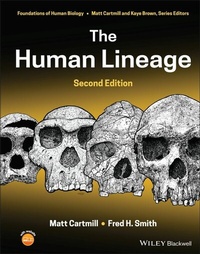
The Human Lineage
Description

This new edition of The Human Lineage is the best and most current guide to the morphological, geological, paleontological, and archeological evidence for the story of human evolution. This comprehensive textbook presents the history, methods, and issues of paleoanthropology through detailed analyses of the major fossils of interest to practicing scientists in the field. It will help both advanced students and practicing professionals to become involved with the lively scholarly debates that mark the field of human-origins research. Its clear and engaging chapters contain concise explanatory text and hundreds of high-quality illustrations. This thoroughly revised second edition reflects the most recent fossil discoveries and scientific analyses, offering new sections on the locomotor adaptations of Miocene hominoids, the taxonomic distinctiveness of Homo heidelbergensis, the Burtele foot, Ardipithecus, and Neandertal genomics. Updated and expanded chapters offer fresh insights on topics such as the origins of bipedality and the anatomy and evolution of early mammals and primates. Written and illustrated by established leaders in the field, The Human Lineage:
* Provides the background needed to study human evolution, including dating techniques, mechanics of evolution, and primate adaptations
* Covers the major stages in human evolution with emphasis on important fossils and their implications
* Offers a balanced critical assessment of conflicting ideas about key events in human evolution
* Includes an extensive bibliography and appendices on biological nomenclature and craniometrics
Covering the entire story of human evolution from its Precambrian beginnings to the emergence of modern humanity, The Human Lineage is indispensable reading for all advanced students of biological anthropology.
More details
Other editions
Additional editions
Persons
Matt Cartmill is Professor of Anthropology at Boston University and Professor Emeritus of Evolutionary Anthropology at Duke University. Dr Cartmill is a Guggenheim and AAAS Fellow, a former president of the American Association of Physical Anthropologists and recipient of their Charles Darwin Lifetime Achievement Award, a founding co-editor of the International Journal of Primatology, and the former editor-in-chief of the American Journal of Physical Anthropology.
Fred H. Smith is University Professor Emeritus of Anthropology at Illinois State University and Adjunct Professor at the University of Colorado, Boulder. A past president of the American Association of Physical Anthropologists and an AAAS and Alexander von Humboldt Fellow, he has received awards for his work from the U.S., Ireland, Germany and Croatia. Dr. Smith has conducted research in Europe, West Asia, and Africa, and has taught internationally at the Universities of Hamburg, Tübingen and Zagreb.
Content
Foreword xi
Preface to the First Edition xiii
Preface to the Second Edition xvi
Some Notes on Nomenclature xix
About the Companion Website xxi
1 The Fossil Record 1
1.1 The Discovery of the Deep Past 1
Changing Ideas About the Changing Earth 1
Neptune vs. Vulcan 2
A Brief Guide to Sedimentology 3
Dating the Rocks 4
The Succession of Faunas 5
Radiation-Based Dating Techniques 7
Other Dating Techniques 9
Dating Based on the Cycles of the Earth 9
The Problem of Orogeny 11
Continental Drift 11
1.2 A Brief History of Life 12
Life: The First Three Billion Years 12
Multicellular Life 14
The Cambrian Revolution 15
Jaws, Fins, and Feet 16
The Reptilian Revolutions 18
The Two Great Extinctions 20
The Mammals Take Over 21
2 Analyzing Evolution 23
2.1 Darwin and Evolution 23
Parsimony and Pigeons 23
Darwin's Theory 24
Improving on Darwin 27
2.2 The Origin of Species 30
What, if Anything, is a Species? 30
The Speciation Process 31
The Tempo of Speciation 32
Semispecies, Hybrids, and Isolating Mechanisms 33
2.3 Species Concepts and Classification 35
Races, Semispecies, and Taxonomy 35
Other Species Concepts 37
Morphospecies and Chronospecies 39
2.4 Microevolution and Macroevolution 40
Is Evolution Smooth or Jerky? 40
The Neo-Darwinian Synthesis 41
The Politics of Macroevolution 42
2.5 Reconstructing the Tree of Life 42
Phylogenetic Inference 42
Sources of Error in Phylogenetics 44
2.6 Taxonomy and Classification 47
Linnaean Systematics 47
Evolutionary Systematics 47
Phenetics and Cladistics 49
Pros and Cons of Phylogenetic Systematics 49
3 People as Primates 51
3.1 Primates as Mammals 51
The First Mammals 51
Allometry 57
Allometry and Early Mammals 58
Death and Molar Occlusion 59
Allometry, Motherhood, and Milk 60
Respiration and the Palate 60
The Tribosphenic Molar 62
Live Birth and Placentation 64
Jurassic and Cretaceous Mammals 65
3.2 The Order Primates 66
What is a Primate? 66
The Living Strepsirrhines 73
Anthropoid Apomorphies: Ears, Eyes, and Noses 74
Tarsiers 76
Platyrrhines: The New World Anthropoids 77
Cercopithecoids: The Old World Monkeys 78
Hominoids: The Living Apes 79
Pongids and Hominids 81
Bonobos and Chimpanzees 84
Humans vs. Apes: Skulls and Teeth 85
3.3 The Primate Fossil Record 88
Primate Origins: The Crown Group 88
Fossil Primates: The Stem Group 90
Ancestral Traits and Genetic Evidence 91
The First Euprimates 92
Eocene "Lemurs" and "Tarsiers" 94
The First Anthropoids 96
Anthropoid Radiations 98
Miocene Catarrhines 99
Ape Origins 103
Cercopithecoids 107
4 The Bipedal Ape 109
4.1 The Discovery of Australopithecus 109
Being Human vs. Becoming Human 109
The Taung Child 109
Australopithecus Grows Up 111
4.2 The Anatomy of Bipedality 115
Upright Posture and the Vertebral Column 115
Bipedality and the Pelvis 116
Bipedal Locomotion: Knees 118
Bipedal Locomotion: The Hip Joint 123
Bipedal Locomotion: Feet 124
4.3 More South African Finds 127
Australopithecus Stands Up 127
The Skull of Australopithecus africanus 128
Australopithecus robustus 129
Man-Apes, Just Plain Apes, or Weird Apes? 133
Postcranial Peculiarities 133
4.4 Louis Leakey and Olduvai Gorge 135
4.5 Mio-Pliocene Enigmas 139
Sahelanthropus: The Oldest Hominin? 139
Orrorin 140
Ardipithecus 141
The Burtele Foot 146
4.6 The Genus Australopithecus 146
Australopithecus anamensis? 146
Australopithecus afarensis? 148
Afarensis Skulls and Teeth 152
Australopithecus bahrelghazali? 153
Australopithecus deyiremeda? 153
Kenyanthropus platyops? 154
Early Australopithecus from South Africa 154
Australopithecus prometheus? 155
Australopithecus aethiopicus 156
Australopithecus garhi 158
Australopithecus sediba? 159
Australopithecus boisei 160
Australopithecus robustus: Postcranial Skeleton and Relationships 162
4.7 Australopithecine Phylogeny 163
Alpha Taxonomy and Cladograms 163
Getting Around Cladistics 166
4.8 The Australopithecine Postcranium 167
Down from the Trees - How Far, How Fast? 167
Australopithecine Shoulders 171
Arms vs. Legs 172
The Hominin Hand 173
Australopithecine Vertebrae 174
Hip and Femur 177
Early Hominin Feet 179
Postcranial Diversity in Early Hominins 181
4.9 Ecology and Behavior 183
The Facts Thus Far 183
What Did Australopithecines Eat? 183
Early Hominin Environments 186
Social Ecology 188
4.10 Major Issues: Explaining Hominin Origins 192
5 The Migrating Ape 197
5.1 The Spread of Hominins out of Africa 197
5.2 The Emergence of the Genus Homo 198
Homo habilis and the Habilines 198
Habiline Dates and Stratigraphy in East Africa 203
Habiline Skulls 204
Habiline Teeth and Diets 207
Habiline Postcranial Remains 208
Habiline Taxonomy: The Frustrations of Variation 210
Back to South Africa 211
Advanced Australopithecus or Early Homo? Phylogenetic Issues 212
Early Material Culture 214
A Summary of the Habilines in Eight Questions 215
5.3 Homo erectus 216
An Introduction to Homo erectus 216
A Brief History of Homo erectus: 1889-1950 218
Later Discoveries in Africa and Eurasia 220
Erectine Chronology and Geographic Distribution 222
Asian Homo erectus: The Neurocranium 224
Cranial Capacity and the Brain in Asian Erectines 229
Asian Homo erectus: Faces and Mandibles 230
The Asian Erectine Dentition 232
Asian Erectine Postcranial Remains 233
Early African Erectine Skulls and the Ergaster Question 233
Early African Erectine Postcranial Morphology 237
Early Erectine Adaptations: Anatomy and Physiology 242
Early Erectine Adaptations: The Archaeological Evidence 245
Patterns of Development and Evolutionary Change in Erectines 247
Early Erectine Radiations in Africa 248
Out of Africa I: The First Migration into Eurasia 250
Dmanisi - The First Eurasians 253
Indonesian Erectines and the Specter of "Meganthropus" 259
Chinese Erectines 261
The Initial Occupation of Europe 262
Gran Dolina 264
5.4 Peripheral Holdouts along the Continental Margins 267
Flores 267
Luzon 272
Dushan 272
Rising Star 273
5.5 Major Issues: Summing Up the Erectines 275
6 The Big-Brained Ape: Middle Pleistocene Variants and Trends 279
6.1 Homo "heidelbergensis" 279
Crossing the Rubicon? 279
"Archaic Homo sapiens" vs. "Homo heidelbergensis" 280
Brains and Tools in the Middle Pleistocene 282
6.2 Models of Later Human Evolution 284
Changing Origin Narratives 284
The Piltdown Fraud 285
RAO and MRE 287
6.3 Regional Variants in Europe and Africa 289
European Heidelbergs 289
Petralona 290
Bilzingsleben 293
Swanscombe 293
Steinheim 294
Mauer 295
Boxgrove 296
Ceprano 296
Arago (Tautavel) and Lazaret 297
Sima de los Huesos 298
Other European Heidelbergs 303
African Heidelbergs: Kabwe 304
Bodo and Ndutu 306
African Heidelberg Mandibles 307
Other African Heidelbergs 307
North Africans 308
6.4 Asian Heidelbergs? 308
Mugharet El-Zuttiyeh 308
Other West Asian Candidates 309
South Asia 309
East Asia 309
6.5 Australasia 311
Sambungmacan 311
Ngandong 312
6.6 Supraorbital Tori, Chins, and Projecting Faces 314
6.7 The African Transition to Modern Humans 316
Background and Dating 316
The African Transitional Group: Vault Morphology 319
The African Transitional Group: Facial Morphology 320
The African Transitional Group: Additional Bones, Archaeology, and Other Matters 321
6.8 East Asian Archaic Humans 322
Background and Context 322
Dali 324
Harbin 325
Other Chinese Finds 325
East Asian Archaics: Continuity or Someone New? 326
6.9 Major Issues: Speciation, Migration, and Regional Differentiation 327
7 Talking Apes: The Neandertals 333
7.1 Changing Ideas about Neandertals 333
Early Discoveries and Interpretations 335
Neandertals - From Boule to the Twenty-First Century 338
7.2 Neandertal Chronology and Distribution 340
7.3 The Neandertal Skull 346
Neandertal Braincases 346
Neandertal Faces 356
Neandertal Mandibles 359
Neandertal Teeth 362
Prognathism 364
7.4 The Neandertal Body 366
Body Size and Proportions 366
Neck and Upper Limb 369
Lower Vertebrae, Pelvis, and Lower Limb 371
7.5 Neandertal Life History and Demography 374
7.6 Genetics and Genomics 376
The Mitochondrial Genome 376
The Nuclear Genome 378
Genes, Dates, and Lineages 379
Denisovans 380
Ghosts in the Genes 382
7.7 Brains and Behavior 383
Neandertal Brains 383
Neandertal Technology 385
Symbolic Behavior 386
Neandertals and Language 389
Diets and Subsistence Behavior 393
7.8 Neandertal Populations 395
Early European Neandertals 395
Krapina 396
"Würm" Neandertals from Western Europe 398
Western and Central Asian Neandertals 399
Late Neandertals 402
7.9 Major Issues 406
8 The Symbolic Ape: The Origins of Modern Humans 411
8.1 Symbolic Behavior 411
Signs and Symbols 411
A "Creative Explosion"? 412
8.2 Modern Human Anatomy 414
The Modern Skull 414
Cranial Capacity 416
The Postcranial Skeleton 417
8.3 The Fossil Record of Modern Human Origins 418
Geochronology 418
Early Modern Humans: The East African Record 418
Out of (East) Africa: Early Modern People in North and South Africa 421
The First Modern People Outside Africa: The Near Eastern Evidence 424
African and Circum-Mediterranean Gene Flow and Modern Human Origins 430
Modern Human Origins in East Asia 432
The First Australians 437
Europe: A Late Frontier 443
The Initial Upper Paleolithic 444
The Aurignacian and its Makers 445
The Gravettian 450
The Late Entry into Europe 452
Europe: The Morphological Evidence for Continuity 453
8.4 Genetics and Modern Human Origins 455
Genes, Populations, and Migrations 455
Human Self-Domestication? 459
Ancient DNA in Early Modern Humans 460
8.5 Modern Human Origins: The Models vs. the Data 461
The Recent African Origin Model 461
Multiregional Evolution 462
Alternative Views: The Assimilation Model 463
Assimilation and Interactions Between Modern and Archaic Humans 466
Appendix: Cranial Measurements 471
Bibliography 477
Index 583
Preface to the First Edition
Unlike other animals, people wonder how things got to be the way they are; and one of the things we wonder about most is how we got to be so unlike other animals. The science of human origins therefore attracts a lot of interest and attention from a wide range of audiences, from average readers to dedicated researchers. This book about paleoanthropology has been written for readers at the scholarly end of that spectrum, especially for students who have already had a beginning course in the subject. But we have tried to keep it accessible to any educated reader, because we think it is important in today's political and cultural environment to make a substantial account of human evolution available to anyone who has serious questions about it.
As its title implies, this is a book about the evolutionary lineage of the human species, Homo sapiens. Because it is specifically centered on the human lineage, it touches on other aspects of the history of life on Earth only to the extent that they bear on human origins. And because this book focuses on reconstructing the human lineage, it deals mainly with the facts of paleontology, which furnishes the only direct evidence we have of that lineage. Comparative anatomy, molecular biology, historical geology, archaeology, and other fields of science are brought in mainly to provide necessary background and context for the study of the human fossil record.
Opponents of scientific biology are fond of dismissing that record as a pathetic handful of controversial fragments. If that were so, this book would be a lot shorter. An often-repeated creationist canard insists that all known human fossils would fit on a billiard table. This was probably true in the late nineteenth century, but it has not been true for a hundred years. Known human fossils number in the thousands and represent the remains of hundreds of individuals. They are more numerous and better-studied than the fossils of any comparable vertebrate group, because the intense interest that people have in the bones of their ancestors has driven them to devote far more effort to collecting and studying fossil humans than (say) fossil horses or herring. Having seen most of the major collections of human fossils in the world's museums, we can assure our readers that those collections can no longer be laid out on a billiard table. It would be hard to cram them all into a boxcar.
The growth of the human fossil record has been especially rapid over the past half-century. In 1959, W. W. Howells could still provide a basic exposition of almost all of the significant human fossils then known in a relatively slim (384-page) volume entitled Mankind in the Making. Only three years later, Carleton Coon took 724 pages to present an only slightly more detailed account in his book The Origin of Races. Any book that tried to survey today's human fossil collections in the same detail would not fit between a single pair of covers. A recent catalog of most of the major cranial and dental remains of currently known fossil hominins - just photographs and descriptions of skulls and teeth - occupies three quarto volumes totaling more than 1500 pages (Schwartz & Tattersall 2002, 2003, 2005). Most of the decisions involved in writing a paleoanthropology textbook thus concern what to leave out, not what to put in. In making such decisions about the fossil evidence, we have tried to focus not on the details of particular fossils, but on the temporal, regional, or taxonomic patterns that they reveal. Conversely, in covering the theoretical aspects of evolutionary biology, we have stressed those facets of the theory that are deeply involved in current paleoanthropological debates, and skimped on others that are not.
Debates in paleoanthropology are often vigorous and contentious. Some writers would have you believe that such heated debates are both an idiosyncracy and a shortcoming of our discipline. We think they are wrong on both counts. The scientific enterprise is grounded in the assumptions that all knowledge is provisional and that knowledge increases through the refutation of old ideas and their replacement by new ones. Each generation of scientists makes its mark by overthrowing the received wisdom of the previous generation or transcending its limitations. Active and lively sciences are arenas in which ideas and claims compete for survival. Because reputations and egos are involved in these clashes, arguments are often heated and sometimes intemperate. In these respects, debates over the meaning of fossil skulls are not different from similar debates in other sciences over such issues as the reality of polywater or the planetary status of Pluto.
In grappling with the important debates in our discipline, we have tried to do an even-handed job of laying out the core arguments and key facts that support various currently conflicting interpretations of the fossil record. It will not be difficult to figure out where we stand on most of these issues. But it should also be possible for the reader to understand why others read the facts differently, and even to come to conclusions that differ from ours. In general, we have not tried to articulate the reasoning behind ideas that nobody espouses any longer; but we have included a few such discarded ideas that seem to us to have special historical importance, set off inside boxes and labelled "Blind Alleys."
The first three chapters of this book situate the human fossil record in the larger framework of evolutionary biology and provide the necessary background for what follows. Chapter One surveys the development of historical geology, including brief summaries of geological dating techniques and the fossil record of life up through the early radiation of mammals. Chapter Two lays out a sketch of the underpinnings of evolutionary theory, with emphasis on its paleontological applications. In Chapter Three, we discuss the mammalian background and evolutionary history of the order Primates. We have undertaken a relatively complete survey of the other living members of our order, because we think that doing so helps put humans in their proper biological context. Our overview of fossil primates focuses more narrowly on those that have some relevance to the earlier stages of the human lineage, either as potential ancestors or as comparative cases that illustrate relevant concepts and phenomena.
The final five chapters cover the specifically human (hominin) part of the lineage of our species. The initial hominin radiation in Africa, including the origin of the genus Homo, is reviewed and discussed in Chapter Four. Chapters Five and Six deal respectively with fossils commonly assigned to Homo erectus and Homo heidelbergensis. This division is not intended as a proxy for a taxonomic distinction or as a presentation of "stages" of human evolution, but only as a heuristic structure to organize the relevant material. A full chapter (Chapter Seven) is devoted to the Neandertals, because these are the best-known pre-modern humans and offer unique insights into the pattern of later human evolution. Chapter Eight deals with the emergence and radiation of modern humans - people fundamentally like us. Finally, we provide an appendix detailing the anatomical points and measurements used in the book.
Unless otherwise indicated, all illustrations were drawn by one of us (MC). Some of them are diagrammatic or conceptual, but most were redrawn from photographs, with an eye to both anatomical accuracy and ease of interpretation. Figures for which no published source is credited are based on our own ideas, observations, and photographs.
Most of this book's contents represent other people's work. We have relied heavily on the published work and private thoughts of our colleagues, which have of course greatly enriched our own ideas and interpretations as well. In producing the text and figures for this book, we have tried diligently to give credit to our colleagues for their work and ideas, and to be as thorough as possible in providing citations and references. Despite our best efforts, it is inevitable that we have overlooked some important sources and misinterpreted some others. We accept responsibility for such errors and omissions, and ask that our colleagues bring them to our attention.
Writing a book like this one brings clearly into focus for us the high quality of research and researchers in paleoanthropology. Of all the pleasures involved in working on this book, none has been greater than our interactions with colleagues. This project could not have been completed without their input, information, and encouragement. Many of them have kindly provided access to fossils and other material critical to the production of this volume. For general assistance we thank: J. Ahern, B. Asfaw, S. Bailey, O. Bar-Yosef, M. Bolus, D. Boyd, C. L. Brace, G. Bräuer, A. Busby, J. Calcagno, R. Cann, R. Caspari, S. Churchill, R. Clarke, M. Cole, T. Cole, G. Conroy, D. Curnoe, S. Donnelly, A. Durband, A. Falsetti, R. Franciscus, D. Frayer, J. Gaines, J. Gardner, D. Gebo, D. Glassman, A. Grauer, M. Green, L. Greenfield, F. Grine, P. Habgood, T. Holliday, R. Holloway, N. Holton, J.-J. Hublin, K. Hunt, V. Hutchinson, W. Hylander, I. Jankovic, R. Jantz, D. Johanson, C. Jolly, W. Jungers, R. Jurmain, I. Karavanic, R. Kay, W. Kimbel, J. Kidder, R. Klein, J. Kondrat, L. Konigsberg, A. Kramer, C. S. Larsen, S. Leigh, D. Lieberman, M. Liston, F. Livingstone, D. Lordkipandze, C. O. Lovejoy, A. Mann, J. McKee, N. Minugh-Purvis, J. Monge, S. Myster, L. Nevell, S....
