

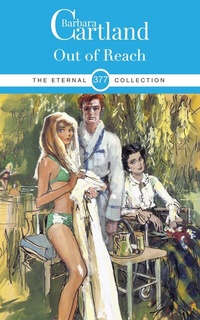
Out of Reach
Description

In post-war Britain, the return of their children brings not only reunion, but revelation - truths that threaten to unravel Lydia's fragile happiness. When an enchanting young woman enters their home, Lydia is forced to confront a crisis that could divide her family forever.
Yet even in her darkest moments, Lydia cannot turn away from love. In the unspoken yearnings of her sister and the struggles of her daughter, she begins to see her own life anew - perhaps her life is not as broken as she fears. And, when she uncovers the truth behind her husband's restless dreams, Lydia must decide: will she surrender to her grief, or find the strength to fight for the love they once shared? All it told in this moving story of doubt and sadness, love and ultimate happiness.
All prices
More details
Person
She wrote across a wide variety of genres, but is of course most closely associated with romance, and with her stories of chaste heroines, dashing heroes and everyone finally living happily ever after. Barbara was a colourful character in many senses of the word and was as well known for her controversial and witty interviews and absorbingly exciting life story as she was for her bright pink clothes and extravagant appearance.
To read Barbara Cartland's life story is to be impressed that someone could fit so much into only one life. As well as writing a staggering number of books, she was also involved with great advances in many diverse fields from aviation to alternative medicine and helped many groups who she perceived as being unfairly treated, from midwives in poor working conditions to Romany gypsy children who wanted to be allowed to attend school.
She was fascinatingly contradictory in her interviews and novels, Barbara often extolled the virtues of traditional relationships between men and women and falling in love, but hers is the story of a driven, independent-minded woman who was unafraid to turn her hand to anything which interested her and right wrongs Barbara Cartland is synonymous with traditional romantic fiction, but her life story is perhaps just as engrossing as her fiction.
Content
2
The maid finished arranging the curls at the back of Lydia's head and then fetched the flat leather jewellery-case and set it down in front of her on the dressing-table.
Lydia stared at her own reflection in the mirror. Her hair, newly washed, was shining with soft burnished lights, and the turquoise blue of her chiffon evening dress framed the white grace of her long throat.
She looked - as she well knew - a lovely woman, and then as she caught sight of the back of her chair she threw off with a nervous, irritable gesture the rug that covered her knees.
"Give me the Chinese shawl, Rose," she said, sitting silent while her maid fetched it from the cupboard and placed it over her, the embroidered flowers with their vivid colours adding to the colourful picture she already made.
"That looks lovely, Madam," Rose said enthusiastically. "I'm glad you bought that blue dress - it suits you a treat."
"It will go well with my aquamarines," Lydia replied.
But she smiled at the compliment and bending forward opened her jewel-case. She slipped two clips on the front of her dress and put a smaller one on to the lobe of each ear and then turned to the ring tray. There was a line of rings in it, and as she picked up the big square-cut aquamarine - one of Ivan's last presents to her - her eyes lingered for a moment on a thin narrow ring of coloured enamel that was the first present he had given her after they had been married. It had not cost very much, but in those days, it seemed to them a fortune.
Even so, it was in exquisite taste, a ring that anybody would have been proud to own regardless of its monetary value, a Regency piece of white and red enamel made by a clever craftsman and engraved with the words, "My heart is thine".
Lydia picked up the ring and turned it over in her fingers. How much had happened since then! And yet in some ways it was true that Ivan's heart had been hers. He had been unfaithful, he had loved other women - and yet she could fearlessly ask herself the question whether he had ever given them anything that was hers.
When she had married him, when she had run away from the quiet, ordered existence of her country home, she had told herself with all the conceit of the very young that she knew exactly what she was facing in the future and was prepared for it. Perhaps in some ways her very ignorance and inexperience had saved her from much of the agony and heart-burning of anticipation. Things that happened after marriage had come to her as a shock, but she had not gone through the long misery of waiting for them to happen, of knowing the inevitable before it happened.
No, she could truly say that she had been ecstatically happy with Ivan, especially during those first years of their marriage - the years in which he had been climbing to fame and becoming recognised because his genius compelled attention and could not be ignored.
And then - it was difficult for her to put into words even to herself, what she had felt when other women first began to play a part in Ivan's life. She had been jealous, of course - madly, crazily and wildly jealous - and yet somehow, she had managed to keep her balance, to keep herself from making scenes and antagonising Ivan as she could so easily have done had she behaved in what anyone else would have called a normal way. It was not entirely her own cleverness that had prevented her doing this, and it was only now, when she was over forty, that Lydia had begun to understand the strange hold she had over her husband.
She had been brought up to be undemonstrative. All her family were unemotional, calm, and what they called "extremely English" in their outlook. She had learnt it in the nursery that it was bad form to show emotion. When her mother died before Lydia had reached her teens, she had accepted her father's code, which was one of understatement on every possible occasion.
Colonel Windover had brought up his two daughters strictly, but in what he believed was a kindly, decent fashion.
In reality, Lydia was starved for affection - but she had no idea of it and only learnt to control and discipline with Puritanical severity, a nature that, if left alone, would have been both affectionate and demonstrative.
By the time she was eighteen, when she had blossomed into a sudden and surprising beauty, she had learnt to be ashamed of her own impulses and to be shy and suspicious of her desire to show affection towards those she loved.
"I can't stand this modern, exaggerated way of talking," Colonel Windover would grumble, when people talked of things being "too, too marvellous", "topping" and "divine" - using the enthusiastic slang of the post-war period.
Lydia was fond of her father and she had been brought up to admire him.
He had been set up to her as the supreme authority from the very moment of her birth, for in ruling his household with an autocratic benevolence, Colonel Windover expected from them in return a willing and unquestioning subservience. He was extremely selfish, although he was quite unconscious of the fact, and consequently filled the house with his own friends, for the idea that his daughters required youthful companions never entered his head.
He had not been a young man when he had married, and by the time Lydia was eighteen his contemporaries were all over fifty and interested only in hunting and shooting. They had little to say to a pretty girl just leaving the schoolroom, except to kiss her occasionally behind the door in what they assured her was "a fatherly manner" and subject her to a good deal of good-natured chaff about her appearance.
Lydia accepted it all as part of her life because she had known no other - dogs, horses, conversation confined entirely to sport had been, in fact, the main part of her education. But at times she craved for something different, something less material, something more mystical, desires which seemed to her vaguely reprehensible.
Then like a bombshell came her meeting with Ivan.
She remembered so well being asked to a party at which he was to play. The talented wife of the local M.F.H. had been responsible for it, and Colonel Windover had expressed both his dislike and disgust of musical evenings.
"Why can't the women let us talk or provide a good game of bridge?" he grumbled. "Sitting about on a hard chair listening to some long-haired gigolo making a hideous noise isn't my idea of enjoyment."
She had so nearly not gone to the party.
Lydia knew afterwards that if her father had refused the invitation, as sometimes he was wont to do, she would have accepted his decision placidly and gone on leading her quiet, even existence without a thought of what might have been hers.
But they had gone, and on entering the crowded room she had seen Ivan. How strange he was, how different from other men she had known in her short life. He was conspicuous, of course, amongst the hard-riding, somewhat boorish country squires and the young men of her own generation who had just missed the war and were looking rather limply into the future, wondering what the devil they were to do with themselves.
There was nothing indecisive, nothing limp, about Ivan. From the moment he stepped into that big chintz-decorated country drawing room he dominated it. People listened to him when he was speaking - and even the country squires were hushed into an almost mesmerised silence when he played.
He was not long-haired or exotically dressed, as Colonel Windover anticipated. But he certainly looked un-English. Also, he seemed to Lydia to have very little in common with the other members of his sex in that gathering. He made them all seem coarse and ungainly. Tall and abnormally thin, he moved with a grace that had, however, nothing feminine in it.
He was handsome, but not by any classical or preconceived standards. His high cheek-bones, his deep-set eyes proclaimed his Russian blood, but his hair instead of being dark was a very deep red - his jaw was square and determined, and his mouth in repose was firm too.
One knew at first sight that here was a man who would get what he wanted and that it would be difficult for anything or anybody to stand in his way.
When Ivan smiled, he was irresistible, but it was not until he played that Lydia understood that at last here was something that without knowing it, she had been waiting for all her life. His music snatched her up from her mundane normality into an ecstasy that stripped away the superficial veneer which had held her senses prisoner since childhood and left her trembling but transformed.
It had all been beyond words. She could only feel and go on feeling, her eyes burning in a white face until the vibrations which were emanating from her had met Ivan's and drawn his eyes to hers across the intervening space of the crowded room.
It was then he had strolled across to her, cutting short a voluble woman who was talking to him of her own musical experiences - it was doubtful if the poor lady had even come to the end of her sentence.
He had stood in front of Lydia, not holding out his hand, not touching her, but just looking - and yet she felt as if there and then he took her into his arms.
"You liked it?"
She could only answer him in a monosyllable,
"Yes."
They had stood looking at each other. Somehow it had been a moment when there was no need for words, their eyes said everything that needed to be said. Both their hearts were beating quickly.
Ivan, of course, had known and understood what was happening. He was already old in experience, and besides his Russian blood made him fatalistic -...
