

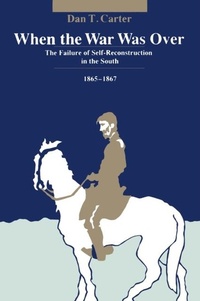
When the War Was Over
Description

In the months after Appomattox, the South was plunged into a chaos that surpassed even the disorder of the last hard months of the war itself. Peace brought, if anything, an increased level of violence to the region as local authorities of the former Confederacy were stripped of their power and the returning foot soldiers of the defeated army, hungry and without hope, raided the already impoverished countryside for food and clothing. In the wake of the devastation that followed surrender, even some of the most virulent Yankee-haters found themselves relieved as the Union army began to bring a small level of order to the lawless southern terrain.
Dan T. Carter's When the War Was Over is a social and political history of the two years following the surrender of the Confederacy -- the co-called period of Presidential Reconstruction when the South, under the watchful gaze of Congress and the Union army, attempted to rebuild its shattered society and economic structure. Working primarily from rich manuscript sources, Carter draws a vivid portrait of the political leaders who emerged after the war, a diverse group of men -- former loyalists as well as a few mildly repentant fire-eaters -- who in some cases genuinely sought to find a place in southern society for the newly emancipated slaves, but who in many other cases merely sought to redesign the boundaries of black servitude.
Carter finds that as a group the politicians who emerged in the postwar South failed critically in the test of their leadership. Not only were they unable to construct a realistic program for the region's recovery -- a failure rooted in their stubborn refusal to accept the full consequences of emancipation -- but their actions also served to exacerbate rather than allay the fears and apprehensions of the victorious North. Even so, Carter reveals, these leaders were not the monsters that many scholars have suggested they were, and it is misleading to dismiss them as racists and political incompetents. In important ways, they represented the most constructive, creative, and imaginative response that the white South, overwhelmed with defeat and social chaos, had to offer in 1865 and 1866. Out of their efforts would come the New South movement and, with it, the final downfall of the plantation system and the beginnings of social justice for the freed slaves.
More details
Other editions
Additional editions

Person
Dan T. Carter is Andrew W. Mellon Professor of Southern History at Emory University. He is the author of Scottsboro: A Tragedy of the American South, which was awarded the Bancroft Prize in History for 1969.
Content
- Cover
- Contents
- Acknowledgments
- Abbreviations
- Introduction
- Chapter I: Social Disorder and Violence in the Land of the Vanquished
- Chapter II: Self-Reconstruction Begins: The Failure of Strait-Sect Unionism
- Chapter III: Southern Realism and Southern Honor: The Limits of Self-Reconstruction
- Chapter IV: Uncertain Prophets in the Land of the Vanquished
- Chapter V: The Proslavery Argument in a World Without Slavery
- Chapter VI: Self-Reconstruction: The Final Act
- Chapter VII: Political Alternatives in the Land of Fog and Confusion
- Index
- A
- B
- C
- D
- E
- F
- G
- H
- I
- J
- K
- L
- M
- N
- O
- P
- R
- S
- T
- U
- V
- W
- Y
