

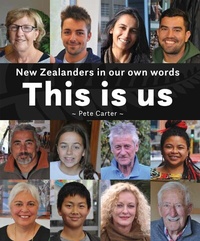
This is Us
Description

Zealanders, spanning the length and breadth of the country; from Cape Reinga to
Stewart Island. It was written in response to the Christchurch terrorist attack
but is not about it; it is instead a representation of the New Zealand people
in their own words. A celebration of the diverse, open, and inclusive
communities that exist across New Zealand, This is Us inspires hope by
showing the kindness and spirit of everyday people.
Each interview provides a snapshot of the subject's life, accompanied by
a photographic portrait. The joy interviewees felt in telling their stories
shines from the page. Each of the interviewees has a unique story to tell, and
to have them collected in one place creates an engaging and insightful reading
experience that will delight anyone interested in finding out more about Kiwi society
and culture.
Carter spoke with characters from a variety of professions, age groups
and cultural backgrounds. From a New Zealander with a long line of Kiwi
ancestors, to a person with a Maori name but Italian and Brazilian parents, this
collection reflects the ethnic diversity and cultural riches of New Zealand. This is Us is a tribute to the Kiwi
spirit.
More details
Other editions
Additional editions

Person
Content
I'm a Kiwi through and through. I love seeing the All Blacks win. Being a Kiwi for me is eating your greens and doing the dishes. If everyone did that, the world would be a better place.
Gus
I was born in 2000. I'm Dad's only child but have two half siblings through Mum. It was just Mum, Dad and me - and a cat. I never lived with my siblings.
I was four when I got my first guitar. I'd just strum until I got blisters. I was captivated. I didn't know what I was doing. I got an electric guitar when I was ten, a full-size one. That was awesome. I still remember the feeling. At my first gig I played in front of a thousand people. I was ten. I felt in control and I loved it. I had no technique and ruined my voice box.
Ninety per cent of the time I play for myself - practising and running through chords, in my bedroom, with my headphones on. My parents have been really supportive. I'm studying music at university but I'm a country boy at heart. My dream is to sell out Wembley. I want to make a living doing what I love.
I used to dream of being a long-distance runner. It's about competing against myself. I'll finish my degree and then travel - Nashville, New York. These days it's about who you know, so I have to get out there. I do drink but to be honest I'd rather drink water. And smoking . . . why would you put smoke in your lungs?
I'm a Kiwi through and through. I love seeing the All Blacks win. Being a Kiwi for me is eating your greens and doing the dishes. If everyone did that, the world would be a better place.
"Being a New Zealander is very important to me; even more so for my kids, who are one step further removed, being able to inhabit that definition and claim it for themselves.
Ali
I stopped working for the media about five years ago. I'd had a good run, and sometimes you have to go and look at what else is out there.
When my father first came out here, he was the liaison for the Pakistani cricket team in Christchurch. My mother, who is English, would cook them Pakistani food. Cricket is one of the few contacts that New Zealand and Pakistan have. Two countries on either side of the world with very different ways of life being able to get on the sports field and appreciate each other's skills - that is the magic of sport.
I was never a particularly good cricketer, though I do still play indoor cricket. I was in the pipe band at St Andrew's College, and I was the New Zealand champion mace flourisher in 1994.
Being a New Zealander is very important to me; even more so for my kids, who are one step further removed, being able to inhabit that definition and claim it for themselves. They also have European Kiwi and Italian ancestry to deal with.
I think there's a real need for self-examination, and we need to attempt to become the nation that all of those people caught up in the massacre crossed the world for - the country that they aspired to live in, rather than the one in which they died.
Alastair
My great-grandfather arrived here in 1827, so we've been here a while. In 1867, my grandfather and a friend rode from here to Auckland. The Maori Wars were still going on, and they slept with the Maori. The only trouble they had was in Taupo where the locals wanted to take their horses.
I did dentistry at Otago and then thought I'd do medicine. I worked my passage back home to the UK and got myself a place at St Mary's Medical School - that's where I met Di. I brought her back, and we settled down and have been here ever since.
We have four children; one unfortunately died, so we have three now.
I don't care what colour anyone's skin is, as long as they're good blokes.
I brew my own beer, and I used to grow my own tobacco, but my doctor daughter put a stop to that.
Di
I was born in London, at St Mary's Hospital, but was evacuated to Dorset during the war. After that we lived in Kent, and then I went nursing back at St Mary's. That's where we met, of course.
What I miss the most is the age of everything, the history of the UK. We were going to go back - but we didn't.
Alastair was a house surgeon and registrar at Hastings Hospital and then a GP. I was a nurse, a practice nurse and midwife. We semi-retired for a while and bred Angora goats.
Andrew was diving when he drowned; he made a silly decision - there was a southerly blowing. He loved life. He was 31. It changed our lives.
Wade
I was born in Lower Hutt. I went to Hutt Central Primary, Hutt Intermediate then Hutt High. I live in the Hutt now, too.
After school I went overseas for eight months and played cricket for a club in Harrogate. Then I trained to be an auto sparky. I got qualified, but I was offered a job here and haven't looked back. I'm branch manager now of a fastenings company.
My life outside of work revolves around sport: I play cricket and rugby, and just hang out with my mates.
I own a couple of properties now; my mum and dad encouraged me into doing that. Before that I was probably pissing my money up against the wall.
Overseas, New Zealanders are seen as good people - loyal and hardworking. When you're over there people would open up their homes and help you out.
I haven't really thought too far ahead. I'll carry on doing what I'm doing. I like the investment path I'm taking; I'll build up the equity and then try and retire as early as possible.
Helen
One of my mother's best friends moved to Whanganui and we visited them from South Korea for a two-week holiday when I was nine. Mum fell in love with the town. We went home and she just about started packing. Three months after that holiday we moved here. We left Dad behind to start with, but then he followed out later. Mum and I spoke hardly any English, but Dad's was really good.
When we arrived there were not many Koreans in town but every Sunday we would go to church in Palmerston North. It was Mum's way to build friendships. Mum and my aunty opened the Korean restaurant in Whanganui.
At school, music was really important. I played the violin; I considered studying music at uni. I went to Otago and studied neuroscience. I loved it but then I gave medicine a go and now I'm a fourth-year med student.
I'm thinking that I'm going to follow general practice as that's what I want to do. There's a weird view that general practice is the easy way out, but I don't think so.
My flat is in Newtown. It's very cool here - there's an Ethiopian shop and a Chinese medical centre. The demographic is amazing.
My parents have now moved to Kapiti. They love it there. We're very happy here.
"My flat is in Newtown. It's very cool here - there's an Ethiopian shop and a Chinese medical centre. The demographic is amazing.
"My wife and I had talked about possibly moving to Australia, then the perfect job turned up in New Zealand. We like to joke that we were aiming for an English-speaking country . . . and we almost got that.
Jay
I arrived from London in March ten years ago; the wife and family arrived two months later - the kids were three, seven and ten.
My wife and I had talked about possibly moving to Australia, then the perfect job turned up in New Zealand. We like to joke that we were aiming for an English-speaking country . . . and we almost got that.
I'm English but I was born in Belgrade, in the former Yugoslavia. Mum was Indian; her family were diplomats and her Brahmin parents were there at the time. Dad was Anglo-Indian - he was a mechanic. I grew up in England. I've been to India since, but not back to Belgrade.
I like the fact, as a brown person, that the brown people were here first. Growing up in the UK there was racism; there was always a message that you're an outsider. It takes away an argument at the knees.
New Zealand is a much friendlier place with a lot less violence than the UK. It's really quite pleasant - you can go into the roughest areas of the city and survive. Those travellers that came through that everyone complained about, that happens on an hourly basis back home. It is a long way away from anywhere.
My only regret is moving to Wellington - we should have moved somewhere warmer.
Emily
I've been at this school for five years. When I leave this school, I'm going to Australia for a holiday, and then I'm going to Hutt Intermediate.
I have one sister - she's fifteen. My parents are from Vietnam. I went there last December; it's really cool. I speak a little bit of Vietnamese. We don't have any pets here, but I have two dogs in Vietnam.
I want to keep a pig; I like pigs more than anything in the world. I'd play with it and feed it. My mum says if we move to a farm, we could have a pig.
I like to read; my favourite book is...
