

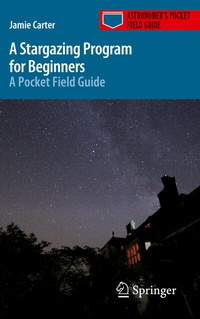
A Stargazing Program for Beginners
A Pocket Field Guide
Published on 20. November 2015
XVI, 419 pages
978-3-319-22072-7 (ISBN)
Description

Sets out a simple month-by-month program to reveal all of the night sky's biggest and most beautiful secrets in just one year - and with only a few hours of stargazing each month
By investing just an hour a week and $50 in binoculars, it's possible to learn a few simple techniques and quickly gain a real insight into the night sky's ever-changing patterns - and what they tell us about Earth, the seasons and ourselves. Searching more for a learned appreciation of nature and our exact place within the cosmos than academic scientific knowledge, science and travel writer Jamie Carter takes the reader on a 12 month tour of the night sky's incredible annual rhythms that say so much about Earth. During the journey he learns about the celestial mechanics at work in the skies above that are - to the beginner - almost beyond belief. As well as the vital constellations and clusters, and the weird and wonderful nebulas, he searches out "dark sky destinations" across the globe that help increase knowledge and give a new perspective on familiar night sky sights. On the journey he witnesses a solar eclipse and grapples with star-charts, binoculars, smartphone apps, telescopes, spots satellites and attempts basic astro-photography. By year's end, the reader will be able to glance at the night sky from anywhere on the planet and tell what direction he or she is facing, what time it is, where all the planets are and even where the Galactic Center Point is.
By investing just an hour a week and $50 in binoculars, it's possible to learn a few simple techniques and quickly gain a real insight into the night sky's ever-changing patterns - and what they tell us about Earth, the seasons and ourselves. Searching more for a learned appreciation of nature and our exact place within the cosmos than academic scientific knowledge, science and travel writer Jamie Carter takes the reader on a 12 month tour of the night sky's incredible annual rhythms that say so much about Earth. During the journey he learns about the celestial mechanics at work in the skies above that are - to the beginner - almost beyond belief. As well as the vital constellations and clusters, and the weird and wonderful nebulas, he searches out "dark sky destinations" across the globe that help increase knowledge and give a new perspective on familiar night sky sights. On the journey he witnesses a solar eclipse and grapples with star-charts, binoculars, smartphone apps, telescopes, spots satellites and attempts basic astro-photography. By year's end, the reader will be able to glance at the night sky from anywhere on the planet and tell what direction he or she is facing, what time it is, where all the planets are and even where the Galactic Center Point is.
Reviews / Votes
"Jamie Carter's Stargazing Program gives the basics you need to get started in Stargazing . . Carter's book is great fro someone who is already interested in astronomy but hasn't thought of the stargazing and observing aspect of it just yet, or for someone who enjoys spending time in the nature for hiking or camping purposes. And naturally if you're already a stargazer or amateur astronomer, then it's a great reminder of some basics." (AstroMadness.com, December, 2016)More details
Series
Edition
1st ed. 2015
Language
English
Place of publication
Cham
Switzerland
Publishing group
Springer International Publishing
Product notice
Reflowable
Illustrations
XVI, 419 p. 153 illus., 150 illus. in color.
File size
18,68 MB
ISBN-13
978-3-319-22072-7 (9783319220727)
DOI
10.1007/978-3-319-22072-7
Schweitzer Classification
Other editions
Additional editions
Book
12/2015
Springer
€48.14
Shipment within 10-15 days
Person
Jamie Carter is a journalist based in the United Kingdom with 17 years experience of communicating science and technology via articles in magazines, newspapers and online. In his work as a travel journalist he has written several eye-witness articles and reports on everything from the aurora borealis, total solar eclipses and stargazing to the dark sky destinations, astro-tourism and astro-photography. His work has been published by the BBC Sky At Night magazine and website, MSN, LifeHacker, Real Travel and Hong Kong's South China Morning Post newspaper, for which Jamie is a regular columnist. Jamie also owns and edits the TravGear.com website. While reporting from under some of the darkest skies the world has to offer, Jamie became convinced that stargazing should be an essential part of any trip or outdoor vacation. His efforts to learn as much as possible about the night sky in one calendar year led to some intensive research, incessant stargazing, and an unexpected obsession with the lunar calendar. It led to a series of articles for the BBC Sky At Night magazine, which inspired this book.
Content
Preface.- Part I: The Wide-Eyed View.- January: Where Am I?- February: Soaked in Stars.- March: The Plane Truth.- Part II: A Closer Look.- April: The Galaxy Revealed.- May: Binocular Tours and the ISS.- June: The Night Shift.- July: Deep South.- August: Moonrise, Meteors and the Milky Way.- Part III: Deep Sky.- September: Third Layer.- October: Andromeda Galaxy.- November: Return of the Kings.- December: One Orbit Complete.- Part IV: Dark Sky Destinations.- Upside-Down Stargazing.- Eclipses and Aurora.- Finding Dark Skies.- Appendix: Stargazing Resources.
