

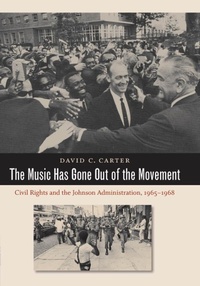
The Music Has Gone Out of the Movement
Civil Rights and the Johnson Administration, 1965-1968
Published on 1. September 2012
384 pages
978-1-4696-0657-6 (ISBN)
Description

After the passage of sweeping civil rights and voting rights legislation in 1964 and 1965, the civil rights movement stood poised to build on considerable momentum. In a famous speech at Howard University in 1965, President Lyndon B. Johnson declared that victory in the next battle for civil rights would be measured in “equal results” rather than equal rights and opportunities. It seemed that for a brief moment the White House and champions of racial equality shared the same objectives and priorities. Finding common ground proved elusive, however, in a climate of growing social and political unrest marked by urban riots, the Vietnam War, and resurgent conservatism.
Examining grassroots movements and organizations and their complicated relationships with the federal government and state authorities between 1965 and 1968, David C. Carter takes readers through the inner workings of local civil rights coalitions as they tried to maintain strength within their organizations while facing both overt and subtle opposition from state and federal officials. He also highlights internal debates and divisions within the White House and the executive branch, demonstrating that the federal government’s relationship to the movement and its major goals was never as clear-cut as the president’s progressive rhetoric suggested.
Carter reveals the complex and often tense relationships between the Johnson administration and activist groups advocating further social change, and he extends the traditional timeline of the civil rights movement beyond the passage of the Voting Rights Act.
Examining grassroots movements and organizations and their complicated relationships with the federal government and state authorities between 1965 and 1968, David C. Carter takes readers through the inner workings of local civil rights coalitions as they tried to maintain strength within their organizations while facing both overt and subtle opposition from state and federal officials. He also highlights internal debates and divisions within the White House and the executive branch, demonstrating that the federal government’s relationship to the movement and its major goals was never as clear-cut as the president’s progressive rhetoric suggested.
Carter reveals the complex and often tense relationships between the Johnson administration and activist groups advocating further social change, and he extends the traditional timeline of the civil rights movement beyond the passage of the Voting Rights Act.
More details
Other editions
Additional editions
David C. Carter
The Music Has Gone Out of the Movement
Civil Rights and the Johnson Administration, 1965-1968
Book
12/2014
The University of North Carolina Press
€45.30
Shipment within 15-20 days
David C. Carter
The Music Has Gone Out of the Movement
Civil Rights and the Johnson Administration, 1965-1968
Book
08/2009
The University of North Carolina Press
€67.04
Article exhausted; check different version
Person
David C. Carter is associate professor of history at Auburn University.
Content
- Intro
- Contents
- Preface
- Text Abbreviations
- 1. Leapfrogging the Movement: The Howard University Speech and the Tragic Narrative
- 2. Romper Lobbies and Coloring Lessons: Poverty Wars and the Child Development Group of Mississippi
- 3. The Cocktail Hour on the Negro Question: The Watts Riot, the Moynihan Report, and the Search for a Scapegoat
- 4. Bomb Throwers and Babes in the Wood: The White House Conference on Civil Rights
- 5. Mississippi Is Everywhere: The Meredith March and CDGM'S Last Stand
- 6. The Unwelcome Guest at the Feast: Vietnam and the Political Crisis of 1966
- 7. Scouting the Star-Spangled Jungles: The White House, the Community Relations Service, and the Dilemma of Urban Unrest
- 8. Just File Them-or Get Rid of Them: LBJ and the Fate of the Kerner Commission Report
- Epilogue. Two Nations: The Scars of Centuries
- Notes
- Bibliography
- Acknowledgments
- Index
- A
- B
- C
- D
- E
- F
- G
- H
- I
- J
- K
- L
- M
- N
- O
- P
- R
- S
- T
- U
- V
- W
- Y
