

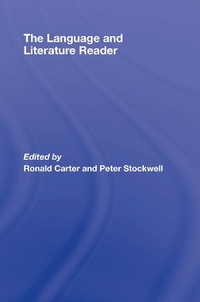
The Language and Literature Reader
1st Edition
Published on 19. August 2020
320 pages
978-1-000-11543-7 (ISBN)
Description

The Language and Literature Reader is an invaluable resource for students of English literature, language, and linguistics. Bringing together the most significant work in the field with integrated editorial material, this Reader is a structured and accessible tool for the student and scholar.
Divided into three sections, Foundations, Developments and New Directions, the Reader provides an overview of the discipline from the early stages in the 1960s and 70s, through the new theories and practices of the 1980s and 90s, to the most recent and contemporary work in the field. Each article contains a brief introduction by the editors situating it in the context of developing work in the discipline and glossing it in terms of the section and of the book as a whole. The final section concludes with a 'history and manifesto', written by the editors, which places developments in the area of stylistics within a brief history of the field and offers a polemical perspective on the future of a growing and influential discipline.
Divided into three sections, Foundations, Developments and New Directions, the Reader provides an overview of the discipline from the early stages in the 1960s and 70s, through the new theories and practices of the 1980s and 90s, to the most recent and contemporary work in the field. Each article contains a brief introduction by the editors situating it in the context of developing work in the discipline and glossing it in terms of the section and of the book as a whole. The final section concludes with a 'history and manifesto', written by the editors, which places developments in the area of stylistics within a brief history of the field and offers a polemical perspective on the future of a growing and influential discipline.
More details
Edition
1. Auflage
Language
English
Place of publication
London
United Kingdom
Publishing group
Taylor & Francis Ltd
Target group
College/higher education
ISBN-13
978-1-000-11543-7 (9781000115437)
Copyright in bibliographic data and cover images is held by Nielsen Book Services Limited or by the publishers or by their respective licensors: all rights reserved.
Schweitzer Classification
Other editions
Additional editions
Ronald Carter | Peter Stockwell
The Language and Literature Reader
Book
04/2008
1st Edition
Routledge
€206.90
Shipment within 15-20 days
Ronald Carter | Peter Stockwell
The Language and Literature Reader
Book
04/2008
1st Edition
Routledge
€72.90
Shipment within 15-20 days
Persons
<
Ronald Carter is Professor of Modern English Language at the University of Nottingham. He has written and edited more than 50 books in the fields of literary-linguistics, language and education, applied linguistics and the teaching of English. He has taught and lectured in over thirty countries world-wide and published over 100 academic papers. Recent and forthcoming books include: Exploring Grammar in Context (with Rebecca Hughes and Michael McCarthy) (CUP, 2000); The Cambridge Guide to Teaching English to Speakers of Other Languages (ed with David Nunan) (CUP, 2001); second editions of Working with Texts and (with John McRae) The Routledge History of Literature in English (Routledge, 2001) and The Routledge Guide to Modern Writing (2003). Language and Creativity: The Art of Common Talk (Routledge) was published in 2004 and forthcoming in 2005 is The Cambridge Grammar of English (with Michael McCarthy). Professor Carter is a fellow of the Royal Society of Arts, a fellow of the British Academy for Social Sciences and is currently chair of the British Association for Applied Linguistics (2003-2006).
Peter Stockwell is Professor of Literary Linguistics at the University of Nottingham and the author of many books and academic articles in the fields of literature and language, sociolinguistics, critical discourse analysis, language and cognition, surrealism and literary theory. His most recent books include Sociolinguistics (Routledge, 2001), Cognitive Poetics (Routledge, 2002) and Language in Theory (with Mark Robson, Routledge, 2004). He is the editor of the Routledge English Language Introductions series. Previous books include The Poetics of Science Fiction (Longman, 2000), a co-edited festschrift volume in honour of Professor Peter Verdonk of the Universiteit van Amsterdam, entitled Contextualised Stylistics (Rodopi). In 1996, with Howard Jackson, he wrote a language study textbook, An Introduction to the Nature and Functions of Language (Stanley Thornes), and edited (with Derek Littlewood) a collection of essays on science fiction and fantasy literature: Impossibility Fiction: Alternativity - Extrapolation - Speculation (Rodopi). In 1991 he edited with Phillip Shaw, Subjectivity and Literature from the Romantics to the Present Day: Creating the Self (Pinter). He also edits the e-journal Nottingham Linguistic Circular. In the School of English Studies, he is director of Praxis - the centre for the study of literary discourse. He is also head of Modern English Language, acts as Deputy Head of School, and is the Vice-Dean of the Faculty of Arts. Peter Stockwell is currently treasurer of the Poetics and Linguistics Association (PALA). >
Ronald Carter is Professor of Modern English Language at the University of Nottingham. He has written and edited more than 50 books in the fields of literary-linguistics, language and education, applied linguistics and the teaching of English. He has taught and lectured in over thirty countries world-wide and published over 100 academic papers. Recent and forthcoming books include: Exploring Grammar in Context (with Rebecca Hughes and Michael McCarthy) (CUP, 2000); The Cambridge Guide to Teaching English to Speakers of Other Languages (ed with David Nunan) (CUP, 2001); second editions of Working with Texts and (with John McRae) The Routledge History of Literature in English (Routledge, 2001) and The Routledge Guide to Modern Writing (2003). Language and Creativity: The Art of Common Talk (Routledge) was published in 2004 and forthcoming in 2005 is The Cambridge Grammar of English (with Michael McCarthy). Professor Carter is a fellow of the Royal Society of Arts, a fellow of the British Academy for Social Sciences and is currently chair of the British Association for Applied Linguistics (2003-2006).
Peter Stockwell is Professor of Literary Linguistics at the University of Nottingham and the author of many books and academic articles in the fields of literature and language, sociolinguistics, critical discourse analysis, language and cognition, surrealism and literary theory. His most recent books include Sociolinguistics (Routledge, 2001), Cognitive Poetics (Routledge, 2002) and Language in Theory (with Mark Robson, Routledge, 2004). He is the editor of the Routledge English Language Introductions series. Previous books include The Poetics of Science Fiction (Longman, 2000), a co-edited festschrift volume in honour of Professor Peter Verdonk of the Universiteit van Amsterdam, entitled Contextualised Stylistics (Rodopi). In 1996, with Howard Jackson, he wrote a language study textbook, An Introduction to the Nature and Functions of Language (Stanley Thornes), and edited (with Derek Littlewood) a collection of essays on science fiction and fantasy literature: Impossibility Fiction: Alternativity - Extrapolation - Speculation (Rodopi). In 1991 he edited with Phillip Shaw, Subjectivity and Literature from the Romantics to the Present Day: Creating the Self (Pinter). He also edits the e-journal Nottingham Linguistic Circular. In the School of English Studies, he is director of Praxis - the centre for the study of literary discourse. He is also head of Modern English Language, acts as Deputy Head of School, and is the Vice-Dean of the Faculty of Arts. Peter Stockwell is currently treasurer of the Poetics and Linguistics Association (PALA). >
Content
Preface. Acknowledgements. Part 1: Foundations 'Taking a Poem to Pieces' John Sinclair. 'Stylistics' David Lodge. 'Linguistic Function and Literary Style: An Inquiry into the Language of William Golding's The Inheritors' Michael Haliday. 'On the Deviance of Literary Discourse' Henry Widdowson. 'Applying Linguistics' Elizabeth Closs Traugott and Mary Louise Pratt. 'Linguistic Criticism' Roger Fowler. 'Metre' Geoffrey Leech. 'Discourse Analysis and Drama' Mick Short. Part 2: Developments 'Poem, Reader, Response: Making Sense with 'Skunk Hour' Michael Toolan. 'Style and Interpretation in Hemingway's "Cat in the Rain"' Ron Carter. 'Changing the Guard at Elsinore' Walter Nash. 'But what is Literature?: Toward a Descriptive Definition of Literature' Willie van Peer. 'Deixis and the Poetic Persona' Keith Green Bakhtin. Addressivity, and the Poetics of Objectivity' Alison Tate. 'Teach Yourself Rhetoric: An Analysis of Philip Larkin's "Church Going"' Katie Wales. 'World Enough and Time: Deictic Space and the Interpretation of Prose' Paul Werth. 'Making the Subtle Difference; Literature and Non-Literature in the Classroom' Guy Cook. Part 3: New Directions 'Educating the Reader: Narrative Technique and Evaluation in Charlotte Perkins Gilman's Herland' Jean Jacques Weber. 'Satirical Humour and Cultural Context: With a Note on the Curious Case of Father Todd Unctuous' Paul Simpson. (Sur)real Stylistics: From Text to Contextualizing' Peter Stockwell. 'Feeling Moved by Metaphor' Ray Gibbs. 'Point of View in Drama: An Analysis of Brimstone and Treacle' Dan McIntyre. 'Conrad in the Computer: Examples of Quantitative Stylistic Methods' Michael Stubbs. ''Split Selves" in Fiction and in Medical 'Life Stories'' Catherine Emmott. 'Too Much Blague? The Text Worlds of Barthelme's Snow White'' Joanna Gavins. 'A Cognitive Stylistic Approach to Mind Style in Narrative Fiction' Elena Semino. 'Connectives in Free Indirect Style: Continuity or Shift?' Violeta Sotirova. Part 4: Coda 'Stylistics: Retrospect and Prospect' Peter Stockwell and Ron Carter. Index
