

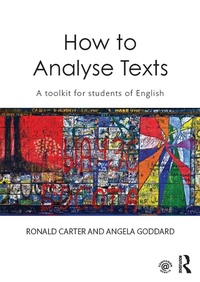
How to Analyse Texts
A toolkit for students of English
Published on 20. August 2015
261 pages
978-1-317-40552-8 (ISBN)
Description

How to Analyse Texts is the essential introductory textbook and toolkit for language analysis. This book shows the reader how to undertake detailed, language-focussed, contextually sensitive analyses of a wide range of texts - spoken, written and multimodal. The book constitutes a flexible resource which can be used in different ways across a range of courses and at different levels.
This textbook includes:
three parts covering research and study skills, language structure and use, and how texts operate in sociocultural contexts
a wide range of international real-life texts, including items from South China Morning Post, art'otel Berlin and Metro Sweden, which cover digital and print media, advertising, recipes and much more
objectives and skill review for each section, activities, commentaries, suggestions for independent assignments, and an analysis checklist for students to follow
a combined glossary and index and a comprehensive further reading section
a companion website at www.routledge.com/cw/goddard with further links and exercises for students.
Written by two experienced teachers of English Language, How to Analyse Texts is key reading for all students of English language and linguistics.
This textbook includes:
three parts covering research and study skills, language structure and use, and how texts operate in sociocultural contexts
a wide range of international real-life texts, including items from South China Morning Post, art'otel Berlin and Metro Sweden, which cover digital and print media, advertising, recipes and much more
objectives and skill review for each section, activities, commentaries, suggestions for independent assignments, and an analysis checklist for students to follow
a combined glossary and index and a comprehensive further reading section
a companion website at www.routledge.com/cw/goddard with further links and exercises for students.
Written by two experienced teachers of English Language, How to Analyse Texts is key reading for all students of English language and linguistics.
Reviews / Votes
"Without a doubt the most practical and innovative textbook on text analysis on the market. Not only do Carter and Goddard provide clear explanation of theoretical concepts, but they also provide concrete advice about how to go about the practical work of collecting and analysing a range of different texts. A superb introduction to text analysis for beginning students and a useful resource book for more advanced students and researchers."Rodney H. Jones, City University of Hong Kong
"This user-friendly book covers a wide range of carefully chosen text types and genres, and takes a modern approach to text analysis. How to Analyse Texts is a fantastic resource for students on undergraduate English Language courses."
Mario Saraceni, University of Portsmouth, UK
"This is a delightful coursebook marrying the study of a range of modern, multimodal, electronic, creative and ludic texts with the core tools of descriptive linguistics. It shows that multimodal texts can be taken seriously and that English grammar can be fun! The authors have put together a highly useful yet accessible introduction that will serve the next generation of students of media and modern English language very well."
Rajend Mesthrie, University of Cape Town, South Africa
"How to Analyse Texts is an impresssive introductory textbook for Communication and Humanities students. It covers all aspects of language studies in an accessible and clear way, guiding students step by step in the intricate processes of understanding and interpreting texts. The latest developments in linguistic/semiotic analyses are extremely well presented and illustrated. Ron Carter and Angela Goddard's toolkit book is, as they themselves say, 'to be used' in real situations and practices. I will certainly use it with my own students."Carmen Rosa Caldas-Coulthard, Federal University of Santa Catarina, Brazil and University of Birmingham, UK "Without a doubt the most practical and innovative textbook on text analysis on the market. Not only do Carter and Goddard provide clear explanation of theoretical concepts, but they also provide concrete advice about how to go about the practical work of collecting and analysing a range of different texts. A superb introduction to text analysis for beginning students and a useful resource book for more advanced students and researchers."
Rodney H. Jones, City University of Hong Kong
"This user-friendly book covers a wide range of carefully chosen text types and genres, and takes a modern approach to text analysis. How to Analyse Texts is a fantastic resource for students on undergraduate English Language courses."
Mario Saraceni, University of Portsmouth, UK
"This is a delightful coursebook marrying the study of a range of modern, multimodal, electronic, creative and ludic texts with the core tools of descriptive linguistics. It shows that multimodal texts can be taken seriously and that English grammar can be fun! The authors have put together a highly useful yet accessible introduction that will serve the next generation of students of media and modern English language very well."
Rajend Mesthrie, University of Cape Town, South Africa
"How to Analyse Texts is an impresssive introductory textbook for Communication and Humanities students. It covers all aspects of language studies in an accessible and clear way, guiding students step by step in the intricate processes of understanding and interpreting texts. The latest developments in linguistic/semiotic analyses are extremely well presented and illustrated. Ron Carter and Angela Goddard's toolkit book is, as they themselves say, 'to be used' in real situations and practices. I will certainly use it with my own students."Carmen Rosa Caldas-Coulthard, Federal University of Santa Catarina, Brazil and University of Birmingham, UK
"How to Analyse Texts provides several reasons for deserving a place of its own among the existing body of literature, owing in particular to the practical nature of the book: more than providing a theoretical description of language use and how texts can be analysed, the book works as a toolkit that provides learners with the tools required to analyse texts, and furthermore shows them how to use those tools. The book therefore aims to encourage an active learning process, whereby practical applications and activities encourage the readers to acquire real analytical skills."
Rui Sousa-Silva, Centro de Linguistica da Universidade do Porto, Portugal
More details
Language
English
Place of publication
London
United Kingdom
Publishing group
Taylor & Francis Ltd
Target group
Primary & secondary/elementary & high school
College/higher education
Product notice
Reflowable
Illustrations
2 s/w Tabellen, 42 s/w Photographien bzw. Rasterbilder, 8 s/w Zeichnungen
12 Tables, black and white; 8 Line drawings, black and white; 42 Halftones, black and white
File size
19,38 MB
ISBN-13
978-1-317-40552-8 (9781317405528)
Copyright in bibliographic data and cover images is held by Nielsen Book Services Limited or by the publishers or by their respective licensors: all rights reserved.
Schweitzer Classification
Other editions
Additional editions
Book
08/2015
1st Edition
Routledge
€215.41
Shipment within 15-20 days
Book
08/2015
1st Edition
Routledge
€61.40
Shipment within 15-20 days
Persons
Ronald Carter is Professor of Modern English Language in the School of English at the University of Nottingham, UK. He is the series co-editor of the Routledge Applied Linguistics, Routledge Introductions to Applied Linguistics and Routledge English Language Introductions series.
Angela Goddard is a Professor of English Language, a UK Higher Education National Teaching Fellow and Chair of Examiners for English Language A level at a national examination board. She has taught English across different sectors of education and at universities both in the UK and abroad. Her research interests include language and creativity, and the language of new technologies. She has written and edited many books and articles on English Language, including the Routledge Intertext series.
Angela Goddard is a Professor of English Language, a UK Higher Education National Teaching Fellow and Chair of Examiners for English Language A level at a national examination board. She has taught English across different sectors of education and at universities both in the UK and abroad. Her research interests include language and creativity, and the language of new technologies. She has written and edited many books and articles on English Language, including the Routledge Intertext series.
Content
Acknowledgements
List of Texts
Part I: Foundations: researching texts
Part II: Drilling Down: how texts are structured
Section 1: Graphological and Phonological levels
Section 2: Lexical and Semantic level
Section 3: Grammatical level
Part III: Building Up: Texts and Contexts
A checklist for text analysis
Corpus resources and projects
References
Links
Further reading
Glossary and Index
List of Texts
Part I: Foundations: researching texts
Part II: Drilling Down: how texts are structured
Section 1: Graphological and Phonological levels
Section 2: Lexical and Semantic level
Section 3: Grammatical level
Part III: Building Up: Texts and Contexts
A checklist for text analysis
Corpus resources and projects
References
Links
Further reading
Glossary and Index
