

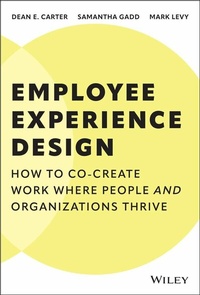
Employee Experience Design
Description

How to harness Employee Experience Design to attract and retain the best talent
In Employee Experience Design: How to Co-create Work Where People and Organizations Thrive, three highly experienced leaders explain how businesses can use Employee Experience Design to create workplaces that deliver better business results by first focusing on meaningful employee experiences.
Many leading organizations worldwide have successfully implemented Employee Experience Design, but until now, there has been no comprehensive book that outlines exactly how to do it. Employee Experience Design delivers a proven, step-by-step method that leads to more engaged and productive employees, which in turn leads to superior organizational performance.
With inspiring stories from leading brands like Airbnb, Patagonia, and many others, this book addresses challenges businesses face, such as:
- We all know that the world of work is continuously evolving and unpredictable. Many leaders are not sure how to make changes to address new, unexpected challenges. Employee Experience Design is a system leaders can use to meet those challenges.
- Employee Experience Design is much more than a rebrand of traditional HR practices. It's a shift in mindset that HR and the organization can use to navigate highly competitive markets and ones with thin profit margins.
- Many organizations are drowning in policies and initiatives. Employee Experience Design is a way to reduce that burden while delivering better results both for employees and for the bottom line.
Employee Experience Design is a timely and practical guide for business leaders, executives, and managers who want to recruit the best talent, engage and retain those people, and deliver impressive business results.
More details
Other editions
Additional editions
Persons
DEAN E. CARTER has over two decades of experience as an executive officer for renowned and Fortune50 companies such as Patagonia and Sears, as well as a board director for private and publicly traded companies. His views on employee experience and future of work are frequently featured in global publications, podcasts, corporate events, and mainstage keynotes.
SAMANTHA GADD is a globally recognised pioneer in Employee Experience Design. As Founder of Humankind, New Zealand's leading people and performance consultancy, and Excellent, a global EX Design certification, she has helped hundreds of organisations design work-places where people and businesses thrive. Samantha led the creation of the global EX Manifesto and continues to champion human-centred design as a strategic lever for performance.
MARK LEVY is the pioneer of the shift from HR to Employee Experience, which he and his team designed at Airbnb. Mark's career includes previous leadership roles at Best Buy, Levi Strauss & Co., and Gap Inc. Mark is an EX Advisor and Public Speaker.
Content
Part I Imagine 1
Chapter 1 The $100 Bill 3
Seeing Value Others Overlook
Chapter 2 Hardball Objections, Straight Answers 9
Chapter 3 The North Star 21
The EXD Guiding Principle
Chapter 4 A Conversation with Beth Grous 35
The Impact of Trust and Humanity, and the Courage of Everyday Leaders
Part II Prepare 47
Chapter 5 Mindsets 49
Seven Mindsets for Employee Experience Design Copyrighted Material
Chapter 6 A Conversation with Kirsty Lloyd 63
How Empathy and Feedback Became Cultural Anchors at Scale
Part III Design 77
Chapter 7 Culture Check 79
Moments That Matter and Moments of Truth
Chapter 8 Three Frameworks 87
A Structure for Achieving Meaningful Design
Chapter 9 The Double Diamond 109
A Proven Design Method
Part IV Experiment 137
Chapter 10 The EX Blueprint 139
Letting Everyone See the Big Picture
Chapter 11 A Conversation with Melanie Rosenwasser 145
Bringing UX Rigor to EX: It's a Product, Not a Perk
Part V Measure 159
Chapter 12 Metrics That Matter 161
Taking the Pulse of Your Organization
Chapter 13 A Conversation with Greg Pryor 175
Turning Experience into Intelligence and Then into Impact
Part VI Celebrate/Extend 187
Chapter 14 A Conversation with Michelle Bonfilio 189
The Emotional Core of Employee Experience Design
Chapter 15 Making EXD Your Own 205
Final Wisdom and What Grows over Time Postscript: A Personal Reflection from the Authors 211
Acknowledgments 213
About the Authors 219
Index 223
1
The $100 Bill
Seeing Value Others Overlook
Books like this one can feel a bit impersonal, but even though we are not sitting across from you, we're pretty sure that we know a little bit about you:
- You're a leader of people or take initiative to lead in your organization;
- You are tired of the traditional approach HR has taken in driving their initiatives into the organization;
- You are open-minded and looking for ways to improve your organization, or else you would not be reading this book;
- You've probably been around the block a few times and have seen plenty of fads come and go; and
- You have a highly developed BS meter.
How did we do? If this sounds like you, we're going to have a great time together.
You'll hear much more about us in the following pages, but it's important for you to know this: The three of us collectively have more than 75 years of experience in HR/EX and other leadership roles in organizations of all sizes-and we have super-sensitive BS meters, too.
Our purpose in writing this book is to give you insights that you can immediately use to improve your organization.
Because you've been around the block, right away we have a challenge on our hands: You've probably heard of "Employee Experience" or "EX." We'll be taking you through an approach to EX that is next level, and known as Employee Experience Design, or EXD. Relatively few organizations have fully implemented EXD, and the benefits are huge for those that have.
Our further goal is to talk with you, practitioner to practitioner, leader to leader. We don't need to tell you how hard it is to implement an initiative in your organization-no doubt you have the scars to show for it.
That means we've set the bar high for this book: We need to tell you at least a few things even you didn't know and that you can use right away in your own unique circumstances. It's a tall order, but we're up to the challenge.
It's Not Just a Book-It's a Handbook
Books are great, but often a handbook is even better, and that's what we've created here. Because we don't know your particular situation, we've laid out this handbook in a way that you can jump around to suit your interests, and easily refer back to sections as you work through challenges in your organization.
In this handbook, we try to cover three important aspects of EXD:
- The Why. Skeptical people are the best: They have lots of questions and need convincing before they'll get onboard with anything. This first part of the handbook covers why EXD is so important and addresses many legitimate-and tough-questions you may have. We also talk about how EXD leads to better business outcomes.
- The What. We have supported EXD in hundreds of organizations worldwide. This part of the handbook gives you the important mindset shifts, principles, decisions, actions, and tools you can use to implement EXD in your organization.
- The How. The greatest insights are useless if they never get implemented. But organizations are like fingerprints: no two are exactly alike, even though there are similarities. In this part, we give you what you need to know in order to make EXD work for your particular circumstances and for your role in the organization.
You're in for a Treat
We know literally thousands of professionals in HR/EX and other leadership roles, and some of those people shine like bright stars. They're special in at least two ways: they've implemented EXD in difficult circumstances, and they're great at telling their story.
Not only do we have full conversations with several stars in this handbook, but you'll hear from many others in the context of certain points we make throughout these pages.
The $100 Bill
We'll get into lots of hard-hitting questions soon, but right away we want to address what you might be thinking now:
If EXD is so great, why hasn't it gone viral? Why doesn't every organization use it?
Fair question, and it's where our parable comes in. Imagine that a wealthy person lost a $100 bill in a snowstorm. It landed in a gutter and got plowed into a pile of snow. Some days later, just a portion of that bill became visible in the snow and mud.
- The vast majority of people walk right by because they're busy, late for a meeting, on the phone, whatever.
- A few people see something muddy and green, but hey it's a thing in the gutter.
- Perhaps hundreds of people will walk by before someone stops, takes the time to recognize it, and makes the further effort to fish it out of the mud. The value of the bill was always there, but only a fraction of people will be in a position to both recognize it and take action.
EXD is the $100 bill. The mud is all the years of annual surveys and shiny new tech tools that obscure the true value of EXD, not to mention the barrage of information that buries us in more mud each week. If we can see past all that, EXD is there for the taking.
You're the one who paused and picked up what you saw as valuable, in the form of this handbook. What you'll learn can be transformative for your organization and for your career, as you'll soon see. It could even be worth millions.
Who Are We?
We are Dean E. Carter, Samantha Gadd, and Mark Levy. How three people from different continents and companies ended up writing a book together is a story we'll share later. And instead of writing out lengthy bios, which change regularly, we thought it would be more interesting to describe some of our collective professional experiences in no particular order:
- Sold adult diapers for Procter & Gamble.
- Worked as a labor-law attorney for a company where our job was to catch people making mistakes.
- Was CHRO for a 240,000-person company.
- Worked as a travel agent.
- Was an area trainer.
- Currently and in the past, have been on the boards of many companies.
- Lived and worked in Paris (very different organizational approach in France).
- Created a leadership development program.
- Dean of an academy for future heads of HR.
- Global head of talent at a branding and design firm.
- Learned how to sell and adjust eyewear.
- Built a woman-owned consultancy that's the largest of its kind in New Zealand.
- CHRO for iconic worldwide brands like Patagonia, Levi's, Gap, Eddie Bauer, Best Buy, Airbnb, Technicolor, Fossil.
- Have had the following departments reporting to one or more of us:
- HR
- Food and facilities
- Safety and security
- Wellness
- Social impact
- Finance
- Real estate
- Legal
- Family services
Although the three of us come from very different backgrounds, we share a common belief-HR and other roles that affect the experiences of employees are absolutely critical to the success of every organization. We also know that most of these roles have a pile of work, competing priorities, and limited resources.
This handbook can be an antidote to that situation when you apply what you learn here. We'll guide you through a path to do more that does not involve the typical "solution" of adding more to your plate or asking for a larger budget.
What EXD and This Handbook Are Not
Let's look at what else EXD and this guide are not:
- This is not a disguised pitch for expensive consulting services. On the one hand, it's true that we haven't found a way to condense three careers' worth of knowledge and experience into one volume. But we can guarantee you this: After finishing this guide, you'll have clarity on the specific path you can take to implement what you learn here, with nothing further to buy.
- Because we want to support you in ways that extend beyond this handbook, we will occasionally point you to a URL where you can leave your email address and we will send you (at no charge) additional reading or resources like handouts.
- EXD is not a silver bullet. You won't hear us making any claims along the lines of: "Five simple steps to revolutionize your business!" EXD takes real work to pull off-sometimes hard work by you and others. There will also be setbacks because we both know that real progress never happens in a straight line. But as you'll see, you're very likely to wish you had known of this approach much earlier in your career.
- EXD is not "one size fits all." That's both bad and good news. The bad is the work necessary to adapt EXD to your organization. It will take some practice to get full benefits from it. As you'll read later, we've certainly made our share of mistakes along the way. The good news is you will soon have something that's tailored to your unique situation and that delivers a substantial ROI on your efforts.
- Finally, this is not a "once and done" deal where you can form a team, get a new logo designed, and then check it off your list. We think you'll agree that we live in a continuous state of change. Whether it's...
