

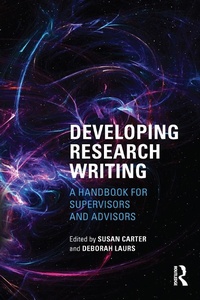
Developing Research Writing
A Handbook for Supervisors and Advisors
Published on 16. August 2017
278 pages
978-1-134-88811-5 (ISBN)
Description

Developing Research Writing is designed to encourage, inspire and improve the advisory practice of providing writing feedback. This book provides insights and advice that supervisors can use to advance their support of their research students' writing and, at the same time, survive increasing supervisory demands.
Book parts are framed by empirical supervisor and doctoral student experiences and chapters within each part provide multiple approaches. The carefully chosen contributors are specialists on research writing and doctoral pedagogy, who guide the reader through the key stages of providing feedback. Split into nine key parts the book covers:
starting a new supervision with writing in focus;
making use of other resources along the way;
encouraging style through control of language;
writing feedback on English as an Additional Language (EAL) writing;
Master's and Honours smaller projects' writing feedback;
thesis by publication or performance-based writing;
maintaining and gathering momentum;
keeping the examiner happy;
writing feedback as nudging through identity transition.
The parts cohere into a go-to handbook for developing the supervision process. Drawing on research, literature and experience, Developing Research Writing offers well-theorized, yet practical and grounded advice conducive to good practices.
Book parts are framed by empirical supervisor and doctoral student experiences and chapters within each part provide multiple approaches. The carefully chosen contributors are specialists on research writing and doctoral pedagogy, who guide the reader through the key stages of providing feedback. Split into nine key parts the book covers:
starting a new supervision with writing in focus;
making use of other resources along the way;
encouraging style through control of language;
writing feedback on English as an Additional Language (EAL) writing;
Master's and Honours smaller projects' writing feedback;
thesis by publication or performance-based writing;
maintaining and gathering momentum;
keeping the examiner happy;
writing feedback as nudging through identity transition.
The parts cohere into a go-to handbook for developing the supervision process. Drawing on research, literature and experience, Developing Research Writing offers well-theorized, yet practical and grounded advice conducive to good practices.
Reviews / Votes
Robyn Barnacle, School of Graduate Research, RMIT UniversityOverall I believe this book proposal has merit. The editors - particularly Susan Carter - and many of the contributors are well known within certain circles within Australian and New Zealand and - to a lesser extent - UK. However, the inclusion of Anthony Pare may lead to interest in Canada and Pat Thomson may lead to greater interest in the UK.
Terry D Evans Emeritus Professor at Deakin University
The editors are very experienced at this sort of editorial work on doctoral processes and have earned international reputations for their efforts. A major strength is that the topic is enduring and important. Given the ways that supervisory preparation and development is undertaken in universities, it is debatable whether a specific book would be in broad demand; it is more likely that specific chapters would be copied and used for supervisor workshops, courses etc.
More details
Language
English
Place of publication
London
United Kingdom
Publishing group
Taylor & Francis Ltd
Target group
Professional and scholarly
Illustrations
12 s/w Tabellen, 25 s/w Zeichnungen
12 Tables, black and white; 25 Line drawings, black and white
File size
3,68 MB
ISBN-13
978-1-134-88811-5 (9781134888115)
Copyright in bibliographic data and cover images is held by Nielsen Book Services Limited or by the publishers or by their respective licensors: all rights reserved.
Schweitzer Classification
Other editions
Additional editions
Book
08/2017
1st Edition
Routledge
€170.84
Shipment within 10-20 days
Book
08/2017
1st Edition
Routledge
€60.50
Shipment within 10-20 days
Persons
Susan Carter is Senior Lecturer in the Centre for Learning and Research in Higher Education (CLeaR), University of Auckland, New Zealand.
Deborah Laurs is Senior Learning Advisor in Student Learning Te Taiako, Victoria University of Wellington, New Zealand.
Deborah Laurs is Senior Learning Advisor in Student Learning Te Taiako, Victoria University of Wellington, New Zealand.
Content
Acknowledgements *
Who we are: contributors' biographical details *
Editors *
Chapter authors *
Introduction: opening the books on research writing feedback *
Part I: Starting a new supervision with writing in focus *
The relationship between reading, thinking and writing the literature review component of a doctoral confirmation proposal *
Settling students into a community of practice *
Framing feedback expectations: A 'pedagogy of explicitness' *
Setting up frameworks *
Part II: Making use of other resources along the way *
The role of tertiary learning advisors in successful doctoral completion *
Making the implicit explicit: generic writing workshops *
Peer-writing groups *
Online thesis-writing resources *
Part III: Encouraging style through control of language *
Giving feedback on grammar and style *
Giving early feedback to doctoral writers *
How to improve your advisees' writing permanently-in 30 minutes *
Part IV: Writing feedback on English as an Additional Language (EAL) writing *
Written feedback typically provided on L2 students' chapter drafts *
Five approaches to supporting students writing in English as an additional language *
Feeding back on research writing: New Zealand supervisors' priorities with an L2 focus *
Part V: Master's and Honours smaller projects' writing feedback *
Supervising master's/honours: A project management approach to researcher development *
Directive feedback in honours' or master's degree research *
Effective supervision of master's researchers in professional contexts *
Part VI: Thesis by publication or performance-based writing *
Feedback from journal reviewers: writing a thesis by publication *
Supervising a thesis that includes publications *
Finding my voice(s) in the creative arts thesis *
Part VII: Maintaining and gathering momentum *
Writing Methodically: Teaching Students by Our Words and Deeds *
Writing prolifically *
Strategies for helping students through writer's block *
Part VIII: Keeping the examiner happy *
Helping students demonstrate mastery of doctoral threshold concepts *
Building bulwarks: Defence in thesis writing *
What examiners value in a PhD *
Keeping the examiner happy - things to do: *
Part IX: Writing feedback as nudging through identity transition *
Writing an identity into being *
Negotiating agency through authorial voice in thesis writing *
Cultural identity/researcher identity: managing multiple positionings *
The SISA matrix for feedback fostering doctoral students' creativity *
Managing those haunting voices: A student and supervisor in dialogue *
Thinking rhetorically: A pragmatic approach to texts
Conclusion *
Bibliography *
Index *
Who we are: contributors' biographical details *
Editors *
Chapter authors *
Introduction: opening the books on research writing feedback *
Part I: Starting a new supervision with writing in focus *
The relationship between reading, thinking and writing the literature review component of a doctoral confirmation proposal *
Settling students into a community of practice *
Framing feedback expectations: A 'pedagogy of explicitness' *
Setting up frameworks *
Part II: Making use of other resources along the way *
The role of tertiary learning advisors in successful doctoral completion *
Making the implicit explicit: generic writing workshops *
Peer-writing groups *
Online thesis-writing resources *
Part III: Encouraging style through control of language *
Giving feedback on grammar and style *
Giving early feedback to doctoral writers *
How to improve your advisees' writing permanently-in 30 minutes *
Part IV: Writing feedback on English as an Additional Language (EAL) writing *
Written feedback typically provided on L2 students' chapter drafts *
Five approaches to supporting students writing in English as an additional language *
Feeding back on research writing: New Zealand supervisors' priorities with an L2 focus *
Part V: Master's and Honours smaller projects' writing feedback *
Supervising master's/honours: A project management approach to researcher development *
Directive feedback in honours' or master's degree research *
Effective supervision of master's researchers in professional contexts *
Part VI: Thesis by publication or performance-based writing *
Feedback from journal reviewers: writing a thesis by publication *
Supervising a thesis that includes publications *
Finding my voice(s) in the creative arts thesis *
Part VII: Maintaining and gathering momentum *
Writing Methodically: Teaching Students by Our Words and Deeds *
Writing prolifically *
Strategies for helping students through writer's block *
Part VIII: Keeping the examiner happy *
Helping students demonstrate mastery of doctoral threshold concepts *
Building bulwarks: Defence in thesis writing *
What examiners value in a PhD *
Keeping the examiner happy - things to do: *
Part IX: Writing feedback as nudging through identity transition *
Writing an identity into being *
Negotiating agency through authorial voice in thesis writing *
Cultural identity/researcher identity: managing multiple positionings *
The SISA matrix for feedback fostering doctoral students' creativity *
Managing those haunting voices: A student and supervisor in dialogue *
Thinking rhetorically: A pragmatic approach to texts
Conclusion *
Bibliography *
Index *
