

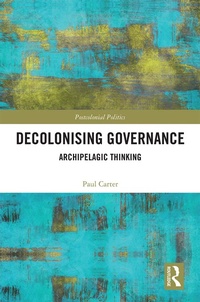
Decolonising Governance
Archipelagic Thinking
1st Edition
Published on 19. September 2018
252 pages
978-1-351-21302-8 (ISBN)
Description

Power may be globalized, but Westphalian notions of sovereignty continue to determine political and legal arrangements domestically and internationally: global issues - the legacy of colonialism expressed in continuing human displacement and environmental destruction - are thus treated 'parochially' and ineffectually. Not designed for dealing with situations of interdependence, democratic institutions find themselves in crisis. Reform in this case is not simply operational but conceptual: political relationships need to be drawn differently; the cultural illiteracy that prevents the local knowledge invested in places made after their stories needs to be recognised as a major obstacle to decolonising governance.
Archipelagic thinking refers to neglected dimensions of the earth's human geography but also to a geo-politics of relationality, where governance is understood performatively as the continuous establishment of exchange rates. Insisting on the poetic literacy that must inform a decolonising politics, Carter suggests a way out of the incommensurability impasse that dogs assertions of indigenous sovereignty. Discussing bicultural areal management strategies located in south-west Victoria, Maluco (Indonesia) and inter-regionally across the Arafura and Timor Seas, Carter argues for the existence of creative regions constituted archipelagically that can intervene to rewrite the theory and practice of decolonisation.
A book of great stylistic elegance and deftness of analysis, Decolonising Governance is an important intervention in the related fields of ecological, ecocritical and environmental humanities. Methodologically innovative in its foregrounding of relationality as the nexus between poetics and politics, it will also be of great interest to scholars in a range of areas, including communicational praxis, land/sea biodiversity design, bicultural resource management, and the constitution of post-Westphalian regional jurisdictions.
Archipelagic thinking refers to neglected dimensions of the earth's human geography but also to a geo-politics of relationality, where governance is understood performatively as the continuous establishment of exchange rates. Insisting on the poetic literacy that must inform a decolonising politics, Carter suggests a way out of the incommensurability impasse that dogs assertions of indigenous sovereignty. Discussing bicultural areal management strategies located in south-west Victoria, Maluco (Indonesia) and inter-regionally across the Arafura and Timor Seas, Carter argues for the existence of creative regions constituted archipelagically that can intervene to rewrite the theory and practice of decolonisation.
A book of great stylistic elegance and deftness of analysis, Decolonising Governance is an important intervention in the related fields of ecological, ecocritical and environmental humanities. Methodologically innovative in its foregrounding of relationality as the nexus between poetics and politics, it will also be of great interest to scholars in a range of areas, including communicational praxis, land/sea biodiversity design, bicultural resource management, and the constitution of post-Westphalian regional jurisdictions.
More details
Series
Edition
1. Auflage
Language
English
Place of publication
London
United Kingdom
Publishing group
Taylor & Francis Ltd
Target group
College/higher education
Illustrations
2 Line drawings, black and white
File size
6,52 MB
ISBN-13
978-1-351-21302-8 (9781351213028)
Copyright in bibliographic data and cover images is held by Nielsen Book Services Limited or by the publishers or by their respective licensors: all rights reserved.
Schweitzer Classification
Other editions
Additional editions
Book
06/2020
1st Edition
Routledge
€65.40
Shipment within 15-20 days
Book
10/2018
1st Edition
Routledge
€252.97
Shipment within 15-20 days
Person
Author of the acclaimed The Road to Botany Bay, an essay in spatial history, Paul Carter's more recent books include Dark Writing, geography, performance, design (2008), Meeting Place, the human encounter and the challenge of coexistence (2013) and Places Made After Their Stories, design and the art of choreotopography (2015). Also a poet, his collection Ecstacies and Elegies was published in 2013. Through his design studio Material Thinking he has made signal contributions to the public art and design of Federation Square (Melbourne) and Yagan Square (Perth). Paul Carter is Professor of Design/Urbanism at the School of Architecture and Design, RMIT University.
Content
Introduction
1. Exchange rates: figuring the archipelago
2. From your own seashore: a philosophical geography
3. Ocean connections: local knowledge and regions of care
4. Affiliations after the flood: archipelagic poetics
5. Overflow: a model for culture-based regional development
6. Bacan: biodiversity in the anarchipelago
Conclusion
1. Exchange rates: figuring the archipelago
2. From your own seashore: a philosophical geography
3. Ocean connections: local knowledge and regions of care
4. Affiliations after the flood: archipelagic poetics
5. Overflow: a model for culture-based regional development
6. Bacan: biodiversity in the anarchipelago
Conclusion
