

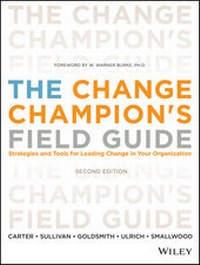
The Change Champion's Field Guide,
Description

Nearly a decade later, leading change pioneers in the field have realigned to bring you the second edition of the Change Champion's Fieldguide.
This thoroughly revised and updated edition of the Change Champion's Field Guide is filled with the information, tools, and strategies needed to implement a best practice change or leadership development initiative where everyone wins. In forty-five chapters, the guide's contributors, widely acknowledged as the 'change champions' and leaders in the fields of organizational change and leadership development, explore the competencies and practices that define an effective change leader. Change Champions such as Harrison Owen, Edgar Schein, Marv Weisbord, Sandra Janoff, Mary Eggers, William Rothwell, Dave Ulrich, Marshall Goldsmith, Judith Katz, Peter Koestenbaum, Dick Axelrod, David Cooperrider, and scores of others provide their sage advice, practical applications, and examples of change methods that work.
Change Champion's Field Guide examines the topic of leadership and change within four main topics including:
- Key elements of leading successful and results-driven change
- Tools, models, instruments, and strategies for leading change
- Critical success and failure factors
- Trends and research on innovation, change, and leadership
- Guidelines on how to design, implement, and evaluate change and leadership initiatives
- Fresh case studies that highlight leading companies who are implementing successful change in innovative and inspired ways.
Louis Carter is CEO and founder of Best Practice Institute (BPI) and concept innovator of the world's first 360-degree feedback tool on a social networking platform, skillrater.com. He and BPI were recognized as one of the top 15 in leadership development by Leadership Excellence magazine.
Roland Sullivan is one of the original 100 change agents. Mentored by Bennis, he has led change efforts with more than 1,000 organizations in 30 countries and taught in over 14 universities, including the most recognized change program in the world, Pepperdine University.
Marshall Goldsmith is widely recognized as one of the world's foremost authorities in helping leaders achieve positive, measurable change in behavior for themselves, their people, and their teams.
Dave Ulrich has been ranked by Business Week as the #1 management educator. He has also been listed in Forbes as one of the "world's top five" business coaches.
Norm Smallwood is president and co-founder of Results-Based Leadership, Inc. and is a recognized authority in developing businesses and their leaders to deliver results and increase value.
More details
Other editions
Additional editions
Content
- Intro
- The Change Champion's Field Guide: Strategies and Tools for Leading Change in Your Organization
- Copyright
- Contents
- List of Figures, Tables, and Exhibits
- Acknowledgments
- Who Should Read This Book?
- About This Book
- How to Use This Book
- Applications on the Job
- Taking Full Advantage of This Book
- Introduction by the Editors
- Foreword
- Prelaunch
- Self-Examination
- External Environment
- Establishing the Need for Change
- Establishing the Vision and Direction for the Future
- Launch
- Post-Launch
- Sustaining the Change
- Part One: Transformational and Large-Scale Change
- Chapter One: Driving Change Through Career Models: An Operating System for Integrated Talent Management
- HR and Business Transformation
- Service Orientation
- Guarding the Castle Means Not Taking Risks
- Integrated Talent Management Based on Career Models
- A Developmental Workforce Architecture Aligned to the Future State
- Future-State Architecture
- An Employee Engagement Framework
- Functional Differentiation
- A Foundation for Strategic Workforce Analytics
- Is it Working?
- At Microsoft
- At ITT
- Lessons Learned
- Conclusion
- Notes
- Chapter Two: Driving Cultural Transformation During Large-Scale Change
- Introduction
- Business Rationale for Engaging in Organizational Culture Change
- What Is Organizational Culture?
- I. Culture Change Takes Place More Effectively When Worked at Three Levels: Organizational, Team, and Individual
- II. Culture Change Is Accelerated by Connecting Individual Beliefs to Organizational Results
- III. Cultural Change Requires a Planned and Disciplined Implementation Cascade
- IV. Cultural Change Is Accelerated by Using a "Leader-Led Learning" Approach
- V. Technology Should Be Leveraged for Communications, Measurement, and Reporting Successes Related to Cultural Adoption and Transformation
- Conclusion
- Chapter Three: Leveraging Musical Experiential Learning for Organizational Impact
- The Art
- The Science
- Head, Heart, Hands-Integrated Learning
- Chapter Four: Navigating the White Water of Organization-Wide Change: Best Practice Principles for Change Management
- Reasons for Change Initiative Failure
- Inadequate Preparation for Change
- Flawed Change Implementation Activities
- Inability to Anchor Changes
- Principles for Bringing about Organization-Wide Change
- Principle 1: Assess the Change Situation Carefully Before Initiating Any Change
- Principle 2: Design an Initial Change Plan to Fit the Change Situation
- Principle 3: Communicate a Compelling Vision of the Bene. ts of Adopting This Change
- Principle 4: Monitor and Build or Maintain the Credibility of the Change Leader(s)
- Principle 5: Rely on "Influence Without Authority" Change Tactics as Much as Possible
- Principle 6: Revise the Change Plan as the Change Initiative Unfolds
- Principle 7: Be the Change You Seek in Others
- Practicing The Principles Through Simulated Experience
- Change Management Context
- Change Management Process
- Change Management Learning Outcomes
- Chapter Five: Practice Positive Deviance for Extraordinary Social and Organizational Change
- Introduction
- Background
- Desperate Times Lead to Desperate Actions
- The Challenge
- Testing the Hypothesis
- Community Ownership of the Solution
- Discovering the Positive Deviants
- Positive Deviance Inquiry
- Designing the Intervention
- Discerning and Disseminating: Keeping Score and Scoring Another Six-Month Visa
- Same Paradigm, New Applications
- From Condoms to Corporations-PD Amplified
- From PD Practitioner to "Amplifier"
- Conclusion
- Chapter Six: Restoring Hope During Times of Mistrust
- Executive Summary
- Introduction
- Whole-ScaleT in Action
- The Secrets to Unleashing Hope
- Purpose as the North Star
- Conclusion
- Chapter Seven: The Borderless Organization: Its Time Has Come
- Principles for Borderless Operation and Learning
- 1. Customer: Mutual Influence, Partnership, Transparent Interdependence, and Competent Relationships Are Essential in the Customer Experience
- 2. Globalization: What Happens Within Your Border Has an Impact on All Other Parts of Your World and Vice Versa
- 3. Nanotechnology: Utilize the Latest Nanotechnology to Process Relevant Data and Speed Interaction Among Essential Networks
- 4. Trust: Build Trusting and Credible Relationships with Those Who Most Need to Collaborate
- 5. Communication: Authentic Multidimensional Communication Breaks Down Silos and Removes Psychological Barriers to Oneness
- 6. Work Environment: Success is Not Taken for Granted
- People Are Obsessive About Creating a Happy Learning Environment
- 7. Strategic Networks or Adaptive Structures: The Command and Demand Hierarchical Structure is Consciously Destroyed and Replaced with Sensible, Agile Networks
- 8. Leadership Transformation: Leadership Walks the Talk in a Borderless Mindset
- 9. Talent Development: HR Policies and Practices Support a Borderless Organization
- 10. Organization Development: Facilitate Organization-Wide Learning with a Special Focus on One Team/One Vision So Borders Naturally Dissipate by Transforming an Internal Change Agent
- Conclusion
- Chapter Eight: The Costs of System Blindness and the Possibilities of System Sight: Middle Bashing, a Case in Point
- Middle Bashing Has a Long and Less Than Glorious History
- It's Not Personal
- Living in a World of Tearing
- The Space Can Do Us In
- Middles Losing Their Minds
- Living in a Tearing Condition Without Being Torn
- We're Not a Group
- Middle Peer Group Strategy
- Disperse and Integrate
- Overcoming the "I" Mentality
- Coda
- Chapter Nine: Words Matter: Build the Appreciative Capacity of Organizations
- Our Images and the Organizations We Live In
- Appreciation in Organizational Life
- Organizational Change
- An Appreciative Dynamic
- Building Blocks of Appreciative Inquiry
- The Power of Appreciation
- The Power of Inquiry
- Impact of Appreciative Inquiry Intervention
- Appreciative Inquiry at Roadway Express
- Plan an Appreciative Inquiry
- Affirmative Topic Choice
- Phase 1: Discover
- Phase 2: Dream
- Phase 3: Design
- Phase 4: Destiny
- Post-Summit Work
- The Benefits of Appreciative Inquiry
- Where to Find More Information
- Chapter Ten: Whole System Transformation Through a Polarity Lens: An Idea Whose Time Has Come
- Whole System Transformation Work Seen Through a Polarity Lens
- The "Either/Or" Transformation Lens: Seeing Only Part of the Picture
- The "Both/And" Lens: Seeing the Whole Picture
- Tap Polarities: Get the Energy in Your Transformation Effort Working for You
- The Rich History and Exciting Future of Polarities
- The Ancient Wisdom in Polarities
- Polarities Have Been "Re-Discovered" Within Business
- The Polarity Map: Anatomy of a Wisdom Organizer for Transformation Work
- Navigating Your Way Through Key Polarities
- The Organization's Interests and Individual Employee Interests
- Conditional Respect and Unconditional Respect
- Logic and Emotion
- Short Term and Long Term
- How Polarity Thinking Can Supplement Your Transformation Work
- Leveraging the Energy in All Polarities: Seeing, Mapping, and Transforming
- Including Key Stakeholders
- Seeing
- Mapping
- Transforming 1: Assessing Present Realities
- Transforming 2: Taking Action Steps
- Getting Unstuck: A Five-Step Approach to Accelerating Transformation Work
- Polarity Thinking and Transformation: An Idea Whose Time has Come
- Chapter Eleven: Whole Systems Transformation: An Effectiveness Paradigm Shift for Strategic Change
- Today's Transforming World
- The Practice of Whole System Transformation
- What is WST?
- Elements of the Whole Systems Transformation Model
- Element 1: The Outcome: Organization Agility
- Element 2: Pre-Launch
- Element 3: Leadership Transformation
- Element 4: Critical Mass Transformation
- Element 5: Sustained Development
- Element 6: Transform Internal Change Agent
- Element 7: Establish a Real-Time Strategic Transformation Team
- Element 8: Change Foci
- Element 9: Communication
- Element 10: Thrill the Customer
- Element 11: Results
- Element 12: Action Research
- Part Two: Fundamentals of Leading Change
- Chapter Twelve: Be a Skilled Communicator: Lead Dialogue Processes to Build Commitment and Reach Shared Understanding
- Introduction
- Background
- The Cost of Loose Coupling Among Talk, Decision, and Action
- It is Not That Difficult to Defend an Opinion
- It is Much More Difficult to Really Understand One
- What Makes This Approach Different, Interesting, and Innovative?
- Metallic Briefcase or a Brown Roll of Paper
- Flashmarks: Highlighting the Hot Spots
- Using Questions for Helping the Birth of Ideas
- An Open Process
- Summary
- Chapter:Thirteen: Build Expert Negotiators: What Do We Know About Training World-Class Negotiators?
- Introduction
- The Mutual Gains Approach to Negotiation
- Negotiation Capability is a Skill, Not a Gift
- There Is "Nothing So Practical as a Good Theory"
- Can One-time Training Help? Yes, But It Is Not Enough
- Negotiation Is an Organizational Not an Individual Task
- Coaching Advice to Senior Managers and Executives
- Conclusion
- Chapter Fourteen: Change Leadership Behavior: The Impact of Co-Workers and the Impact of Coaches
- The Five Organizations and Their Approaches
- Five Key Learnings
- Implications for Leadership Development
- Chapter Fifteen: Change Through Smart-Mob Organizing: Using Peer-by-Peer Practices to Transform Organizations
- Executive Summary
- Why Peer-by-Peer Now
- Three Ways to Use Peer-by-Peer Practices
- 1. Face-to-Face Meetings
- 2. Social Networks
- 3. Collaboration Technology
- Suggestions for Putting Peer-by-Peer Practices Into Place
- Implications for Change Sponsors and Other Leaders
- Chapter Sixteen: Do Leaders Have Tools and a Common Language to Work Together for Sustainable Change?
- Introduction
- Context
- Leader's Toolbox® Approach
- The Leader's MapT as a Tool
- When to Use the Leader's MapT
- How to Use the Leader's MapT
- Leadership Tools
- Example Tool: The Four Cs (Communication + Commitment + Consequences = Contract)
- Conclusion
- Chapter Seventeen: How Nature Innovates: The Competitive Edge for Organizations
- Introduction
- Natural Wisdom
- Change Changes
- Phase I: Experimentation
- Phase II: Improvement
- Phase III: Innovation
- Rules for Success
- The Process
- Culture?
- Environment?
- Navigating Phase III
- Sources of Phase III Innovation
- Conclusion
- Chapter Eighteen: Liberating Structures: A Pattern Language for Engagement
- What is a Pattern Language?
- Conclusion
- Chapter Ninteen: Maintain the Highest Ethics and Integrity: Raise the Bar from Corporate Compliance to Total Organizational Integrity
- The Ethics Landscape
- Moving Beyond Legal and Compliance
- Total Organizational Integrity
- Strategically Based
- Leadership Involvement
- Total Integration
- Tactical Deployment
- Review and Updating
- Individual Integrity
- Conclusion
- Chapter Twenty: Meetings: Will You Choose Contentment or Greatness?
- Meetings Matter
- What Are Habits?
- What is Your Meeting Habit?
- Change a Habit by Replacing It
- What We Don't Need is More Training on Meetings
- Meetings as Conversations
- Make Your Next Meeting as Engaging as a Video Game
- Engaging Meetings Are Productive Work Experiences
- Meetings and Your Brain
- Make The Most of Your Meeting Opportunities
- Chapter Twenty-One: My Life on the Learning Curve
- Revisiting Lewinian Action Research
- Getting Ahead of the Curve
- Capitalizing Experience
- A New Myth: Learning from Experience
- Change My Myths, Change My Practice
- Chapter Twenty-Two: Open Space Technology- And Beyond
- Conclusion 1-All Systems Are Open
- Conclusion 2-All Systems, Including Human Systems, Are Self-Organizing
- Conclusion
- Chapter Twenty-Three: Rethinking Scale in Organizational Change
- Seven Types of Mental Models
- Discovering the Theory of Process
- Looking at Team Process
- Jumping to Thinking at an Organizational Scale
- Chapter Twenty-Four: Ten Principles for Changing the World One Meeting at a Time
- Introduction
- Six Principles for Managing Structure
- Principle 1-Get the Whole System in the Room
- Principle 2-Control What You Can, Let Go What You Can't
- Principle 3-Explore the Whole Elephant
- Principle 4-Let People Be Responsible
- Principle 5-Find Common Ground
- Principle 6-Master the Art of Subgrouping
- Four Principles for Managing Our Own Behavior
- Principle 7-Make Friends with Anxiety
- Principle 8-Get Used to Projections
- Principle 9-Be a Dependable Authority
- Principle 10-Learn to Say No If You Want Your Yes to Mean Something
- Conclusion
- Chapter Twenty-Five: The Philosophic Change Champion: Philosophy in a New Era (Work in Progress)
- Tutorial for a World That Works
- Who We Are
- Principles
- What is Root-Cause Analysis?
- The Next Generation of Best Practices: A Research Program
- Going Forward, Your Self is Your Instrument and Your Organization is Your Vehicle-In How You Show Up in the World. Are You Ready?
- Summation: Essentials
- Out of a Job?
- A Mnemonic
- Your New Mind for the Post-It Age
- The Outer Diamond: Leadership Capacity (Key!)
- The Inner Diamond
- Translation
- Transition to Details of Deep Structure Number One: EGO, Freedom, and/Free Will
- Free Will Anecdote
- Bringing it All Together
- The Structure of Free Will
- Authenticity in Leadership: The Power of Free Will
- Quality Decisions in Times of Change and Stress
- Reflection
- Ask Yourself, "What is Happiness?"
- Sample Informal Deep-Structure Analysis
- Why Happiness
- Support Strength
- External Space and Internal Space in Dialogue
- Supplement
- Locating the Spiritual Dimension Among the Diversity of Worldviews
- At The Edge of That Which Is
- 1. STEM (Science, Technology, Engineering, and Math)
- 2. Why is There Something Rather Than Nothing? (Leibniz, 17th Century
- Heidegger, 20th Century)
- 3. Consciousness (Global Spirit, the Cosmic Mind, or World Reason)
- 4. The Archetypal Decision for Finitude
- The Edge of Thought
- The Ultimate Deepening
- Chapter Twenty-Six: Understand and Apply Sociology and Anthropology: Build Brand and Leadership Through Business Anthropology, Market Research, and Scenario Planning
- What's New?
- The Big Shifts
- Need for Innovation
- Anthropological Research Strategies
- Scenario Planning
- Customized Consumer Panels
- Emerging Technologies and Outsourcing
- Scenario-Based Futures of Consumer Research
- Chapter Twenty-Seven: Value Diversity and Inclusion: Leveraging Differences for Bottom-Line Success
- Introduction
- Diversity in a Box
- Why Focus on Leveraging Diversity and Creating a Culture of Inclusion?
- What is an Inclusion Breakthrough?
- A Demanding Business Environment
- A Changing Workforce
- New Competencies for a New Workplace
- Strategy is Key
- Making Leveraging Diversity and Inclusion a Way of Life
- Conclusion
- Part Three: Transformational Leadership and Sustaining Results
- Chapter Twenty-Eight: Changing Organizational Culture Through Clear Leadership
- What Started at Palomar Health and Why
- The Clear Leadership Model
- Why We Don't Learn from Our Collective Experience in Organizations
- On Top of That, We Make Up Stories About Each Other's Experiences
- Executive Teams Can Have the Most Mush
- The Experience of Clearing Out the Mush Among Executives at Palomar Health
- Moving it Down and Changing the Organization's Culture
- The Clear Leadership Model in More Depth
- Creating a Climate of Clarity Requires Leadership Maturity
- Chapter Twenty-Nine: Crucial Conversations, Transformational Moments, and Real Organizational Change
- Introduction: What Should We Change?
- The Case of a New CEO
- So, What's a Leader to Do?
- The Pivot Point
- Putting a Spotlight on The Human Barriers to Change
- Crucial Conversations Help to Create Transformational Moments
- Change Me-Change Us
- One More Benefit-We Become Smarter!
- Conclusion
- Chapter Thirty: Develop Leaders Who Build Market Value: The Right Results, The Right Way
- Steps for Change Management
- 1. Build a Case for Change
- 2. Tie Leadership Development to Existing Business Initiatives
- 3. Articulate One Theory of Leadership for Leaders at Every Level
- 4. Assess Your Leaders Using Your Leadership Brand as the Goal
- 5. Targeted Investment in Leaders
- 6. Measure Impact of Investment in Leadership Development
- Conclusion
- Implications
- Chapter Thirty-One: Developing Organization Change Champions Throughout the Organization
- The Urgent Need to Develop Skills in Managing Change
- Why Few Changes Succeed and a High-Payoff Alternative
- The Roles of Organization Change Champions
- Initiating Change
- Facilitating Change
- Implementing Change
- Guidelines for Training and Utilizing Organization Change Champions
- Conclusion
- Chapter Thirty-Two: Early Traps in Consulting Efforts: Managing Dysfunctional Client Behavior During "Entry"
- Introduction
- The Messianic Form
- The Doomsday Form
- The Counter-Dependence Form
- Conclusion
- Chapter Thirty-Three: Keep Good Company: New Ways to a Sustainable, Blue-Chip Creative Culture
- Introduction
- Project Platypus
- Thirteen Ways to a Sustainable Creative Culture
- The Right Mix
- Environment
- Create Big Challenges
- Time to Graze
- Shared Experience
- It's About Trust
- Storytelling
- Joy
- The Individual and the Group
- Collaboration, Not Competition
- Chaos is Good
- Intuitive Leaders
- An Evolving Culture
- Chapter Thirty-Four: Manage Your Work and Values: Go Beyond Replacing Executives and Manage Your Work and Values
- Introduction
- The Call to Action
- Reason 1: Terrorism and the Aftereffects
- Reason 2: Demographic Changes
- Reason 3: The Crisis in Confidence About Business Leadership
- Reason 4: Tightened Immigration
- Defining Succession Management
- Why Succession Management is Requested
- Succession Management Defined
- How Succession Management is Carried Out
- Traditional Problems with Succession Management
- Why Succession Management is Not Enough
- Managing Work
- Managing How to Do the Work
- Prediction
- What These Alternatives Will Do and Will Not Do
- Managing Values and Ethics
- How Organizations Establish Corporate Value Statements and Code of Conduct Statements
- How to Improve and Integrate Values and Ethics Modeling with Succession Management
- Predictions
- Conclusion
- Chapter Thirty-Five: Managing Organizational Emotional Alignment for Exceptional Business Performance Results
- Introduction
- Emotional Mismanagement
- The Stress Effect
- Revitalizing Performance While Reducing Stress
- Assessment Instrument
- Organizational Cost Savings
- The Role of the Heart in Heartmath Interventions
- Harnessing the Power of the Heart
- Measuring Organizational Alignment
- Business Heart
- Coherence as a Key Performance Indicator
- Conclusion
- Chapter Thirty-Six: The Role of Leadership in the Management of Organizational Transformation and Learning
- Learning Anxiety and Survival Anxiety
- What Leaders Should Not Do-Increase Survival Anxiety
- What Leaders Should Do-Decrease Learning Anxiety
- How Can Leaders Increase Psychological Safety?
- 1. Provide a Positive Vision of the Future ("Higher Purpose")
- 2. Involve the Learners in the Process
- 3. Create a Climate of Support and Encouragement
- 4. Provide a Practice Field, a Safe Learning Environment
- 5. Provide a Clear Direction and First Steps
- 6. Create a Group Setting for Learning
- 7. Provide Role Models and Coaching Help
- 8. Create Norms and Incentives That Encourage Embracing of Errors
- Conclusion
- Chapter Thirty-Seven: You Can't Become a Champion Unless You Keep Score: Measuring People Management Programs
- Introduction
- The Benefits of Metrics
- The Top Ten Reasons Why HR Should Utilize Metrics
- 1. Shift to "Fact-Based" Decisions
- 2. To Obtain Funding
- 3. To Meet Your Goals
- 4. To Drive Improvement
- 5. To Change Behavior
- 6. To Eliminate Confusion About What is Important
- 7. To Give Early Warning Alerts or "Smoke Detectors"
- 8. To Understand Critical Success Factors
- 9. To Build Coordination/Cooperation
- 10. To Demonstrate That Metrics Plus Technology Equal Better Decision Making
- Other Reasons Why HR and Talent Management Must Champion the Use of Metrics
- Improving People's Productivity Has Huge Economic Benefits
- Technology Allows Managers to Shift to Fact-Based Decisions
- Globalization and "the Speed of Business" Also Force Managers to Shift to Fact-Based Decisions
- HR is the Last Function to Fully Adopt Metrics
- Dooming "People Programs" to a Life of Being Underfunded
- Understanding Why HR Metric Efforts Have Produced Limited Results
- The Top Twenty Faults with HR Metric Approaches
- Decision Making and Action-Related Faults
- Metric Selection-Related Faults
- Steps in Developing Metrics
- Step 1. Select a Metric for Each Program Goal
- Step 2. Choose Some Soft and Some Hard Metrics
- Step 3. Understanding the Five Categories of Business Impact
- Step 4. Apply the Characteristics of Great Measure to Any Metric You Develop
- Step 5. Develop a List of "Standard" HR Functional Metrics
- Step 6. Select Some Simple, but Attention-Getting Metrics
- Step 7. Consider Adopting Advanced Metrics
- Step 8. Build the Business Case for Increased HR Funding
- Step 9. Use "Testing" to Provide "Dead Bang" Proof of Your Business Impact
- Conclusion
- Part Four: Case Studies of Change Methods in Action
- Chapter Thirty-Eight: Case Study 1: Action Learning in Action: Crack the Code at Bank of America
- Crack the Code Objectives and Approach
- Purpose
- Project Goals and Objectives
- Overall Process
- An Overview of Six Sigma Methodology
- Action Learning Program Framework
- Implementation and Key Findings
- Diagnosis of the Situation
- Measurement and Analysis
- Learning Administration
- Learning Design and Development
- Metrics and Implications for Learning Analyses
- Recommendations
- Stakeholder Engagement
- Project Recommendations
- Key Learnings
- From Six Sigma/DMAIC Process
- From Action Learning Process
- Conclusion
- Chapter Thirty-Nine:Case Study 2: Appreciative Inquiry in Action: Telefonica
- Creating Commitment
- Striving for Excellence
- Building Collective Identity
- Chapter Forty: Case Study 3: Culture Change in Action: Twelve Months Without Buy-In
- An Accountability-Based Approach to Change and Culture Transformation
- Mutually Agreed-Upon Desired Outcomes
- People at All Levels and All Functions Can Be Counted on to Take Actions
- Phase 1: An Accountability Assessment
- Summary of Conclusions for the Accountability Assessment
- Phase 2: Culture Change Based on Crossfunctional Accountability
- Step 1: Working Session with IS Senior Management Team
- Step 2: Working Session with IS Middle Managers
- Step 3: Team and Individual Coaching
- Step 4: Follow-Up Session 1
- Step 4: Follow-Up Session 2
- Epilogue
- Chapter Forty-One: Case Study 4: Developing Leaders in Action: Globalizing Leadership at LG Electronics
- Building the Business Case
- 1. Building the Business Case
- 2. Defining the Leadership Brand
- 3. Assessing Leaders and Leadership
- 4. Invest in Developing Leaders
- 5. Measure Results and Impact
- 6. Ensure External Reputation
- Being the Change You Want to See
- Summary
- Chapter Forty-Two: Case Study 5: Emotional Intelligence in Action: Sabre Holdings Corporation
- Background and Objectives
- Project Implementation
- Outcomes
- Next Steps
- Chapter Forty-Three: Case Study 6: Open Space in Action: A Structure for Emergent Strategy and Change at Accor's Summer University
- A Search for a Strong Identity
- Opening Space in a Solid Container
- Successful Integration of Sofitel and Pullman
- Novotal Change Process "Back to the Future"
- Decentralization of Training and Development
- Introduction of a Policy for Corporate Citizenship
- Creation of Club Accor
- The Longer-Lasting Impact
- Chapter Forty-Four: Case Study 7: Transformational Change Moments in Action: South Texas Project
- The Challenge
- The Path Forward
- Results
- Chapter Forty-Five: Case Study 8: Whole System Transformation and Polarity in Action: The Business of Paradox at Cargill and at BBC News
- Presenting Issues
- Key Events
- Project Launch
- The Stories
- Mapping
- Design
- Editor's Day
- Implementation Workshops
- Recommendations
- Sustained Impact
- References and Suggested Readings
- Who Should Read This Book
- Introduction by the Editors
- Foreword
- Chapter One
- Chapter Two
- Chapter Three
- Chapter Four
- Chapter Six
- Chapter Seven
- Chapter Eight
- Chapter Nine
- Chapter Ten
- Chapter Eleven
- Chapter Twelve
- Chapter Thirteen
- Chapter Sixteen
- Chapter Eighteen
- Chapter Twenty
- Chapter Twenty-One
- Chapter Twenty-Two
- Chapter Twenty-Three
- Chapter Twenty-Four
- Chapter Twenty-Seven
- Chapter Twenty-Eight
- Chapter Twenty-Nine
- Chapter Thirty
- Chapter Thirty-One
- Chapter Thirty-Two
- Chapter Thirty-Three
- Chapter Thirty-Four
- Chapter Thirty-Five
- Chapter Thirty-Six
- Chapter Thirty-Seven
- Chapter Forty-Three: Case 6
- Name Index
- Subject Index
- About the Contributors
- Part I: Transformational and Large-Scale Change
- Chapter 1
- Chapter 2
- Chapter 3
- Chapter 4
- Chapter 5
- Chapter 6
- Chapter 7
- Chapter 8
- Chapter 9
- Chapter 10
- Chapter 11
- Part II: Fundamentals of Leading Change
- Chapter 12
- Chapter 13
- Chapter 14
- Chapter 15
- Chapter 16
- Chapter 17
- Chapter 18
- Chapter 19
- Chapter 20
- Chapter 21
- Chapter 22
- Chapter 23
- Chapter 24
- Chapter 25
- Chapter 26
- Chapter 27
- Part III: Transformational Leadership and Sustaining Results
- Chapter 28
- Chapter 29
- Chapter 30
- Chapter 31
- Chapter 32
- Chapter 33
- Chapter 34
- Chapter 35
- Chapter 36
- Chapter 37
- Part IV: Case Studies and Methodologies in Action
- About Best Practice Institute

