

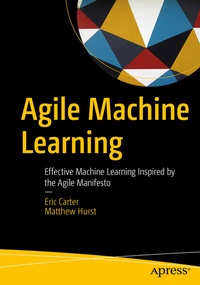
Agile Machine Learning
Description

Build resilient applied machine learning teams that deliver better data products through adapting the guiding principles of the Agile Manifesto.
Bringing together talented people to create a great applied machine learning team is no small feat. With developers and data scientists both contributing expertise in their respective fields, communication alone can be a challenge. Agile Machine Learning teaches you how to deliver superior data products through agile processes and to learn, by example, how to organize and manage a fast-paced team challenged with solving novel data problems at scale, in a production environment.
The authors' approach models the ground-breaking engineering principles described in the Agile Manifesto. The book provides further context, and contrasts the original principles with the requirements of systems that deliver a data product.
What You'll Learn
-
Effectively run a data engineeringteam that is metrics-focused, experiment-focused, and data-focused
-
Make sound implementation and model exploration decisions based on the data and the metrics
-
Know the importance of data wallowing: analyzing data in real time in a group setting
-
Recognize the value of always being able to measure your current state objectively
-
Understand data literacy, a key attribute of a reliable data engineer, from definitions to expectations
Who This Book Is For
Anyone who manages a machine learning team, or is responsible for creating production-ready inference components. Anyone responsible for data project workflow of sampling data; labeling, training, testing, improving, and maintaining models; and system and data metrics will also find this book useful. Readers should be familiar with software engineering and understand the basics of machine learning and working with data.
More details
Other editions
Additional editions
Persons
Matthew Hurst is a Principal Engineering Manager and Applied Scientist currently working in the Machine Teaching group at Microsoft. He has worked in a number of teams in Microsoft including Bing Document Understanding, Local Search and in various innovation teams.
Content
Chapter 1: Early Delivery.- Chapter 2: Changing Requirements.- Chapter 3: Continuous Delivery.- Chapter 4: Aligning with the Business.- Chapter 5: Motivated Individuals.- Chapter 6: Effective Communication.- Chapter 7: Monitoring.- Chapter 8: Sustainable Development.- Chapter 9: Technical Excellence.- Chapter 10 Simplicity.- Chapter 11: Self-organizing Teams.- Chapter 12: Tuning and Adjusting.- Chapter 13: Conclusion.
