

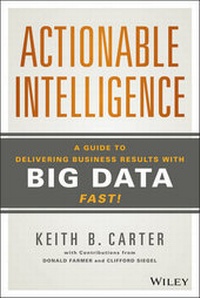
Actionable Intelligence
Description

More details
Other editions
Additional editions
Persons
Content
Preface
What's actionable intelligence?
In speaking around the world on the topic of making better decisions using facts, I've found again and again that leaders from all industries yearn for more information. They want to be able to assess risks and opportunities quickly and efficiently. They want answers in enough time to be able to make a difference. They want to seize opportunities. They need intelligence that is on time and accurate. They want what I call “actionable intelligence.”
A Vision of What Could Be: The Hospital Information System
As I was beginning my own journey into actionable intelligence, my mother had a stroke. Her stroke led me to understand the real need for intelligence in a transformative way.
It was a gray day in early 2010. I was on my way to my office at the Estée Lauder Companies, Inc. in Melville, New York, where I was working in a global role establishing an intelligence organization, running the project management office (PMO) for supply chain, managing Sarbanes -Oxley and customs compliance, and implementing operational efficiencies throughout the business.
As I drove to the office, my head was filled with thoughts of supply chain intelligence. My thoughts were interrupted when my cell phone started ringing.
It was my father.
“Son, I'm at the hospital. Your mother fainted in the bathroom this morning and I couldn't revive her.”
Silence. . ..
I asked, “Where are you? What hospital?”
“Please come to South Nassau Community Hospital,” he responded.
When I arrived at the hospital, my mother, Mary, was sitting up in bed, looking a bit weak.
The doctor told me, “Your mother had a stroke.”
She looked fine, but could only mouth words to us. She could not speak. Miraculously, she began to speak about 30 minutes later and was able to move her arm. We spent the rest of the day at the hospital, waiting and wondering.
At about 6:30 the next morning, as I was making my way out of my house, my cell phone rang. It was a nurse at the hospital.
“Mr. Carter, come quickly to the hospital,” he said. “Your mother had another stroke.”
I was numb.
I immediately called my dad and drove over to the hospital.
When I arrived at my mom's bedside, she couldn't speak, she couldn't move the right side of her body or her left arm. As she was poked and prodded by the doctors, she didn't visibly react to any pain.
Tears came to my eyes. Here was my mom—my hero for life—now with a contorted face and unable to speak or move.
I became greatly concerned. What efforts would be made to support my mother?
I asked for information—basic things, such as what we could expect medications to do to help my mother. The hospital staff responded coldly: “We are busy. Later we will try to give you the information.”
I pushed for more: “How did this second stroke happen? What do the MRI and X-rays look like?”
They responded, “We don't have that information. Go to records downstairs.”
I did, but to see the records I had to stand in line and pay. I received the images on a disk in a format I couldn't immediately view.
In fact, I ran into roadblocks that prevented me from gathering facts at every turn.
It was difficult to find doctors who would explain the situation, and nurses were at best impatient and often downright mean. (I would realize later that their frustration stemmed from being worked hard and lacking information themselves to respond to customers like me.)
The situation was beyond frustrating. I just couldn't access information fast enough, and relatives from all over the country were asking me again and again, “What's the status?” “How's Mary?” “What medicines is she taking?” “How often?” “When?” “How much?” “With what?” “What are the side-effects?”
And so on and so on.
I became information central. I set up conference calls at specific times for my relatives to provide information so I wouldn't have to call 50 people individually. However, these calls were very frustrating because I was stuck between a hospital that didn't readily share updates about my mother and family members who wanted to be totally involved in her care. They were all concerned, and so was I. We wanted facts so we could understand and improve the situation.
Thankfully, an angel and dear family friend, Dr. Linda Huang, helped us move my mom to Columbia University Presbyterian Hospital (Columbia for short).
Each case of moving a patient from one hospital to another is different, but typically, the accepting physician reviews the case and assesses the risk versus the benefits of moving the patient. Thankfully, Linda, a graduate of Columbia Dentistry and assistant professor of the same, was able to make it happen.
Columbia was amazing! I drove there following the ambulance. When I arrived and saw my mother being taken care of, I immediately approached a doctor. He took the time to walk my father and me through her case.
I had been trying to understand the medications prescribed to my mother at the other hospital, but the nurses and doctors were always too busy there. When I asked the doctors at Columbia, they said, “Wait one moment.” And, indeed, in just minutes, they presented a chart of medications. The chart explained the indications, contraindications, side effects, timing, and dosages of all the medications. Wow! Talk about instant information.
It was amazing; the hospital staff had time to spend with me and had all the information they needed at their fingertips.
Later, I would ask the doctors more questions—specifically, about the MRI that I never saw at the previous hospital. You will recall that the previous hospital gave us a CD that could be viewed only using specific hospital software—and cost me time and money to receive.
The Columbia doctor took me over to a workstation in the hallway. These workstations were located throughout the hospital. He logged in, entered my mother's information, and immediately brought up all her records. He showed me the MRI on the spot, and calmly and respectfully showed me the infarction (dead part of the brain) and explained its impact.
I didn't have to go to a separate records department. I didn't have to wait in line. I didn't have to pay. And, importantly, I could immediately view and understand the information. Why? Because the information was at the doctor's fingertips. And, he took time to explain everything to me in a way that had meaning.
The hospital information system was so powerful at Columbia that anytime I wanted information I could simply ask and it was given. Staff could just as easily access information.
I was very impressed, and my family was pleased with the understanding that this new flow of information enabled. The level of care at Columbia was remarkably more engaging and patient-oriented—all because of information.
It was this hospital experience that propelled me toward a journey to actionable intelligence capabilities: instant access to forward-looking information on everyone's desktops.
Benefits of Actionable Intelligence
As a business leader or a business function lead, you have customers . Don't you want to be able to find information about a specific request from a customer immediately? Just as Columbia University Presbyterian Hospital has thousands of patients, you might have thousands of orders. The ability to find the right information for a customer at the right moment—and to be able to immediately explain the information—earns you so much trust and faith, it is impossible to measure the benefit.
Without the kind of hospital information system that Columbia University Presbyterian has, when someone asks a question you likely have to say, “Let me call you back,” then research the information, which possibly involves e-mailing other people. (Hopefully, they will send a response.) This is an issue because people are impatient and very busy. The reason they are asking your business a question is because they want to know the information right now, not 30 minutes later and certainly not days later.
Think about the soft benefits of having answers at your fingertips:
- You don't have to take as much time to answer the customer.
- The customer has more confidence in your ability to deliver.
- Expectations can be set quickly.
The hard benefits:
- When you share the information, you can react to the customer's request and achieve hard benefits right away by adjusting the order if they need more or less.
- More broadly, all plans can be adjusted to take into account all the known information at all times, leading to real savings and increased efficiency at a relatively small cost.
For a concrete example of what actionable intelligence can do, consider this quote from a product director in a large fast-moving consumer goods company.
We've been carefully tracking an important product launch, worth $55.6 million in the next 12 months. The actionable intelligence tool showed me the global forecast has increased by 160,000 pieces globally for the next six months in the last four weeks...
