

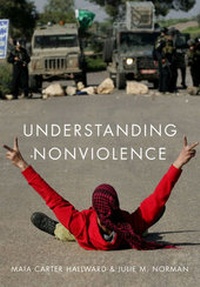
Understanding Nonviolence
Description

Reviews / Votes
"From undermining racist lunch counter segregation in Nashville to supporting the worldwide food sovereignty movements, this book demonstrates that nonviolent action continues to play a vital role in creating social justice and real change." Morning Star This thorough and well-written book ably combines theory with a wide range of case studies to provide an excellent introduction to the growing field of nonviolence. Brian Martin, University of Wollagong, New South Wales "Rarely does one find an edited volume so comprehensive and expert in its treatment of such a timely subject. Hallward and Norman have assembled an impressive cohort of contributors who have written an excellent set of chapters. The end result is essential reading for any student or scholar seriously interested in civil resistance and nonviolence." Erica Chenoweth, University of Denver "It is a comprehensive book that will be immediately effective as a core text in courses on nonviolence. It finds the balance between readable and challenging, thought-provoking and accessible." Peace Research: The Canadian Journal of Peace and Conflict StudiesMore details
Other editions
Additional editions
Persons
Content
CHAPTER 1
Introduction
Maia Carter Hallward and Julie M. Norman
Sometimes it only takes the initiative of one individual to start a mass movement that calls into question a government's actions and draws international attention. Erdem Gündüz, also known as the Standing Man, is one such individual. His silent protest of Turkish repression of media and civilian freedom during the Gezi Park protests in 2013 inspired countless others to join him. On the evening of June 17, 2013, after the Turkish government issued a ban on demonstrating, Gündüz stood motionless for six hours in Istanbul's Taksim Square, looking toward the Ataturk Cultural Center. He did not move, despite harassment from police and passersby. Throughout the night, hundreds of others joined Gündüz, first in Istanbul, then throughout Turkey and beyond, in his silent protest against the Turkish government. As Mert Uzun Mehmet, one of the protesters in Taksim Square, said, "If they attack when we are united and throwing slogans, then we're going to try to do nothing" (as cited in Birnbaum 2013).
Early in the morning the following day, in Taksim Square, Turkish police arrived and arrested the silent protesters without the earlier tactics of tear gas and water cannons, but under the spotlight of international media. What began as a local issue - to protect development of green spaces in Istanbul - erupted into an international spectacle. The United Nations, the European Union, groups such as Human Rights Watch and Amnesty International, and countries such as Germany (which awarded Gündüz with its M100 Media Award for making his mark on Europe and working for democracy and human rights (Gaydazhleva 2013)), condemned the harsh tactics of police against protesters and demanded de-escalation and dialogue (McElroy 2013).
Interest in nonviolence, both scholarly and popular, has surged in recent years, sparked largely by the protests and demonstrations that characterized the early revolutions of the "Arab Spring," the global mobilization of urban activists in the Occupy Wall Street movement, and the increasing use of social media, new technology, and transnational networks to amplify the visibility of nonviolent campaigns. At the same time as large-scale employment of nonviolent action is more evident in the Western media, new research is revealing important historical trends regarding the outcomes of civil resistance movements on processes of political change (Bartkowski 2013b; Chenoweth and Stephan 2011; Schock 2014; Global Nonviolent Action Database). The concept of nonviolence that forms the theoretical foundation for these manifestations of "people power" is thus emerging as an area of primary importance for students, scholars, practitioners, and policymakers. No longer relegated as a sub-field of peace studies, nonviolence is now a core concept for those engaged in the fields of political science, international relations, public policy, and social change.
Yet, how do we understand, define, and study nonviolence? What are its philosophical and historical origins? What tactics and strategies are involved in nonviolent movements, and how do they function differently in diverse contexts? What limitations are there to nonviolent approaches, and how are the dynamics of nonviolent campaigns shifting? To date, there has been no comprehensive text that addresses these questions. Understanding Nonviolence: Contours and Contexts is designed as a core textbook to provide a nuanced overview of the field of nonviolence studies, drawing from the expertise of key scholars working on these issues. By providing an overview of the history and basic concepts of nonviolence, as well as highlighting key challenges facing scholars and practitioners, this book strives to engage students in critical debates surrounding the study and execution of nonviolent campaigns.
Challenges in defining nonviolence
Although the study of nonviolence has expanded considerably in recent years, the challenge of defining nonviolence and nonviolent movements is inherently contentious. As evidenced in the language used in this chapter and throughout the book, even the terminology used to discuss nonviolence - nonviolent action, civil resistance, unarmed insurrections, popular resistance, nonviolent revolutions - varies across the field. This challenge stems in part from the fact that the term "nonviolence" frames the concept in opposition to violence, giving it a negative orientation that says what it is not rather than what it is. The term also contributes to misconceptions surrounding what constitutes nonviolence, given that, although activists engaging in nonviolent action refrain from the use of physical violence, their opponents (such as the police or army) often do use physical violence to contain or quell the activists. Consequently, the media often frames such encounters as "violent confrontations between protesters and police" despite the fact that only one side (i.e., the police) employed violence. Furthermore, the fact that scholars and activists come to the study and practice of nonviolence from a wide range of disciplines and experiences contributes to the challenge of identifying concrete terms or definitions. The (false) assumption by many in the general public that one must be ethically committed to nonviolence and completely reject violence in order to engage in nonviolent action also gives rise to confusion over the scope of nonviolence, since activists engage in nonviolent action for a mix of "principled" and "pragmatic" reasons. As we aim to show in this book, however, rather than being a limitation, the diversity of approaches to nonviolence allows for it to be implemented and examined in various contours and contexts. Each chapter offers a slightly different interpretation and application of nonviolence, and we challenge students to think critically about how and when the term "nonviolence" is best employed.
Diverse definitions notwithstanding, the following definitions best reflect our understandings of nonviolence in undertaking this book. First, our approach is articulated by Kurt Schock in Unarmed Insurrections (2005, p. 6):
Nonviolent action is nonviolent - it does not involve physical violence or the threat of physical violence against human beings - and it is active - it involves activity in the collective pursuit of social or political objectives. More specifically, nonviolent action involves an active process of bringing political, economic, social, emotional, or moral pressure to bear in the wielding of power in contentious interactions between collective actors. Nonviolent action is noninstitutional, that is, it operates outside the bounds of institutionalized political channels, and it is indeterminate, that is, the procedures for determining the outcome of the conflict are not specified in advance.
Similarly, Nepstad (2011b, p. xvii) defines nonviolence as "a civilian-based form of struggle that employs social, economic, and political forms of power without resorting to violence or the threat of violence." Adam Roberts (2009, p. 2) defines the concept in the language of "civil resistance" - a term used instead of, or in addition to, "nonviolence" in several chapters in this book:
Civil resistance is a type of political action that relies on the use of non-violent methods . It involves a range of widespread and sustained activities that challenge a particular power, force, policy, or regime - hence the term "resistance". The adjective "civil" in this context denotes that which pertains to a citizen or society, implying that movements' goals are "civil" in the sense of being widely shared in a society; and it denotes that the action concerned is non-military or non-violent in character.
Table 1.1 The boundaries of nonviolent action and conventional politics
The definitions above resonate with us because they emphasize the constructive nature of nonviolence, which seeks to create a new social structure or new patterns of relationships rather than simply destroying the existing ones (Mattaini 2003). For example, Zunes and Kurtz (1999, p. 314) note that "the creation of alternative structures provides both a moral and a practical underpinning for efforts at bringing about fundamental social change."
Occasionally one hears the out-of-date "passive resistance" used to characterize nonviolent movements. This inaccurate portrayal was dismissed by Gandhi almost a century ago, for "nonviolence implies much more than an 'act of abstaining' and encompasses a positive, action component that is directed toward the reduction of social injustice and the building of cultures of peace" (Mayton 2001, p. 143). The (mis)representation of nonviolent action as "passive" or as "pacifist" contributes to several of the most common critiques of nonviolent action. Some, for example, argue that appeals for nonviolence, when equated with pacifism, call on aggrieved parties to relinquish their right to (armed)...
