

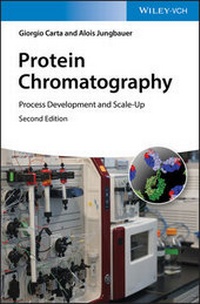
Protein Chromatography
Description

Based on a training course that teaches the theoretical as well as practical aspects of protein bioseparation to bioprocess professionals, this fully updated and revised new edition offers comprehensive coverage of continuous chromatography and provides readers with many relevant examples from the biopharmaceutical industry.
Divided into two large parts, Protein Chromatography: Process Development and Scale-Up, Second Edition presents all the necessary knowledge for effective process development in chromatographic bioseparation, both on small and large scale. The first part introduces chromatographic theory, including process design principles, to enable the reader to rationalize the set-up of a bioseparation process. The second part illustrates by way of case studies and sample protocols how the theory learned in the first part may be applied to real-life problems. Chapters look at: Downstream Processing of Biotechnology Products; Chromatography Media; Laboratory and Process Columns and Equipment; Adsorption Equilibrium; Rate Processes; and Dynamics of Chromatography Columns. The book closes with chapters on: Effects of Dispersion and Rate Processes on Column Performance; Gradient Elution Chromatography; and Chromatographic Column Design and Optimization.
-Presents the most pertinent examples from the biopharmaceutical industry, including monoclonal antibodies
-Provides an overview of the field along with design tools and examples illustrating the advantages of continuous processing in biopharmaceutical productions
-Focuses on process development and large-scale bioseparation tasks, making it an ideal guide for the professional bioengineer in the biotech and pharma industries
-Offers field-tested information based on decades of training courses for biotech and chemical engineers in Europe and the U.S.
Protein Chromatography: Process Development and Scale-Up, Second Edition will appeal to biotechnologists, analytical chemists, chromatographers, chemical engineers, pharmaceutical industry, biotechnological industry, and biochemists.
More details
Other editions
Additional editions
Persons
Alois Jungbauer, PhD, is the head of protein technology and downstream processing at the Department of Biotechnology of the University of Natural Resources and Applied Life Sciences in Vienna (Austria). For more than 30 years, Professor Jungbauer has worked in biochemical engineering, with a focus on bioseparation, where he has published widely and holds 15 patents. He has also organized a biannual professional course in protein chromatography focused on mass transfer, dispersion, and scale-up.
Content
DOWNSTREAM PROCESSING OF BIOTECHNOLOGY PRODUCTS
Introduction
Bioproducts and their Contaminants
Bioprocesses
Biosimilars
Role of Chromatography in Downstream Processing
Environmental Impact of Biopharmaceutical Processing
References
INTRODUCTION TO PROTEIN CHROMATOGRAPHY
Introduction
Basic Principles and Definitions
Modes of Operation
Performance Factors
Separation Performance Metrics
CHROMATOGRAPHY MEDIA
Introduction
Interaction Types and Chemistry
Buffers and Mobile Phases
Physical Structure and Properties
LABORATORY AND PROCESS COLUMNS AND EQUIPMENT
Introduction
Laboratory-scale Systems
Process Columns and Equipment
ADSORPTION EQUILIBRIUM
Introduction
Single Component Systems
Multi-component Systems
Empirical Correlation of Equilibrium Data
References
RATE PROCESSES
Introduction
Rate Mechanisms
Batch Adsorption Kinetics
DYNAMICS OF CHROMATOGRAPHY COLUMNS
Introduction
Material Balance Equations
Local Equilibrium Dynamics
Multi-component Systems
Displacement Chromatography
EFFECTS OF DISPERSION AND RATE PROCESSES ON COLUMN PERFORMANCE
Introduction
Empirical Characterization of Column Efficiency
Modeling and Prediction of Column Efficiency
GRADIENT ELUTION CHROMATOGRAPHY
Introduction
General Theory for Gradient Elution with Linear Isotherms
LGE Relationships and the Iso-Resolution for Ion Exchange Chromatography
LGE Relationships for RPC and HIC
Gradient Elution at High Protein Loads
Separations with pH Gradients
References
CHROMATOGRAPHIC COLUMN DESIGN ADN OPTIMIZATION
Introduction
Chromatographic Process Steps and Constraints
Design for Capture
Design for Chromatographic Resolution
SMB Design
References
INDEX
Preface
Chromatography is an essential tool for the production of purified proteins, in general, and biopharmaceuticals, in particular. The method allows handling the complex mixtures encountered in this industry using readily available stationary phases and equipment suitable for large-scale sanitary operation. Moreover, its practice as a process purification tool is recognized by regulatory agencies so that chromatography is an integral part of essentially all licensed biopharmaceutical processes. Regulatory agencies are increasingly requiring in-depth process understanding. As a result, chemists, engineers, and life scientists working in this field need to become familiar with the theory and practice of process chromatography.
In the past, the design and scale-up of chromatography units for biopharmaceutical purification was largely empirical. As a result, optimum designs often remained elusive. The last 10 years have, however, witnessed increasing emphasis on the use of models based on a mechanistic understanding of both physical and biomolecular properties. On the one hand, engineers, while possessing a strong foundation in transport phenomena and unit operations, often do not have adequate understanding of biomolecular properties. On the other hand, biochemists and biologists often have little understanding of the key scale-up relationships and models needed for optimum design. Our goal for this book and for the courses and workshops that we have taught over the years has been to help create "new phenotypes" - engineers who understand the biophysical properties of proteins and other biomacromolecules and can implement this understanding in the bioprocess setting and life scientists who understand transport phenomena and engineering models and who can apply these tools to the design of process units.
This book is based not only on our own experience in downstream processing but also on the interactions that we have had over the past 20 years with more than 1000 industrial scientists and engineers who have attended our practical protein chromatography courses and workshops. During this time, we have collected many practical examples and acquired a good feeling about the main difficulties that are encountered by both students and beginning practitioners in understanding protein chromatography from both theoretical and practical viewpoints. In order to meet this goal, following the first edition of this book published in 2010, we begin the second edition with a chapter on the biochemical and biophysical properties of proteins and their contaminants. We focus on the properties that are relevant for chromatographic separations such as size, surface charge and hydrophobicity, solution viscosity, and diffusivity and on how to preserve biological activity while addressing regulatory and environmental impact aspects. In Chapter 2, we provide a succinct, general introduction to chromatography identifying the key factors important for design and scale-up. This allows the reader who is not familiar with chromatography to put in proper context the various issues discussed in Chapters 3-10. Chapter 3 addresses the chemistry and structure of many different stationary phases, while Chapter 4 discusses laboratory and process columns and equipment. Both of these chapters are limited in scope to providing the reader with some familiarity with commercially available materials and equipment. No attempt was made to provide a comprehensive coverage, in large part because the field is rapidly expanding and new media and equipment are constantly being introduced. Mechanical design of equipment is also not considered in detail, as rarely, it is a task for separation scientists and engineers in the biopharmaceutical production setting. Chapters 5-9 are structured to acquaint the reader with the theory and models needed to design and scale-up chromatography units. Emphasis is placed on phenomenological models whose parameters can be determined through suitable experimental studies. Many specific numerical examples are provided to illustrate the application of these models to the analysis of laboratory data and to the prediction of column performance. A great deal of emphasis is placed on describing transport in the stationary phase, as adsorption kinetics is often limiting in industrial applications of biochromatography. Thus, Chapter 6 provides a detailed coverage of mass transfer effects and their relationship to the structure of the stationary phase. Chapter 7 explores the dynamic behavior of chromatography columns establishing a link between equilibrium properties, described in Chapter 5, and column behavior. Chapter 8 discusses how equilibrium and rate factors combine to determine column performance and how to model band broadening for practical conditions. Chapter 9 is focused on gradient elution chromatography. We chose to devote a separate chapter to this mode of operation, as, in our experience, it is often frequently less well understood despite its major importance in the practice of biochromatography. Finally, Chapter 10 is designed to bring everything together by providing guidance for the optimum design of process units. This chapter covers both the design of conventional batch chromatography units as well as the design of continuous or semicontinuous multicolumn systems for continuous biomanufacturing.
Despite the structural similarity with the first, beside many updates, the second edition provides a lot of new material. The second edition provides an expanded analysis of surface heterogeneity of molecular properties including consideration of domain-specific chemistry in multidomain proteins as well as new information about the mechanical stability of proteins. Regulatory aspects, including references to ICH guidelines, quality by design (QbD) concepts, viral clearance considerations, and biosimilars are included as well as references to the process mass intensity. Many new examples dealing with data for actual monoclonal antibodies (mAbs) are provided to replace or complement examples based on model proteins that were used throughout the first edition. The new mAb examples provide a more realistic view of current and future industrial practice as these molecules are much larger and much more complex than commonly used model proteins. Data for such molecules were not widely available for the first edition but are available now. Their inclusion, we think, provides much greater practical value demonstrating the application of engineering principles and chromatography theories in a much more realistic context. Many updates were made to stationary phases and their interactions with antibodies, including an expanded coverage of new protein A resins that have become available during the past 10 years. Greater insights into how proteins interact with chromatographic surfaces, protein unfolding and on-column aggregation, and much more detailed views of the physical structures of established and new chromatographic matrices are also included. Improved chromatographic workstations and new chromatography column hardware, including single-use columns and systems, have also become widely available since the first edition and an overview of examples of these technologies is included in Chapter 4. Advances made in the measurement and theoretical description of protein adsorption isotherms have also been made and are covered in Chapter 5. In this context, high-throughput screening methods have become very popular and provide the means of obtaining adsorption data that, combined with mechanistic descriptions of transport and column dynamics, allow predictions of column behaviors with previously unmet accuracy. Advances in understanding and modeling competitive binding in multicomponent protein mixtures are now covered with reference to actual mAb systems, including detailed examples on the separation of mAb charge variants and mAb monomer-dimer mixtures at high loadings. In this context, Chapter 6 now includes an expanded analysis of multicomponent batch adsorption, Chapter 7 includes expanded analyses of single and multicomponent breakthrough dynamics for mAbs, and Chapter 8 includes a coverage of the description of combined dynamics and kinetics effect for mAbs in chromatographic columns. The treatment of gradient elution in Chapter 9 has been expanded by providing a more general version of the Yamamoto model, by introducing the concept and calculation of the isoresolution line, which provides the means to understand the optimization of residence time and gradient duration, by illustrating the concept of buffer design for pH-gradient elution, and by discussing the effects of overloading on gradient elution chromatography of proteins as well as its description based on hybrid modeling approaches. Finally, column design, covered in Chapter 10, has been expanded by introducing the Pareto concept of balancing productivity and capacity utilization/buffer consumption and discussing the impact of multicolumn and continuous processing on this balance. Design charts and application examples are now provided for the analysis of periodic countercurrent systems for protein capture.
Similar to the first edition, we feel that the book's main value is not in "de novo" process development - rather, it focuses mainly on how to optimally design and scale up columns for a process whose steps have already been defined. Nevertheless, understanding these concepts will also aid the scientist involved in early process development identify process steps that are scalable and can be...
