

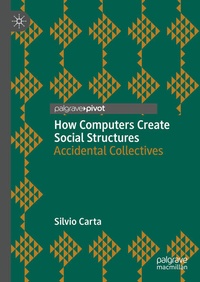
How Computers Create Social Structures
Description

This book introduces the idea of accidental collectives: the grouping of people that occurs as a by-product of the automated work of computers. Software has a growing influence in our lives automating and optimising mundane, time-consuming and repetitive tasks. In doing this, groups of people are automatically created as the result of classification and data analysis. Once grouped by the invisible agency of software, people interact and establish new relationships, generating new collectives and communities. With the support of case studies and real-life examples, this work explores the accidental nature of the generation of new social groups and questions the role of software in social interactions.
More details
Other editions
Additional editions
Person
Silvio Carta is an architect (ARB/RIBA), Chartered Building Engineer (MCABE) and Professor of Architecture at the University of Greenwich. He is the author of Big Data, Code and the Discrete City: Shaping Public Realms (2019) and Machine Learning and the City: Applications in Architecture and Urban Design (2022).
Content
.- Chapter 1: Introduction - Human Geography, Information and Communication Technology and Digital Sociology.
.- Chapter 2: The Role of Computers in the Generation of Social Groups.
.- Chapter 3: Collectives, Technology, Online Apps and Social Networks.
.- Chapter 4: Software, Automated Spatial Configurations and the Built Environment.
.- Chapter 5: Data Ethics, Fairness and Bias.
.- Chapter 6: Conclusion: The Future of Automatic and Accidental Collectives.
