

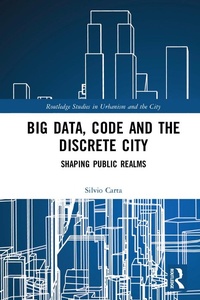
Big Data, Code and the Discrete City
Shaping Public Realms
1st Edition
Published on 19. June 2019
226 pages
978-1-351-00739-9 (ISBN)
Description

Big Data, Code and the Discrete City explores how digital technologies are gradually changing the way in which the public space is designed by architects, managed by policymakers and experienced by individuals. Smart city technologies are superseding the traditional human experience that has characterised the making of the public space until today. This book examines how computers see the public space and the effect of algorithms, artificial intelligences and automated processes on the human experience in public spaces.
Divided into three parts, the first part of this book examines the notion of discreteness in its origins and applications to computer sciences. The second section presents a dual perspective: it explores the ways in which public spaces are constructed by the computer-driven logic and then translated into control mechanisms, design strategies and software-aided design. This perspective also describes the way in which individuals perceive this new public space, through its digital logic, and discrete mechanisms (from Wi-Fi coverage to self-tracking). Finally, in the third part, this book scrutinises the discrete logic with which computers operate, and how this is permeating into aspects of city life.
This book is valuable for anyone interested in urban studies and digital technologies, and more specifically in big data, urban informatics and public space.
Divided into three parts, the first part of this book examines the notion of discreteness in its origins and applications to computer sciences. The second section presents a dual perspective: it explores the ways in which public spaces are constructed by the computer-driven logic and then translated into control mechanisms, design strategies and software-aided design. This perspective also describes the way in which individuals perceive this new public space, through its digital logic, and discrete mechanisms (from Wi-Fi coverage to self-tracking). Finally, in the third part, this book scrutinises the discrete logic with which computers operate, and how this is permeating into aspects of city life.
This book is valuable for anyone interested in urban studies and digital technologies, and more specifically in big data, urban informatics and public space.
More details
Series
Edition
1. Auflage
Language
English
Place of publication
London
United Kingdom
Publishing group
Taylor & Francis Ltd
Target group
College/higher education
Professional and scholarly
Illustrations
10 Tables, black and white; 10 Line drawings, black and white; 48 Halftones, black and white; 58 Illustrations, black and white
ISBN-13
978-1-351-00739-9 (9781351007399)
Copyright in bibliographic data and cover images is held by Nielsen Book Services Limited or by the publishers or by their respective licensors: all rights reserved.
Schweitzer Classification
Other editions
Additional editions
Book
03/2021
1st Edition
Routledge
€68.00
Shipment within 15-20 days
Book
06/2019
1st Edition
Routledge
€215.41
Shipment within 10-20 days
Person
Silvio Carta is an ARB RIBA architect and Head of Art and Design, and Chair of the Design Research Group at the University of Hertfordshire. Previously, he taught at Delft University of Technology School of Architecture, University of Rotterdam and University of Cagliari (Italy). His studies have focused on digital design, digital manufacturing, urban informatics, data visualisation and computational optimisation of the design process. Silvio has published 100+ articles, infographics and reviews in journals and magazines in the field of design, urban studies and architecture, and exhibited his digital projects worldwide. He is editor-at-large of Seoul-based C3-Korea magazine, editor of Architecture Media Politics and Society (AMPS), and the curator of the international lecture series AUDITORIUM 2015-16: The Architecture of Information, Data, People and Public Space (Leuven, Belgium).
Content
Part I Continuity and Discreteness
1. The Idea of Discretisation
2. Discrete Public Space
Part II The Discrete City
3. The Production of the Discrete City
4. Perception of the Discrete City
Part III The New Public Realm
5. The New Public Space - a Spatial Account
6. Built Environment, Big Data and the New Public Life
1. The Idea of Discretisation
2. Discrete Public Space
Part II The Discrete City
3. The Production of the Discrete City
4. Perception of the Discrete City
Part III The New Public Realm
5. The New Public Space - a Spatial Account
6. Built Environment, Big Data and the New Public Life
