

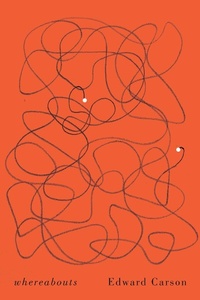
whereabouts
1st Edition
Published on 2. August 2021
93 pages
978-0-2280-0717-3 (ISBN)
Description

in the poem / of the world / there once / was a map / of the map / composed in / the likeness / of a poem
In this riddling and seeking book of poems, Edward Carson navigates the emotional, often contradictory intelligence of the heart and mind. In three interrelated segments, whereabouts powerfully charts the tight emotional spaces between thinking and language, beauty and perception, love and the polemics of self and other.
Taking on cartographic distortions and dynamics of the map metaphor, "thereabouts (or the mapmaker's dilemma)" playfully confronts the quandaries of personal navigation when the wants and needs of the esemplastic mind are forever devising new places to be. Exploring the brain, its neurons, and serpentine synaptic connections, "hereabouts (in fourteen scans)" advances a poetry of rhizomic communication capturing networks of thought and feeling that spring from both conflict and caress. Within a relationship's countless masquerades and revelations, "whereabouts (the lovers' discourse)" invites the reader to eavesdrop on a series of intimate conversations wherein lovers argue and act out their richly populated inner lives, addressing issues of gender, pleasure, communication, control, and sex.
In this riddling and seeking book of poems, Edward Carson navigates the emotional, often contradictory intelligence of the heart and mind. In three interrelated segments, whereabouts powerfully charts the tight emotional spaces between thinking and language, beauty and perception, love and the polemics of self and other.
Taking on cartographic distortions and dynamics of the map metaphor, "thereabouts (or the mapmaker's dilemma)" playfully confronts the quandaries of personal navigation when the wants and needs of the esemplastic mind are forever devising new places to be. Exploring the brain, its neurons, and serpentine synaptic connections, "hereabouts (in fourteen scans)" advances a poetry of rhizomic communication capturing networks of thought and feeling that spring from both conflict and caress. Within a relationship's countless masquerades and revelations, "whereabouts (the lovers' discourse)" invites the reader to eavesdrop on a series of intimate conversations wherein lovers argue and act out their richly populated inner lives, addressing issues of gender, pleasure, communication, control, and sex.
Reviews / Votes
"Read as personal reflections that draw on Carson's lived experience in a heterosexual relationship, the poems in whereabouts offer a fascinating peek into a mind at work, one that is perpetually seeking to escape itself, to find union both with the world and with another mind." Poetry Foundation "Activated by synaptic metaphor, Edward Carson's whereabouts is love poetry by way of neuroimaging. Embracing the 'harmonics of the brain,' the poet breaks down the world sense by sense, delivering a fever dream that is part map, part destination. whereabouts is a welcome addition to the tradition of science poetry." Jim Johnstone, editor of The Next Wave: An Anthology of 21st Century Canadian Poetry "Edward Carson articulates what can only be characterized as a meticulous neuropoetics. Simultaneously cerebral and carnal - on occasion even bawdy - these poems map what we experience moment by moment in a machine code of thoughts and feelings that the mind makes of the flesh. No organ is sexier than the brain, and Carson affirms intimacies deeper than zeros and ones. whereabouts may get your baud rate up, but don't lose track. In this electrochemical romance, Carson has flowcharted a schematic for the praxis toward which lovers aspire and kiss after kiss attain." John Barton, author of Polari "In whereabouts Edward Carson's remarkable poems form a network of synaptic connections that put a mind into question and reveal a mind in the act of questioning. In these poetic maps and countermaps, thinking is unmoored from conventional thought and reimagined as an 'atlas of emotions,' as 'a weather / of its own making.' These are poems to get lost and found in." Adam Dickinson, author of Anatomic "Here are poems that locate and connect as they map an exploratory route through the brain and the heart. Linguistically rich, exacting and sophisticated, they illustrate the underlying principle of interconnectedness - the closeness and the gap. Edward Carson's whereabouts is a pattern-seeking network of elements that hum and buzz the dialectic, that map as they make." Catherine Graham, author of The Celery Forest and AEther: An Out-of-Body Lyric "whereabouts is a fiercely intelligent, brilliantly beautiful book. Using the sonnet as muse, Edward Carson creates a journey and landscape of language unencumbered by convention. Cartography merges into neurology, revealing patterns of beauty and calculation - a poetic corpus callosum - connecting the intellectual to the emotional, the analytical to the erotic. Carson has in whereabouts created a collection to be not so much read, as experienced." Andrea Thompson, author of A Selected History of Soul Speak and Over Our HeadsMore details
Series
Language
English
Place of publication
Canada
Canada
Target group
Professional and scholarly
File size
0,88 MB
ISBN-13
978-0-2280-0717-3 (9780228007173)
Copyright in bibliographic data and cover images is held by Nielsen Book Services Limited or by the publishers or by their respective licensors: all rights reserved.
Schweitzer Classification
Other editions
Additional editions
Edward Carson
Whereabouts
Book
07/2021
McGill-Queen's University Press
€19.00
Article not available at the moment
Person
Edward Carson is the author of Look Here Look Away Look Again, Knots, Birds Flock Fish School, Taking Shape, and Scenes. He lives in Toronto.
Content
- Cover
- Copyright
- Contents
- Thereabouts
- in the poem
- near or far
- distortion
- contiguous
- a map is
- colonizing a
- the brain is
- mercurial
- thoughts of a
- flirtations
- thermodynamic
- tangents in
- woozy in love
- at the end
- Hereabouts
- left lingual gyrus occipital lobe
- right posterior parietal lobe
- left angular gyrus parietal lobe
- right lingual gyrus occipital lobe
- ventrointermedial thalamus
- left posterior parietal lobe
- superior temporal gyrus
- left hippocampus
- ventrolateral thalamus
- postcentral gyrus parietal lobe
- right angular gyrus parietal lobe
- right anterior cingulate gyrus
- right amygdala
- medial prefrontal cortex
- whereabouts
- prologue: amare chronos kairos aevum
- force that makes up in time what it loses in speed
- quantum entanglements
- all by myself don't want to be all by myself
- no one belongs here more than you
- when women were birds
- mean free path
- rarely often always never known
- speak low if you speak love
- embodied subjectand fragmented object
- whose body is this
- love is a difficult cause to demonstrate
- absence in shaping spatial presence
- a rhetoric of semblance
- petite sonatine cantique
- rhetorical pawns in unwinnable arguments
- swift answer slow silence
- after an argument the dark mind of night
- no one says this to you but me
- claims counterclaims
- infinite regress
- infinite meadow
- she knows he think she knows who she is
- alternate voices passing between us
- through skillful omission of critical facts
- a man like a woman like a man
- asymmetrical allure with someone else
- x inactive specific transcript
- neither noise nor signal
- the empty glance of a knowingobserver
- before behind between above below
- a teetering tongue close by
- listen listen listen
- in the way that mostof the wind happens
- romance of a mistaken intention
- turning to affect
- all of me why not take all of me
- neither proving you less wanted nor less dear
- love me or leave me
- eloquence is heard but poetry is overheard
- Notes and Acknowledgments
