

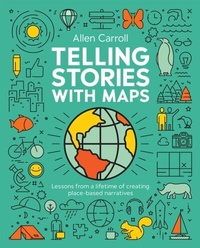
Telling Stories with Maps
Description

Bring your data to life with this essential guide to storytelling with maps.
From scraping patterns in sand to drawing intricate lines on vellum and paper, to charting every place on the planet, humans have used maps as a powerful storytelling medium. The advent of the digital age has revolutionized the creation, distribution, and consumption of maps. The web created enormous opportunities for storytelling, enabling maps to dance and weave, partnering with other multimedia elements?photos, video, audio, text?to tell countless tales about our world.
Featuring a foreword by renowned travel writer and cofounder of Lonely Planet Tony Wheeler, Telling Stories with Maps: Lessons from a Lifetime of Creating Place-Based Narratives bridges both analog and digital realms, showcasing how maps themselves tell stories and enrich narratives by providing context and insight. Richly illustrated with examples from traditional maps to the latest digital visualizations, this book is an essential guide for anyone interested in the powerful storytelling potential of maps.
Allen Carroll leads an editorial team at Esri that publishes ArcGIS® StoryMaps℠ stories and supports a global community of storytellers who have used ArcGIS StoryMaps to create millions of multimedia narratives. Before joining Esri, Carroll spent 27 years at the National Geographic Society, designing scores of maps for its renowned magazine and other publications. Carroll spearheaded the creation of the seventh and eighth editions of the World Atlas; the publication of many new web resources and other special projects featuring biodiversity, conservation, and Indigenous cultures; and numerous other projects. After joining Esri in 2010, Caroll founded its StoryMaps team, which developed web tools that enabled hundreds of thousands of individuals and organizations to tell placebased stories combining interactive maps and multimedia content.
All prices
More details
Other editions
Additional editions
Person
During his 27-year career at the National Geographic Society, Allen Carroll designed scores of maps for its renowned magazine and other publications. Beginning his NGS career on the staff of the magazine's art department, he became its art director, designing diagrams, infographics, and historical reconstructions. As the Society's chief cartographer from 1998 to 2010, he was deeply involved in the creation of the Society's renowned reference and wall maps, globes, and atlases, and oversaw creation of scores of page maps and large-format supplement maps for the magazine. He led the creation of the Seventh and Eighth editions of the World Atlas, incorporating satellite imagery and innovative thematic maps into the editions and integrating them for the first time with interactive Web resources. He spearheaded the publication of many new web resources and other special projects featuring biodiversity, conservation, and indigenous cultures.
After joining Esri in 2010, he founded its StoryMaps team, which developed web tools that enabled hundreds of thousands of individuals and organizations to tell place-based stories combining interactive maps and multimedia content. He continues to lead an editorial team that publishes ArcGIS StoryMaps and supports a global community of storytellers who have used StoryMaps to create millions of multimedia narratives.
Content
Foreword
Introduction
Chapter 1: Why Stories Matter
Chapter 2: Why Maps Matter
Chapter 3: Maps and Minds
Chapter 4: From Analog to Digital
Chapter 5: The Journey to Storytelling
Chapter 6: Maps in Dramatic Roles
Chapter 7: Nine Steps to Great Storytelling
Chapter 8: Plan, Produce, Polish, Publish
Epilogue
Acknowledgements
References
Credits
