


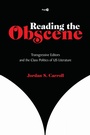
Reading the Obscene
Transgressive Editors and the Class Politics of US Literature
Published on 23. November 2021
280 pages
978-1-5036-2949-3 (ISBN)
Available for download
Description

With Reading the Obscene, Jordan Carroll reveals new insights about the editors who fought the most famous anti-censorship battles of the twentieth century. While many critics have interpreted obscenity as a form of populist protest, Reading the Obscene shows that the editors who worked to dismantle censorship often catered to elite audiences composed primarily of white men in the professional-managerial class.
As Carroll argues, transgressive editors, such as H. L. Mencken at the Smart Set and the American Mercury, William Gaines and Al Feldstein at EC Comics, Hugh Hefner at Playboy, Lawrence Ferlinghetti at City Lights Books, and Barney Rosset at Grove Press, taught their readers to approach even the most scandalizing texts with the same cold calculation and professional reserve they employed in their occupations. Along the way, these editors kicked off a middle-class sexual revolution in which white-collar professionals imagined they could control sexuality through management science. Obscenity is often presented as self-shattering and subversive, but with this provocative work Carroll calls into question some of the most sensational claims about obscenity, suggesting that when transgression becomes a sign of class distinction, we must abandon the idea that obscenity always overturns hierarchies and disrupts social order.
Winner of the 2022 MLA Prize for Independent Scholars, sponsored by the Modern Language Association
As Carroll argues, transgressive editors, such as H. L. Mencken at the Smart Set and the American Mercury, William Gaines and Al Feldstein at EC Comics, Hugh Hefner at Playboy, Lawrence Ferlinghetti at City Lights Books, and Barney Rosset at Grove Press, taught their readers to approach even the most scandalizing texts with the same cold calculation and professional reserve they employed in their occupations. Along the way, these editors kicked off a middle-class sexual revolution in which white-collar professionals imagined they could control sexuality through management science. Obscenity is often presented as self-shattering and subversive, but with this provocative work Carroll calls into question some of the most sensational claims about obscenity, suggesting that when transgression becomes a sign of class distinction, we must abandon the idea that obscenity always overturns hierarchies and disrupts social order.
Winner of the 2022 MLA Prize for Independent Scholars, sponsored by the Modern Language Association
Reviews / Votes
"In Carroll's hands, the question of obscenity in midcentury literature has a whole new conceptual frame and in the figure of theeditor, a whole new protagonist. Going where few critical works before it have dared to tread, this is a highly persuasive and lucidly readable contribution to twentieth-century American cultural studies."-Mark McGurl, Stanford University "A thoroughly enjoyable examination of the role that literary obscenity played in forging the professional-managerial white male commitment to 'free speech.' Jordan Carroll shows that defending obscene literature enshrined modes of dispassion that served liberals' professional climbing."-Sarah Brouillette, Carleton University "What draws us to the obscene? It's a question scholars rarely ask because the allure of the forbidden seems so obvious. What if, though, for the white male professional-managerial class of the mid-to-late twentieth century, the enticement of the obscene was not so hot but rather cool? What if the point of reading smut was not to indulge in prurient interest but to show oneself capable of overcoming such base impulses? Not to masturbate, but to master? Such is the gambit of Jordan S. Carroll's Reading the Obscene, which charts a bildungsroman of boomer hermeneutics."-Whitney Strub, The Baffler "[I]n his Reading the Obscene: Transgressive Editors and the Class Politics of US Literature, Jordan S. Carroll is interested in a different, subtler aspect of the era's creeping corporatization. Rather than examining how the economics of publishing affected culture, Carroll considers how its class politics drove the industry's challenges to censorship, asserting that the 'values and training of the professional-managerial class (PMC)' were the driving force behind publishing's challenges to obscenity laws."-Greg Barnhisel, American Literary History "Carroll's surprising argument is that editors trained PMC men in the exigent art of cool detachment through obscenity.... Reading the Obscene teems with telling details and relishes double-entendres."-Dan Sinykin, ASAP/JournalMore details
Series
Edition
New edition
Language
English
Place of publication
Palo Alto
United States
Target group
Professional and scholarly
Edition type
New edition
ISBN-13
978-1-5036-2949-3 (9781503629493)
Copyright in bibliographic data and cover images is held by Nielsen Book Services Limited or by the publishers or by their respective licensors: all rights reserved.
Schweitzer Classification
Other editions
Additional editions
Book
11/2021
Stanford University Press
€141.50
Shipment within 15-20 days
Person
Jordan Carroll is Visiting Assistant Professor at the University of Puget Sound. His writing has appeared in Post45, Twentieth-Century Literature, and American Literature.
Content
Introduction: The Naked Editor
1. Shocking the Middle Class
2. An Aristocracy of Smut
3. Decrypting EC Comics
4. Reading Playboy for the Science Fiction
5. Mad Ones, Mad Men
6. White-Collar Masochism
Conclusion: Transgression in the Post-pornographic Era
1. Shocking the Middle Class
2. An Aristocracy of Smut
3. Decrypting EC Comics
4. Reading Playboy for the Science Fiction
5. Mad Ones, Mad Men
6. White-Collar Masochism
Conclusion: Transgression in the Post-pornographic Era

