

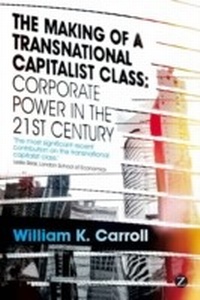
The Making of a Transnational Capitalist Class
Corporate Power in the 21st Century
1st Edition
Published on 9. September 2010
289 pages
978-1-84813-444-7 (ISBN)
Description

Throughout the world, there has been a growing wave of interest in global corporate power and the rise of a transnational capitalist class, triggered by economic and political transformations that have blurred national borders and disembedded corporate business from national domiciles. Using social network analysis, William Carroll maps the changing field of power generated by elite relations among the world's largest corporations and related political organizations.
Carroll provides an in-depth analysis that spans the three decades of the late 20th and early 21st century, when capitalist globalization attained unprecedented momentum, propelled both by the transnationalization of accumulation and by the political paradigm of transnational neoliberalism. This has been an era in which national governments have deregulated capital, international institutions such as the World Trade Organization and the World Economic Forum have gained prominence, and production and finance have become more fully transnational, increasing the structural power of capital over communities and workers.
Within this context of transformation, the book charts the making of a transnational capitalist class, reaching beyond national forms of capitalist class organization into a global field, but facing spirited opposition from below in an ongoing struggle that is also a struggle over alternative global futures.
Carroll provides an in-depth analysis that spans the three decades of the late 20th and early 21st century, when capitalist globalization attained unprecedented momentum, propelled both by the transnationalization of accumulation and by the political paradigm of transnational neoliberalism. This has been an era in which national governments have deregulated capital, international institutions such as the World Trade Organization and the World Economic Forum have gained prominence, and production and finance have become more fully transnational, increasing the structural power of capital over communities and workers.
Within this context of transformation, the book charts the making of a transnational capitalist class, reaching beyond national forms of capitalist class organization into a global field, but facing spirited opposition from below in an ongoing struggle that is also a struggle over alternative global futures.
Reviews / Votes
The longitudinal approach, rigorous empirical research, and great theoretical sensitivity and nuance give the book a unique and exemplary quality. It raises numerous questions for further research and debate and makes a major contribution to critical social research. * Henk Overbeek, VU University * This is a truly excellent book. Carroll and his co-workers take the debates on global capitalism and the network society to a new level. * John Scott, University of Plymouth * Bill Carroll's The Making of a Transnational Capitalist Class is a state-of-the art analysis of the global political-economic power structure as it has developed into the current century. I know of no author in the field who has been able to combine a mastery of empirical method in analysing corporate and planning-group interlocks on a world scale, with an incisive political analysis of the forces occupying the most central locations in the networks that emerge from this analysis. * Kees van der Pijl, University of Sussex * Building on Fennema's pathbreaking research on corporate networks in the 1980s, Carroll and his colleagues have produced an impressive array of evidence to suggest that a transnational capitalist class is in the making. * Leslie Sklair, London School of Economics * This lucid, illuminating, and much needed analysis reveals the underlying structure of the global community of big business at the beginning of the twenty-first century. It provides valuable answers to important questions, including a measured analysis of the degree of unity and division among the most powerful corporations in the world and a vivid portrait of the role transnational policy groups in linking together the world's largest firms. * Michael Schwartz, Stony Brook University * William Carroll provides a superb analysis of global corporate power and the complexities surrounding the issue of transnational capitalist class formation. Sensitive to the relations between the global, regional and national, the challenges posed by state capitalism, and the early impact of the global financial crisis, this will remain the definitive work on the subject for years to come. * Stephen McBride, McMaster University *More details
Edition
1. Auflage
Language
English
Place of publication
London
United Kingdom
Publishing group
Bloomsbury Publishing PLC
Target group
College/higher education
Professional and scholarly
ISBN-13
978-1-84813-444-7 (9781848134447)
Copyright in bibliographic data and cover images is held by Nielsen Book Services Limited or by the publishers or by their respective licensors: all rights reserved.
Schweitzer Classification
Other editions
Additional editions
William K. Carroll
The Making of a Transnational Capitalist Class
Corporate Power in the 21st Century
Book
09/2010
Zed Books Ltd
€31.50
Shipment within 3-4 weeks
William K. Carroll
The Making of a Transnational Capitalist Class
Corporate Power in the 21st Century
Book
09/2010
Zed Books Ltd
€118.60
Shipment within 3-4 weeks
Person
Bill Carroll is a professor of Sociology at the University of Victoria, where he directs the Social Justice Studies Program. Among his recent books are Remaking Media (2006), Challenges and Perils (2006) and Critical Strategies for Social Research (2004). He has won the Canadian Sociological Association's John Porter Prize twice, for his books on the structure of corporate power in Canada. He has held visiting fellowships and appointments at the University of Amsterdam, Griffith University, Kanazawa State University, the Netherlands Institute for Advanced Study in the Humanities and Social Sciences and the Institute of Political Economy at Carleton University. He is an associate editor of The Journal Socialist Studies, and a member of Sociologists Without Borders.
Content
Introduction
Part I: The Formation of a Transnational Corporate Community
1. Is there a transnational corporate community?
2. Forging a new hegemony: the transnational corporate-policy network, 1996
3. Global cities in the global corporate network
Part II: Into the 21st Century: The Changing Organization of Corporate Power
4. Transnational accumulation and global networking
5. Transnationalists and national networkers
6. Billionaires and networkers: wealth, position, and corporate power
Part III: A Transnational Historic Bloc?
7. Constituting corporate Europe
8. Consolidating the transnational corporate-policy network, 1996-2006
9. Hegemony and counter-hegemony in a global field
Conclusion
Part I: The Formation of a Transnational Corporate Community
1. Is there a transnational corporate community?
2. Forging a new hegemony: the transnational corporate-policy network, 1996
3. Global cities in the global corporate network
Part II: Into the 21st Century: The Changing Organization of Corporate Power
4. Transnational accumulation and global networking
5. Transnationalists and national networkers
6. Billionaires and networkers: wealth, position, and corporate power
Part III: A Transnational Historic Bloc?
7. Constituting corporate Europe
8. Consolidating the transnational corporate-policy network, 1996-2006
9. Hegemony and counter-hegemony in a global field
Conclusion
