

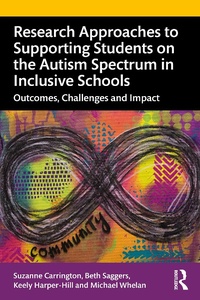
Research Approaches to Supporting Students on the Autism Spectrum in Inclusive Schools
Outcomes, Challenges and Impact
1st Edition
Published on 18. May 2021
152 pages
978-1-000-37690-6 (ISBN)
Description

This book will support researchers in the field of education disability by outlining inclusive research approaches and their challenges, outcomes, and impact. Each chapter reports on school/university-based research supporting inclusion for young people on the autism spectrum. This research has been developed in Australian schools with students, families, teachers, and specialists. The intent of this approach is to mobilise new knowledge to the benefit of all students, including students on the autism spectrum, their families, teachers, and school communities. This book showcases how research can be more inclusive with a move to collaborative, participatory, and co-produced research that will impact on young people, families, and educators. The authors highlight the complex challenges and the positive outcomes of conducting research in inclusive ways and provide detailed practical strategies for researchers.
Inclusive education is socially, emotionally, and academically beneficial for all students and positively impacts on respectful attitudes to difference. This book provides a groundbreaking approach to research that by design is inclusive and therefore provides an invaluable opportunity for building the foundations of an inclusive society for all. This book will be invaluable to researchers, educators, and professional learning in schools.
Inclusive education is socially, emotionally, and academically beneficial for all students and positively impacts on respectful attitudes to difference. This book provides a groundbreaking approach to research that by design is inclusive and therefore provides an invaluable opportunity for building the foundations of an inclusive society for all. This book will be invaluable to researchers, educators, and professional learning in schools.
Reviews / Votes
In this book, listening to voices is not just a motto, it is also a voice for change. Each chapter opens up horizons that will convince you that education for all and with all is not only possible but also exciting- Professor Delphine Odier-Guedj, Haute ecole pedagogique du Canton de Vaud, Lausanne, SwitzerlandHow do we provide autistic students with the truly inclusive education that they deserve? Researchers and educators have tackled this question for decades. This excellent collection of essays from some of Australia's most innovative education researchers provides new answers that will capture attention for many years to come- Professor Liz Pellicano, Macquarie School of Education, Macquarie University, Australia
What distinguishes the research approaches reported in this book from much of traditional autism research is that they share a commitment to genuine collaboration in participatory research. Connecting the expertise of practitioners and academic researchers with the views of different stakeholders and the students themselves, yields rich research insights and builds stronger research that is translational and sustainable- Professor Joanne Deppeler, Educational Psychology and Inclusive Education, Monash University, Australia
Whether discussing research on teleconsultation in regional communities, the iterative co-design of the inclusionED website or the lived experience of an autistic teacher supporting autistic students, a commitment to transforming both our education system and our research practices shines through. Incorporating the insights of autistic scholars and listening to the voices of autistic students as part of the work of embracing diverse learners in our schools and classrooms is at the very heart of this engaging collection.- Dr Rozanna Lilley, Postdoctoral Research Fellow, School of Education, Macquarie University, Australia
More details
Edition
1. Auflage
Language
English
Place of publication
London
United Kingdom
Publishing group
Taylor & Francis Ltd
Target group
Professional and scholarly
College/higher education
Illustrations
1 Tables, black and white; 1 Line drawings, black and white; 14 Halftones, black and white; 15 Illustrations, black and white
ISBN-13
978-1-000-37690-6 (9781000376906)
Copyright in bibliographic data and cover images is held by Nielsen Book Services Limited or by the publishers or by their respective licensors: all rights reserved.
Schweitzer Classification
Other editions
Additional editions
Suzanne Carrington | Beth Saggers | Keely Harper-Hill
Research Approaches to Supporting Students on the Autism Spectrum in Inclusive Schools
Outcomes, Challenges and Impact
Book
05/2021
1st Edition
Routledge
€57.60
Shipment within 15-20 days
Suzanne Carrington | Beth Saggers | Keely Harper-Hill
Research Approaches to Supporting Students on the Autism Spectrum in Inclusive Schools
Outcomes, Challenges and Impact
Book
05/2021
1st Edition
Routledge
€205.00
Shipment within 15-20 days
Persons
Suzanne Carrington is a Professor in education at QUT Australia. She has over 25 years of experience working in universities in teaching, research, international development, and senior leadership roles. Suzanne's areas of expertise are in inclusive education, ethical leadership, and disability impacting on policy and practice in Australian and international contexts.
Beth Saggers is an Associate Professor in the School of Early Childhood and Inclusive Education at QUT Australia.
Keely Harper-Hill is the Research Associate for the Enhancing Learning and Teaching education research program of the Autism CRC at QUT Australia.
Michael Whelan is an Associate Professor at QUT Australia. He is also a writer, musician, and autism advocate.
Beth Saggers is an Associate Professor in the School of Early Childhood and Inclusive Education at QUT Australia.
Keely Harper-Hill is the Research Associate for the Enhancing Learning and Teaching education research program of the Autism CRC at QUT Australia.
Michael Whelan is an Associate Professor at QUT Australia. He is also a writer, musician, and autism advocate.
Content
Part 1 - Introduction. 1. An introduction to research in inclusive education: Empirical evidence for supporting an inclusive approach for students on the autism spectrum. 2. Inclusive research practice: Engaging autistic individuals and their families in research. Part 2 - Outcomes of an inclusive research approach. 3. Supporting students on the autism spectrum in inclusive schools: Research to inform implementation of support and evidence-based practices. 4. Autistic voices in autism education research. Part 3 - Knowledge translation and research impact. 5. With teachers, for teachers: Knowledge translation and professional learning. 6. Meeting the needs of all: The case to translate the evidence base beyond autism. 7. Developing communities of practice for educator professional learning - Developing connections in rural and remote regions. Part 4 - Conclusion. 8. Summary and propositions.
