

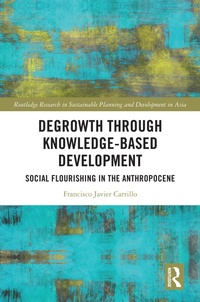
Degrowth through Knowledge-Based Development
Social Flourishing in the Anthropocene
1st Edition
Published on 15. May 2025
278 pages
978-1-040-35410-0 (ISBN)
Description

This book tackles the terms under which a knowledge-based society can indefinitely improve while pursuing an eco-economic steady state. In doing so, it addresses the literature gap on continued social improvement within a post-growth economic and cultural paradigm.
Carrillo consolidates research on the Degrowth paradigm and proposes a conceptual framework for continued social improvement based on the integration of tangible and intangible collective values. He proposes a method that accounts for effective social value through capital systems valuation and development and includes this operational metric system as an alternative to the metric of Gross National Product (GNP). The book critically examines the challenges of identifying a complete and consistent representation of total social value. The book also includes a series of knowledge-based development programmes in cities and regions around the world and discusses policies and practices for urban mitigation and adaptation to the Anthropocene.
This transdisciplinary book will be of particular interest to researchers of degrowth economics, sustainable development, and urban planning.
Carrillo consolidates research on the Degrowth paradigm and proposes a conceptual framework for continued social improvement based on the integration of tangible and intangible collective values. He proposes a method that accounts for effective social value through capital systems valuation and development and includes this operational metric system as an alternative to the metric of Gross National Product (GNP). The book critically examines the challenges of identifying a complete and consistent representation of total social value. The book also includes a series of knowledge-based development programmes in cities and regions around the world and discusses policies and practices for urban mitigation and adaptation to the Anthropocene.
This transdisciplinary book will be of particular interest to researchers of degrowth economics, sustainable development, and urban planning.
Reviews / Votes
"Degrowth through Knowledge-Based Development is a spirited proposal for building an alternative social pathway, based on the principles of shared knowledge and sufficiency. Carrillo redefines progress for the 21st century, showing us how valuing intangible assets -especially knowledge - as a global commons can help societies sustainably flourish."Jeffrey Althouse, Universite Sorbonne Paris Nord, France
"What would qualitative development without quantitative growth look like? This book articulates a vision of knowledge-based development, one where human societies improve their wellbeing through shared knowledge, while staying within their planetary boundaries."
Giorgos Kallis, ICREA Professor, ICTA-UAB, Spain
"Carrillo argues persuasively that the adaptive challenges of the Anthropocene can be met only through degrowth-deliberately shrinking human society's flows of matter and energy; further, that degrowth can have acceptable outcomes only via knowledge-based development (shifting from obtaining value through material consumption to value based on cultural richness)."
Richard Heinberg, Post Carbon Institute, USA
"Degrowth through KBD offers an intriguing and stimulating argument for an economics better linked to the quality of our lives. It deserves to be read by those who are dissatisfied with where mainstream economic thinking is taking us and needs to be read by those who are not."
Gareth Davies, Vrije Universiteit Amsterdam, The Netherlands
More details
Series
Edition
1. Auflage
Language
English
Place of publication
London
United Kingdom
Publishing group
Taylor & Francis Ltd
Target group
College/higher education
Illustrations
5 Tables, black and white; 3 Line drawings, black and white; 2 Halftones, black and white; 5 Illustrations, black and white
File size
5,10 MB
ISBN-13
978-1-040-35410-0 (9781040354100)
Copyright in bibliographic data and cover images is held by Nielsen Book Services Limited or by the publishers or by their respective licensors: all rights reserved.
Schweitzer Classification
Other editions
Additional editions

Francisco Javier Carrillo
Degrowth Through Knowledge-Based Development
Social Flourishing in the Anthropocene
Book
06/2025
Routledge
Unfortunately, price unknown
Available (delivery time upon request)
Francisco Javier Carrillo
Degrowth through Knowledge-Based Development
Social Flourishing in the Anthropocene
Book
05/2025
1st Edition
Routledge
€206.60
Shipment within 10-20 days
Person
Francisco Javier Carrillo is Emeritus Professor of Knowledge Systems at Tecnologico de Monterrey, founder of the World Capital Institute and the International Journal of Knowledge-Based Development. His research interests are in knowledge-based development, capital systems, knowledge cities, and knowledge for the Anthropocene.
Content
List of tables
List of figures
Preface
1. Introduction: Three converging concepts
2. There are only alternatives
3. Knowledge-Based Development
4. Good lives: Striving to improve the human condition
5. From post-development to Degrowth
6. Social improvement dimensions
7. Capital in the Anthropocene
8. Occupying the economy
9. Knowledge markets as commons
10. Degrowth through knowledge-based urban commons
List of figures
Preface
1. Introduction: Three converging concepts
2. There are only alternatives
3. Knowledge-Based Development
4. Good lives: Striving to improve the human condition
5. From post-development to Degrowth
6. Social improvement dimensions
7. Capital in the Anthropocene
8. Occupying the economy
9. Knowledge markets as commons
10. Degrowth through knowledge-based urban commons
