

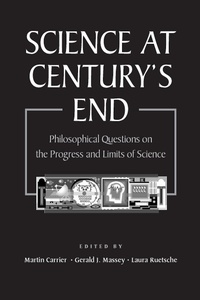
Science At Century's End
Philosophical Questions on the Progress and Limits of Science
Published on 9. August 2014
399 pages
978-0-8229-7244-0 (ISBN)
Description

To most laypersons and scientists, science and progress appear to go hand in hand, yet philosophers and historians of science have long questioned the inevitability of this pairing. As we take leave of a century acclaimed for scientific advances and progress, Science at Century's End, the eighth volume of the Pittsburgh-Konstanz Series in the Philosophy and History of Science, takes the reader to the heart of this important matter. Subtitled Philosophical Questions on the Progress and Limits of Science, this timely volume contains twenty penetrating essays by prominent philosophers and historians who explore and debate the limits of scientific inquiry and their presumed consequences for science in the 21st century.
More details
Other editions
Additional editions
Martin Carrier | Laura Ruetsche | Gerald J. Massey
Science At Century's End
Philosophical Questions on the Progress and Limits of Science
Book
05/2000
University of Pittsburgh Press
€85.66
Article exhausted; check different version
Persons
Martin Carrier is professor of philosophy at Bielefeld University in Germany.
Content
- Intro
- Contents
- Preface
- Introduction: Science at the End of the Century: Prospects and Limits of Science / Martin Carrier, Gerald J. Massey, and Laura Reutsche
- Frontiers of Knowledge
- 1. Extending Ourselves / Paul Humphreys
- 2. The Limits of Generative Atomism: Comment on Paul Humphreys's "Extending Ourselves" / Peter McLaughlin
- 3. The Limits of Natural Science: Rescher's View / Robert Almeder
- 4. Toward the Pale: Cosmological Darwinism and 'The Limits of Science' / Laura Ruetsche
- 5. Nicholas Rescher on the Limits of Science / Jurgen Mittelstrass
- 6. Limits of Science: Replies and Comments / Nicholas Rescher
- 7. How to Pile Up Fundamental Truths Incessantly: On the Prospect of Reconciling Scientific Realism with Unending Progress / Martin Carrier
- 8. Can Computers Overcome Our Limitations? / Nicholas Rescher
- 9. Limits to Self-Observation / Thomas Breuer
- 10. Blinded to History? : Science and the Constancy of Nature / Alfred Nordmann
- 11. On Kinds of Timelessness: Comment on Nordmann / Richard Raatzsch
- 12. Metaphors and Theoretical Terms: Problems in Referring to the Mental / Hans Julius Schneider
- 13. Unity and the Limits of Science / Margaret Morrison
- Prospects for the Special Sciences
- 14. Limits and the Future of Quantum Theory / Gordon N. Fleming
- 15. Limits to Biological Knowledge / Alex Rosenberg
- 16. A Physicist's Comment to Rosenberg / Michael Stoltzner
- 17. The Limits of Experimental Method: Experimenting on an Entangled System: The Case of Biophysics / Giora Hon
- 18. On Some Alleged Differences between Physics and Biology / Andreas Huttemann
- 19. Models of Error and the Limits of Experimental Testing / Deborah G. Mayo
- 20. Inductive Logic and the Growth of Methodological Knowledge: Comment on Mayo / Bernd Buldt
- 21. On Modeling and Simulations as Instruments for the Study of Complex Systems / Manfred Stockler
- Contributors
- Index
