

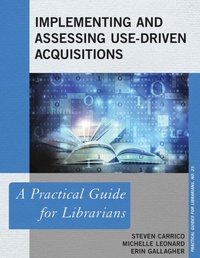
Implementing and Assessing Use-Driven Acquisitions
A Practical Guide for Librarians
1st Edition
Published on 8. March 2016
176 pages
978-1-4422-6277-5 (ISBN)
Description

This enlightening new book in the Practical Guides for Librarians series presents the practicalities of developing, implementing, and evaluating use-driven acquisition (UDA) in academic and special libraries, from the multi-dimensional perspectives of collections, acquisitions, and e-resources. Now that UDA is a proven method of collection management being utilized by an array of libraries around the globe, the need for a straightforward, uncomplicated guidebook is more essential than ever.
This book is both a reference source and a guide for current and future librarians. In addition to chapters highlighting e-book, print, and article-level UDA plans, the book will also include considerations for budgeting, interlibrary loan, consortia UDA, ongoing management and assessment strategies, and stimulating future trends. Of special interest are project management cycles detailing each phase and steps of implementing UDA plans, and relevant case studies involving librarians and vendors who have established UDA plans in libraries of various types and sizes.
This book provides a practical methodology for setting up use-driven acquisitions plans to acquire access to print and e-books for users in academic and special libraries. Every chapter covers important collection development and budgeting objectives of the library, and proposes methods to assess cost and usage of the content received to determine effectiveness and potential modifications to UDA plans.
Practical features that can be used in day-to-day operations include:
. Project management lifecycle with phases and steps for successful implementation
. Sample reports and executive summaries for administrators
. Marketing and branding strategies
. Step-by-step checklists
. Assessment tools and examples
. Multiple case studies of various types of libraries, including budgets and current UDA policies
. Evaluative survey questions
. Interview transcripts
. Glossary of terms and acronym explanations
This book is both a reference source and a guide for current and future librarians. In addition to chapters highlighting e-book, print, and article-level UDA plans, the book will also include considerations for budgeting, interlibrary loan, consortia UDA, ongoing management and assessment strategies, and stimulating future trends. Of special interest are project management cycles detailing each phase and steps of implementing UDA plans, and relevant case studies involving librarians and vendors who have established UDA plans in libraries of various types and sizes.
This book provides a practical methodology for setting up use-driven acquisitions plans to acquire access to print and e-books for users in academic and special libraries. Every chapter covers important collection development and budgeting objectives of the library, and proposes methods to assess cost and usage of the content received to determine effectiveness and potential modifications to UDA plans.
Practical features that can be used in day-to-day operations include:
. Project management lifecycle with phases and steps for successful implementation
. Sample reports and executive summaries for administrators
. Marketing and branding strategies
. Step-by-step checklists
. Assessment tools and examples
. Multiple case studies of various types of libraries, including budgets and current UDA policies
. Evaluative survey questions
. Interview transcripts
. Glossary of terms and acronym explanations
More details
Series
Edition
1. Auflage
Language
English
Place of publication
New York
United States
Publishing group
Bloomsbury Publishing Plc
ISBN-13
978-1-4422-6277-5 (9781442262775)
Copyright in bibliographic data and cover images is held by Nielsen Book Services Limited or by the publishers or by their respective licensors: all rights reserved.
Schweitzer Classification
Other editions
Additional editions
Steven Carrico | Michelle Leonard | Erin Gallagher
Implementing and Assessing Use-Driven Acquisitions
A Practical Guide for Librarians
Book
03/2016
Rowman & Littlefield Publishers
€100.60
Article exhausted; check different version
Steven Carrico | Michelle Leonard | Erin Gallagher
Implementing and Assessing Use-Driven Acquisitions
A Practical Guide for Librarians
Book
03/2016
Rowman & Littlefield Publishers
€96.50
Shipment within 10-20 days
Persons
Steven Carrico is the Chair of the Acquisitions Department, University of Florida Smathers Libraries, with an avid interest in collection development, library budgeting, e-books, and patron-driven acquisitions plans. With multiple publications to his credit on a variety of topics, Steven has presented at the American Library Association, Association of College & Research Libraries, and Charleston library conferences.
Michelle Leonard is a tenured associate university librarian in the Marston Science Library, University of Florida. In 2006, Michelle developed the original UF Libraries Books on Demand project through Interlibrary loan and subsequently course reserves. Since 2009, Michelle has conducted research on collection metrics and presented her research at several national and international conferences.
Erin Gallagher is the E-Resources and Serials Librarian at Rollins College in Winter Park, Florida. Prior to this, Erin spent three and a half years as a Collections Consultant with Ingram Coutts, a leader in academic library services. While with Ingram Coutts, Erin collaborated closely with academic libraries in the United States and Canada to develop and manage their PDA programs, and partnered with the Florida State University System to launch their 11-institution consortium PDA in 2013. Erin has published and presented on PDA projects at conferences such as Charleston and the American Association of Law Libraries Annual.
Michelle Leonard is a tenured associate university librarian in the Marston Science Library, University of Florida. In 2006, Michelle developed the original UF Libraries Books on Demand project through Interlibrary loan and subsequently course reserves. Since 2009, Michelle has conducted research on collection metrics and presented her research at several national and international conferences.
Erin Gallagher is the E-Resources and Serials Librarian at Rollins College in Winter Park, Florida. Prior to this, Erin spent three and a half years as a Collections Consultant with Ingram Coutts, a leader in academic library services. While with Ingram Coutts, Erin collaborated closely with academic libraries in the United States and Canada to develop and manage their PDA programs, and partnered with the Florida State University System to launch their 11-institution consortium PDA in 2013. Erin has published and presented on PDA projects at conferences such as Charleston and the American Association of Law Libraries Annual.
Content
List of Figures
List of Tables
List of Library Case Studies and Vendor Spotlights
Preface
Part I: Developing Use-Driven Acquisition Plans
Chapter 1. Use-Driven Acquisition Project Management
Chapter 2. Collections and Budget Strategies
Chapter 3. Working with Vendors and Content Providers
Part II: E-Book UDA Plans
Chapter 4. Demand-Driven Acquisitions (DDA)
Chapter 5. Evidence-Based Acquisitions (EBA)
Chapter 6. Shared and Consortial Plans
Part III: Targeting Libraries and Collections
Chapter 7. Patron-Driven Acquisition of Print Materials
by Trey Shelton
Chapter 8. Interlibrary Loan - Purchase on Demand (PoD)
Chapter 9. Streaming Video
by Trey Shelton
Chapter 10. PDA in Public and Special Libraries
Part IV: Evaluation and Emerging Strategies
Chapter 11. Assessment of UDA Plans
Chapter 12. Future Directions
Appendix 1. UDA Library Survey
Appendix 2. PDA Public Library Survey
Glossary
Index
About the Authors and Contributor
List of Tables
List of Library Case Studies and Vendor Spotlights
Preface
Part I: Developing Use-Driven Acquisition Plans
Chapter 1. Use-Driven Acquisition Project Management
Chapter 2. Collections and Budget Strategies
Chapter 3. Working with Vendors and Content Providers
Part II: E-Book UDA Plans
Chapter 4. Demand-Driven Acquisitions (DDA)
Chapter 5. Evidence-Based Acquisitions (EBA)
Chapter 6. Shared and Consortial Plans
Part III: Targeting Libraries and Collections
Chapter 7. Patron-Driven Acquisition of Print Materials
by Trey Shelton
Chapter 8. Interlibrary Loan - Purchase on Demand (PoD)
Chapter 9. Streaming Video
by Trey Shelton
Chapter 10. PDA in Public and Special Libraries
Part IV: Evaluation and Emerging Strategies
Chapter 11. Assessment of UDA Plans
Chapter 12. Future Directions
Appendix 1. UDA Library Survey
Appendix 2. PDA Public Library Survey
Glossary
Index
About the Authors and Contributor
